
Brudnicki: Clarke has been "electric" in centre field for Athletics

Toronto Mets and Junior National Team alum Denzel Clarke (Pickering, Ont.) has won MLB’s Electric Play of the Week a record three consecutive weeks for his heroics in centre field for the Athletics. Photo: MLB.com
*This article marks the return of superstar and award-winning scribe Alexis Brudnicki. She wrote countless articles for the Canadian Baseball Network before becoming a rising star in the legal ranks at Brown & James Law Firm in Kansas City, Mo. Welcome back, Alexis! We know it’s only temporary, but we always welcome your articles.*
June 20, 2025
By Alexis Brudnicki
Canadian Baseball Network
KANSAS CITY, Missouri – Denzel Clarke has been in the big leagues for less than a month and he’s already amassed a laundry list of feats that have never been seen or done before.
In his third series, the native of Pickering, Ontario returned to his home country as his A’s faced the Toronto Blue Jays at Rogers Centre. There, not only did he hit the first home run of his major league career, but he also made his first catch that would land the title of MLB’s Electric Play of the Week.
“It was everything I’ve always practiced,” Clarke said. “Getting a good read, getting a good first step, working my way back to the ball, finding where the wall is, and then at the end of the play, that’s where special things happen because you’ve got to go ahead and catch the ball. It was really cool being able to do that at home at Rogers Centre. It was really special for me.”
A week later, Clarke took an incredible route into the wall in Sacramento, this time robbing the Orioles of extra bases, to earn his second spot as the maker of MLB’s Electric Play of the Week.
Yet again, the following week, the 25-year-old made what might be the catch of the season, the century, or of all time, when he lept atop the outfield fence at Angel Stadium and brought a ball back from beyond the wall in a display of athleticism that has been unmatched in recent memory. For that, he became the first player to ever earn MLB’s Electric Play of the Week for three weeks in a row, and he did it in only three weeks in the majors.
“You can see that he’s genuinely enjoying it,” said Adam Stern, a former big league outfielder and outfield coach with the Canadian junior national team. “For the next generation of young ballplayers watching, that’s a big thing. And for young kids watching baseball, Canadian or not Canadian, understanding his story is important too.
“Understanding that he might not have been the best 12- or 13- or 14-year-old. He loved the game, and that was evident. He wanted to work at it, and he was a later developer. That’s special. That can speak to a lot of young players out there. What you see now, you’ve got to know the story prior to really appreciating how far he’s come.”
Clarke’s baseball journey began around 10 years old. He, his mom, and his sister joined their relatives to celebrate a holiday weekend. It was there that he got his first glimpse of the game of baseball, thanks to three cousins who would also one day become big leaguers, Josh, Bo, and Myles Naylor.
“It was Thanksgiving one year and we all just connected,” Clarke said. “We had a sheet of tinfoil, rolled it up into a ball, we got a broomstick, and we were just playing some baseball in the backyard. That was my first time ever trying it, and they really inspired me to give it a shot. It’s definitely a blessing.”
High School
Clarke still didn’t put his full efforts into baseball right away after leaving that backyard. But his athleticism led him and his family to Everest Academy in Vaughan, Ontario, where he first met Chris Begg, a coach and teacher at the school, and a coach with Team Canada.
“I don’t know if I’m impressed or not, to tell you the truth,” Begg said half-jokingly about what Clarke has been doing in the big leagues. “You know he has this in him, this freakish ability. But then I watched that last catch he made, where he rolled over on his back on top of the wall, probably 100 times. Every time, I laugh, thinking you’ve got to be kidding me. I don’t know if I’m shocked, but I will not get tired of it.”
During his time at Everest, Clarke also began playing with the Toronto Mets organization, where his confidence in the game and his abilities grew, and where he earned his first opportunity to play with Team Canada.
“A lot of what he does on the field is instincts and natural talent; I don’t think there are many people in the world that have his athletic ability, let alone baseball players,” Toronto Mets president Ryan McBride said. “Obviously his DNA has Olympic roots [his mother Donna having represented Canada in the 1984 Olympics as a heptathlete] and he’s an incredible athlete who’s turned into an incredible baseball player.”
Team Canada
Those incredible attributes were what stood out to Canadian junior national team head coach Greg Hamilton as he got his first glimpses of the young outfielder.
“Obviously there’s athleticism squared, he’s very projectable, and you get excited about what that can become,” Hamilton said. “The makeup went with the athletic tools, so you knew that the work would be put in and the passion for the game was there. The hitting piece is the most challenging for everyone, and there are exceptions, and he was no exception. But he put in the work. On the defensive side of the game, he had a natural ease to it and good instincts, but he always worked incredibly hard and took great pride in the defensive side. He embraced that side of the game, and a lot of that had to do with the fact that he was an athletic kid who liked being athletic, and it’s fun on the defensive side when you can show that athleticism.”
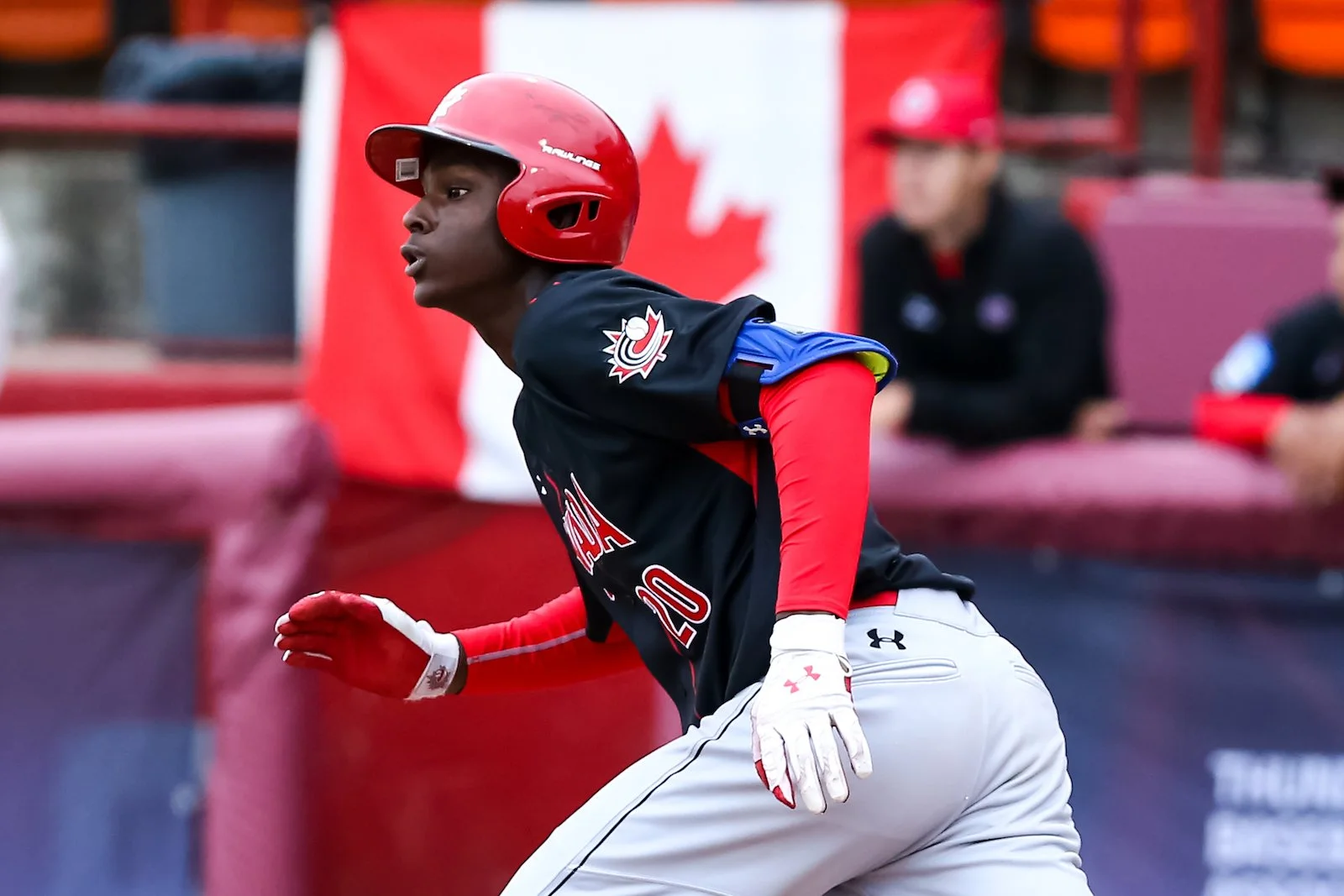
Denzel Clarke’s athleticism stood out when he was honing his skills with the Junior National Team. Photo: Christian J. Stewart, Baseball Canada
With the junior national team, Clarke began to demonstrate a level of consistency in his outfield work that led to success, with that same success leading to continued hard work to reap the same benefits.
“You see him play and the pride that he takes in it, and he’s having fun with it,” Hamilton said. “You can see the smile on his face. He’s a good-natured, fun-loving kid who’s authentic with that smile. He plays on the defensive side of the baseball like many embrace the offensive side. He goes out there with a defensive intent and looks to change the game on the defensive side of the ball as much as if not more than, with the bat.”
Stern has worked with many outfielders during his time coaching with Team Canada, and none have put the puzzle together with the same pieces that the 2017 U18 Baseball World Cup Defensive Player of the Tournament brought to the table.
“I’ve never seen range like that,” Stern said. “You might have seen faster players, but the range is what was incredible, how much ground he can cover. The strides are there. And now when you see him, he’s a physical presence. That’s been the next level for him.”
Added Hamilton: “He was an easy mover, but he put in the work to refine routes and get really good jumps, and he embraced the defensive side of the game. He put in a lot of work, trying to make sure his first step was what it needed to be, getting rep after rep in a serious and focused way. You can be athletic, but if your reads are bad and your angles aren’t good, you can’t outrun the baseball. With Denzel, you never had to tell him to treat the defensive side of the game with seriousness and focus; he just embraced it.”
Beyond the national team, Clarke made distinct choices that led to continued improvements in his development. He had a late start to the competitive side of the game, he was slower to develop than some of his peers, and he needed to find environments that allowed him to grow at a pace he was comfortable with.
“He needed more time and patience and a college coach who believed in him, and coaches who would keep rolling him out there,” Stern said. “It’s a testament to development and players who develop later, like he did. A lot of Canadian kids develop later. The ingredients were always there, and you knew he would be a special player, beyond defense, once he got stronger with the bat. He’s done that and made himself into a major league player, and now we’re seeing the highlight plays. I’ve got to imagine that over a full season, it doesn’t stop.”
College
When Clarke arrived at Cal State Northridge then-assistant coach and now-head coach Eddie Cornejo wasn’t sure what the Matadors had in store for them.
“My first impression was that he wasn’t an actual baseball player and that must have been at school to do something different, because he didn’t walk and talk and act like a baseball player,” Cornejo said. “I thought we had a talented individual with his physical ability, but he was green overall with the game of baseball.”
Clarke’s evolution in college continued through bouts of failure, with cycles of trial and error. The growth that he experienced throughout his time there was evident, and he finished his collegiate career as the 2021 Big West Conference Tri-Defensive Player of the Year.
“He was experiencing, at least when I met him, a tremendous amount of failure,” Cornejo said. “That was pretty normal. He signed with Cal State Northridge because he was told he was going to play. But we, as a coaching staff, made Denzel feel like he was never doing enough. Because he wasn’t, No. 1, but it’s not because we didn’t like him. We love him and he’s a great guy. But he needed things to be broken down and everything needed to be quantifiable. …
“I always tried to put him in a position where he had to challenge himself and learn from himself. I always told him that if he had a chance to play professionally, he’d have to be his own best coach at some point in his career, and I think he was able to learn from that.”
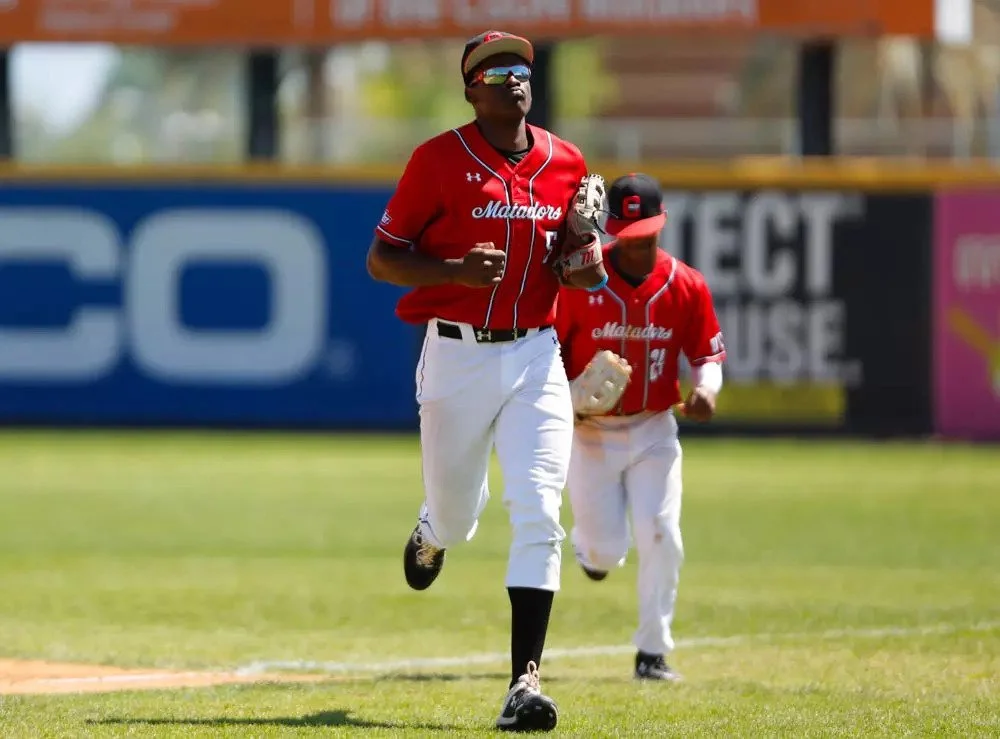
Denzel Clarke (Pickering, Ont.) faced some early struggles at Cal State Northridge but he worked through them and developed into an outstanding big league prospect. Photo: Cal State Athletics
Despite his early struggles, Clarke continued to evolve throughout his time at college, and to embrace every opportunity that he was given.
“He’s a great model for Canadian baseball players,” McBride said. “He chose the right school, going to a mid-major, he chose somewhere where he was going to get an opportunity to play, and he obviously performed. His path is a great model for Canadian baseball players, and it truly is a special story.”
And as the learning continued, so too did the defensive highlights.
“There was a fly ball right behind the shortstop, and for some reason our shortstop was lost,” Cornejo said. “He wasn’t anywhere near the play. But Denzel, from deep centre field, ran all the way to the shortstop position, dove in an awkward fashion with his glove out – it’s the kind of play when you’re diving at an angle and the glove’s on the left hand, so if you’re going to dive really hard you feel like your shoulder might pop out of its socket – and he made the catch sliding onto the dirt of shortstop.
“I’ve never seen anyone cover that much ground and dive at that angle and maintain their shoulder in its place and finish a play like that. That was probably the greatest play I’ve ever seen. Until I saw him make that catch at Angel Stadium.”
Pro Ball
After being selected in the fourth round of the 2021 draft, Clarke hit every level of the minor leagues with the Athletics before making his major league debut this year. Bobby Crosby, the first base coach for the A’s who works with the big club’s outfielders, also had the opportunity to manage Clarke at Double-A Midland two seasons ago, so he had a good idea of what he might come to see on the big league stage.
“Everybody can see the skill set he has and how good an athlete he is,” Crosby said. “I said in my reports that I wrote in Double-A, that he does things on a field that I’ve never seen before, and I played for a decent amount of time before coaching. The stuff you see now and what I saw then, that’s just his ability. …
“There are plays he made [at Double-A] that I had never seen. For him, it’s about confidence and slowing things down, because he’s a high-energy guy. Back then, he would go and shag fly balls, and he does it now here. He knows how many steps he had to the fence. He’s become a smarter, more confident baseball player.”
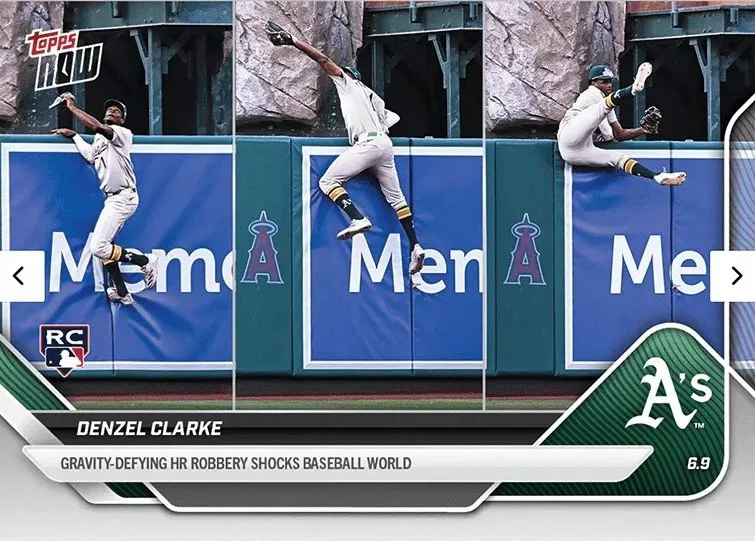
Denzel Clarke’s amazing home run-robbing catch at Angel Stadium was featured on this Topps Now baseball card.
As Clarke has continued to leave a lasting impression on those around him, the major league experience has left an even bigger impact on the young outfielder.
“It’s been a cool experience,” Clarke said. “Getting to play with Baseball Canada, I had the chance to play against professional teams, and then going through the minors, and now being in the big leagues with the players I’ve seen on TV, and playing against them, it’s been really cool. It’s been a really fun experience for me.”
Clarke knows better than anyone that there’s still room for improvement and development, but the more experience he gets, the easier the game will become.
“I can see things going a little bit fast, and that’s with any kid who gets called up,” Crosby said. “But defensively it wasn’t going fast at all. After his first game, he was just [himself]. The numbers, everything we see, they’re really good, but it’s crazy that he has more in him. The more confidence he gets, he’s going to continue.”
For Crosby, the only issue with Clarke’s defense is that there is nothing that other outfielders might be able to learn and take from his game and implement in their own.
“There’s only one,” Crosby said. “Truly. From the time I’ve played, I’ve seen great outfielders. I’ve seen what there is now, and Pete Crow-Armstrong is a great outfielder and he can’t do the stuff Denzel does. Nobody can. You can’t teach someone to scale the wall and be six feet above the fence and catch a ball. The things he does you can’t teach. He’s an incredible athlete doing incredible things.”