
Elliott: Remembering the good doctor, Doc Taylor
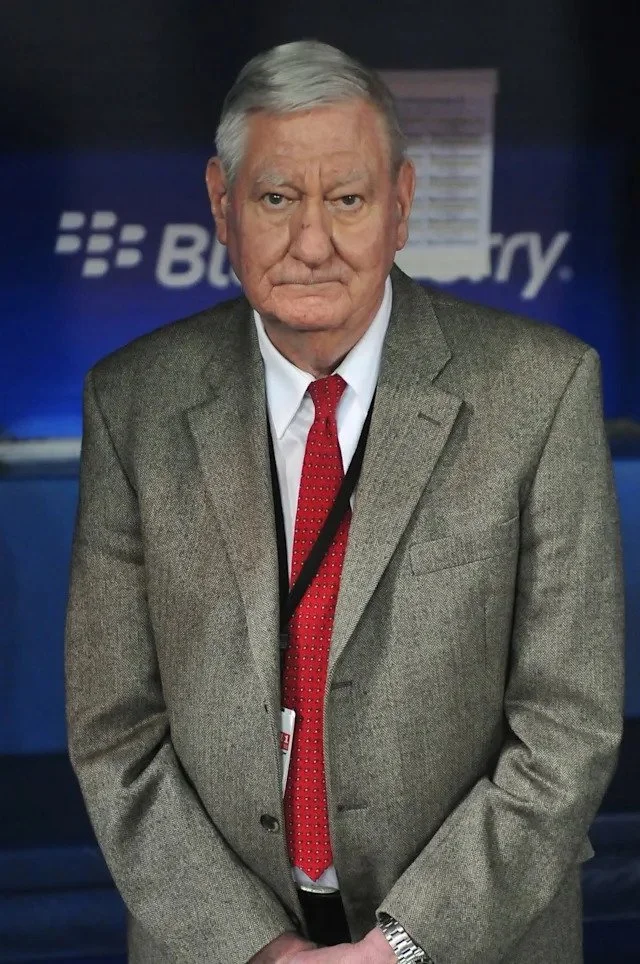
Dr. Ron Taylor passed Monday morning
June 17, 2025
Visitation & funeral info for Ron Taylor: Mount Pleasant Centre, 375 Mount Pleasant Rd, Wed, June 25 2-4 pm & 6-8 pm Funeral Yorkminster Church, 1585 Yonge Street Thur June 26 11 am In lieu of flowers donations to Jays Care or Salvation Army.
By Bob Elliott
Canadian Baseball Network
Tim Crabtree was sitting awaiting treatment in the trainer’s room of the then SkyDome.
The year was 1996.
The night before -- June 26 -- the Toronto Blue Jays reliever had set down the final six Seattle Mariners to ensure a 6-5 win before 30,158. Crabtree set down Dan Wilson, Doug Strange and Darren Bragg in the eighth, then, Rich Amaral, Joey Cora and Alex Rodriguez.
Dr. Ron Taylor, one of the Jays team physicians, approached Crabtree that next night and congratulated him on his first save.
Crabtree, who picked up his first save in the 63rd game of his career, responded by saying “Doc … you have no idea what that feels like.”
Now that statement was a little like Marilyn Monroe returning from Vietnam after performing in front of troops and telling her husband New York Yankee Joe DiMaagio “Joe, you never heard such cheering.”
The Yankee Clipper had heard the cheers.
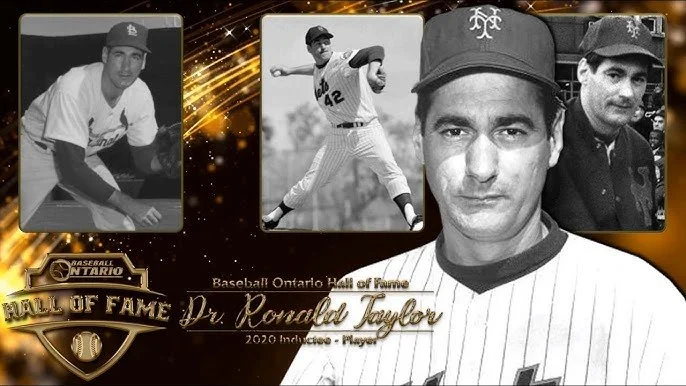
And long before he was a doctor, the Leaside product knew a lot about saves. He had 74 in his 11-year career, including three in the World Series, when he pitched 10 1/3 scoreless for both the St. Louis Cardinals and the New York Mets in post-season play.
Within minutes of Crabtree making his “you’ll never know the feeling” comment a player told me the story. I asked Doc about it. He just shook his head and walked away. A year later, I asked him. Again he shook his head. When Crabtree was dealt to the Texas Rangers I asked again. Same thing.
Doc knew the rules of the trainer’s room. In fact Ronald Wesley Taylor knew a lot: he earned a degree in electrical engineering and a medical degree at the University of Toronto in 1977 and when he left Cleveland Indians camp as a minor leaguer to take classes, he would take ribbing from his teammates, he’d reply, “I’ll be back -- to take one of your spots in the rotation.”
Doc’s career stats in four World Series games (two games with 1964 Cardinals, two with the 1969 Mets): seven innings, 21 batters faced, zero runs, zero hits. He allowed two walks, but one was picked and the other was erased in a double play..
Doc holds the all-time World Series record for innings pitched (seven) and opponents at-bats (19) without allowing a hit.
* * *
He could tell a story: The man always had a sense of humor:
Once he told me about a woman patient who wanted to have plastic surgery on her nose. Doc said it wasn’t needed. The woman insisted. They went back and forth a few times. Finally he said, “OK, I’ll send you to the guy who did mine.”
Doc’s nose never resembled Brad Pitt’s.
Once when the winter meetings were in New Orleans, Doc, his lovely wife Rona and I were on the same flight. We got our bags at the same time and he said, “Let the Blue Jays pay for this one.”
They sat in the back and I jumped in the front.
As we were pulling away, Doc screamed “DRIVER, DRIVER!” The cabbie was probably only going about 10 miles an hour, but he jammed on the brakes as if he was about to cause an eight-car pile up.
“Yes,” the cabbie said turning around to see Doc’s meaty paw on the divider.
“Do you accept cash?” The perplexed cabbie answered, “Why yes we do sir.”
Am not sure whether it was from laughing so hard at Doc’s silly question or the driver jamming on the brakes ... but my cell phone flew onto the floor. I discovered that an hour later inside the hotel. The Doc may have paid for the cab, but it cost me $50 to get my phone back. He had a laugh at that one.
I visited his house one day to interview him for The Northern Game in 2004. His dog, a huge monster came charging down the hall when I knocked at the screen door. From another room I heard Doc yelling, “ATTACK! ATTACK!”
Backing down the steps ... the Doc gave another command and the dog became docile.
He told me one year how he was headed to New York for a reunion of the World champion Mets. I asked how it went a few weeks later.
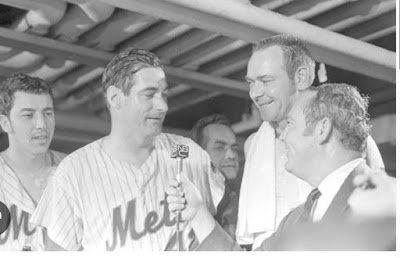
A champagne-soaked Doc being interviewed after the Mets won
“Nothing has changed since 1969 ... the night ended with Jerry Koosman and I telling the same stories … just like in 1969,” said Doc.
At my 50th birthday at the Lone Star anyone who wanted to speak could take a turn. My uncle Ben spoke and maybe the mike was bad or maybe uncle Benny had one too many vinos.
Doc was next and opened with: “Thanks a lot Ben ... it is always a pleasure to follow an animal act.”
* * *
Pals in 1977 and for ever more: About 12 or 13 years ago at the Canadian Baseball Hall of Fame induction ceremonies in St. Marys, I watched from afar as the Doc and Rona emerged from the tent.
The Doc hugged president Paul Beeston and then Pat Gillick, the Cooperstown Hall of Famer.
All three hugged each other in what was truly a beautiful moment. Watching and wondering how many hours these three men, dear friends, had spend together. How many, laughs, tears and stories the three men would have shared.
The laughs would have been led by Beeston, the tears by Gillick and the stories by Doc — the three must have had over the years.
From that snowy opening day to George Bell catching the final out on the last Saturday of the 1985 season to clinch a post-season berth for the first time, the 1987 meltdown in Motown to the back-to-back World Series triumphs in 1992-93.
The three were not work colleagues. They were the dearest of friends. And it showed with the affection they displayed for each other. All three are members of the St. Marys Hall.
* * *
Ground zero trips: Doc phoned me once after he read I had visited ground zero a month after the World Trade Centre bombing. He wanted to know how difficult it was to get behind the police lines.
I explained I knew a New York policeman, who introduced me to his Sargent, who took me to the outer boundary and then he said: “You are on your own.” I explained to the policeman I was a ball writer. “Let me see your BBWAA (Baseball Writers Association of America).” I showed it and in I went.
A couple of months later I asked the Doc if he got in? He explained how there were a “bunch of oldtimers on the line when he got there,” he signed autographs for the Mets fans and in he went.
I had asked if that awful smell was asbestos from the buildings burning? “No, Bobby, it was flesh.” Yuck.
* * *
Memories of Doc: Buck Martinez, Sportsnet: “What a great man. He looked after our players, our families when I came over to Toronto. He made our transition to Toronto seamless. Ron Taylor was a big part or the organization.”
“He had a great impact on the game, for an awfully long time.” _ Greg Hamilton, Junior National Team coach and inductee to St. Marys.
“Ron Taylor was a world-class storyteller and great guy, as you know. Another brick in the wall.” _ Dave Perkins, formerly of the Toronto Star and most recent, Jack Graney winner.
* * *
Doctor, Doctor, Mr. MD: Not once was I ever examined by the Doc, but I used to call his office ... maybe once, or twice or 50 times. Either Anne Bloomfield or Rona would answer.
Anne used to say there was a picture of me hanging on the back of the door, attached to a dart board like the Maple Leafs did with Punch Imlach. I never knew if she was serious.
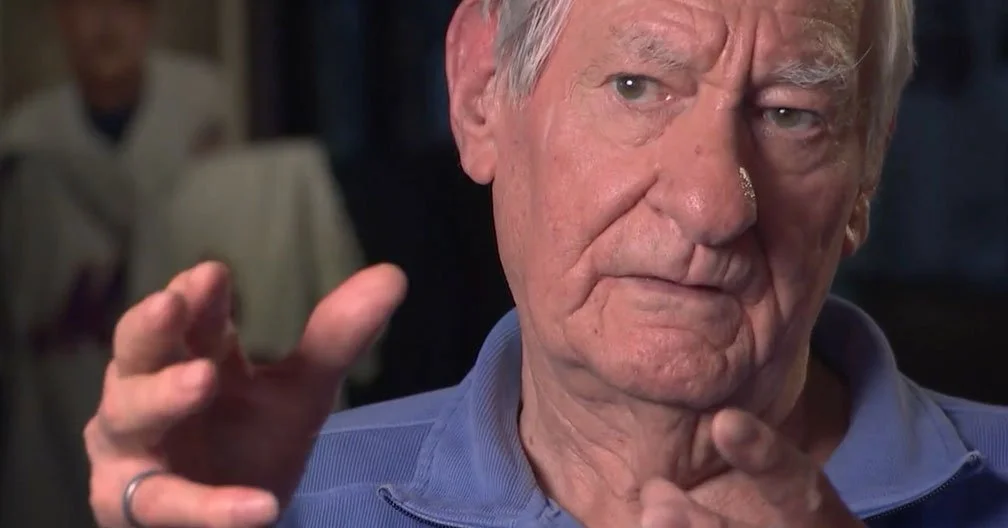
Doc was a great pitcher, a great man and a great humanitarian, running a clinic for sports injuries three times a week at Mt. Sinai. Thanks to a grant from the Syd Cooper Family Foundation, he established the S.C. Cooper Family Sports Medicine Clinic -- besides running his own practice.
When young players were injured rather than seeing a family doctor (who would normally say, “Son, take six weeks off to rest,”) I’d call the Doc’s office to see if he had time to squeeze in one more. Our season is too short to take six weeks off and rest.
Usually Doc would tell a pitcher to not throw for two weeks ... once in a while he’d phone “and tell that kid you sent in last week to do his arm exercises.”
Doc examined the shoulder of former first-round high school position player Scott Thorman, Mike Kusiewicz, who won the South Atlantic League ERA title as an 18-year-old, and his brother Brian (Big Money) Kusiewicz and a bunch of others who went to school south of the border or simply loved playing ball. Draft eligible or a peewee, Doc had time for everyone. Especially those who brought in a bottle of wine or Glenfidditch Scotch whiskey.
I remember one Mississauga Southwest player coming back and saying, “There were hockey players, badminton players and tennis players in the room at Mt. Sinai and he called me to be examined first.”
I said in Doc style, “Well kiddo, it wasn’t because of your good looks … he called you first because you were a ball player. He can relate to ball players.”
Usually, I told them to take a new ball and get it signed. When Field of Dreams came out, a youngster asked me if the Burt Lancaster character was based on Doc Taylor. No, but it could have been.
Now Dr. Jason Smith does an excellent job caring for arm injuries of all ages. Dr. Smith attended Princeton, was drafted by the Calgary Flames, then studied at the University of Calgary and McGill University, before earning a sports fellowship in Birmingham, Alabama at the American Sports Medicine Institute under supervision of Dr. James Andrews, the world-renowned injury specialist, the intricac
* * *
Successful sons: A lot of chuildren of famous athletes have a great sense of entitlement and are seriously lacking when it comes to work ethic.
That was not the case with the Taylor boys Drew Taylor and Matthew Taylor.
Matthew went to Queen’s University in Kingston, graduating with a degree in film studies. He is a co-founder of Film House Inc. Then, he worked at Alliance Atlantis and CanWest in TV programming and market research.
He has worked in theatrical marketing at Maple Pictures, Think Film and Alliance Films, as well as managing theatrical marketing for VVS Films. His feature film The Death of Indie Rock premiered at the Bloor Street Cinema and aired on Super Channel and he was an associate producer on the documentary Our Man in Tehran which went on to air on TMN, Movie Central and HBO Canada.
Drew was a left-handed pitcher as a teenager and there was talk that the Doc would hide on the hill at The Shrine known as Talbot Park or behind the bushes at Connorvale Park in Etobicoke so his son would not be nervous.
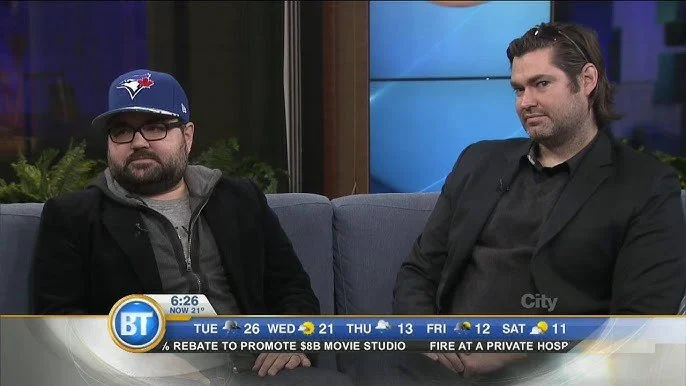
Matthew and Dr. Drew Taylor
There was no need to hide in the bushes after Drew spent his freshman year at Georgia Tech and transferred to Michigan where he went 9-1 in 16 games -- making 14 starts with a 3.97 ERA as he fanned 104 in 95 1/3 innings. He was selected the Wolverines’ top pitcher and earned All-Regional honours. Then, he pitched in 39 games in the Blue Jays’ system.
Drew was inducted into the Ontario Blue Jays Hall of Fame after pitching for coaches Danny Bleiwas and Gary Wilson. He was a member of the 2001 team that won the AABC Regionals and advanced to the Connie Mack World Series in Farmington, New Mexico.
From there he completed an undergraduate degree in Biology at Michigan and a Masters from the same school in Molecular, Cellular, Developmental Biology. He also completed his PhD with the University of Toronto in Biomedical Engineering.
So, now it is Dr. Drew Taylor and he is the co-founder and chief executive officer at Acorn Biolabs charting molecular cell biology.
Fittingly Dr. Drew and Matthew shared the director’s billing on the film about their father: Ron Taylor, Dr. Baseball.
* * *
Cardinal memories: At the 2004 World Series, St. Louis Cardinals right fielder Larry Walker (Maple Ridge, BC) went 4-for-5 with a double, a home run and two RBIs in his first World Series game Saturday. So, before Game 2 we got to thinking about great Canadian World Series performances. We walked by the booth at Fenway and McCarver was filling out his lineup.
We asked him about reliever Ron Taylor who pitched in two games of the 1964 Series as St. Louis beat the Yankees in seven games. Taylor was a fierce competitor. It was never more evident than in Game 4 in 1964. The Yankees led the series 2-1 and scored three times in the first inning.
McCarver always considered Taylor the “unsung hero” of the 1964 Series for his effort in Game 4 with the Yankee leading, two games to one, and ahead 3-0 in the game.
Cards starter Ray Sadecki had faced four hitters and retired one man -- Phil Linz erased when McCarver threw out him attempting to steal third. Roger Craig worked the next 4 2/3 innings, allowing two runs, and when Cardinals third baseman Ken Boyer hit a grand slam off lefty Al Downing in the fifth, manager Johnny Keane gave the ball to Taylor.
“Walking in from the bullpen you see the immense crowd, the auxiliary scoreboard, the TV cameras, and I walked by Boyer at third and he said, ‘Keep the ball down, Ronnie,’” Taylor said.
He did. Pitching to McCarver, Taylor put four zeroes on the board, allowing zero hits and walking one. , after five innings. Ken Boyer hit a grand slam to put Cardinals ahead in the sixth. Doc had a a pitch-around walk to Mantle the day after Mantle hit a walk-off homer facing Barney Schultz.
In front of 66,312 at old, old Yankee Stadium, Taylor made it as easy as pitching at Talbot Park. Except he was facing Elston Howard, Tom Tresh, Joe Pepitone, Clete Boyer, Johnny Blanchard, Linz, Bobby Richardson, Roger Maris and Mickey Mantle, who earned the walk. The 4-3 win evened the series 2-2.
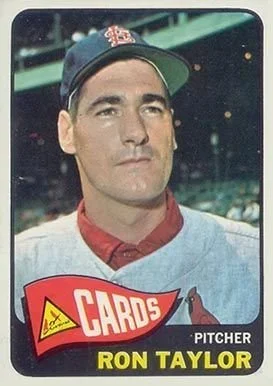
“We had two guys go out who weren’t expected to pitch, go the rest of the game and beat them,” said McCarver. “I mean after all they were the Yankees.”
Before Game 7 at Busch Stadium in St. Louis, the pitchers played a game -- left-handed hitters, captained by Sadecki, vs. the right-handed hitters, captained by Taylor.
“Sadecki’s team complained that we had batted out of order and went to Bob Uecker, our official commissioner for an official ruling,” said Taylor, who erased the evidence. “I ate the lineup. We were a loose bunch before Game 7.”
When the Cardinals clinched the NL that year, it was a giddy time, since the Cards had not been to the Series since 1946.
“So, naturally we all go to Stan Musial’s restaurant to continue the celebration,” McCarver said in the FOX-TV booth. “We look around and someone says, ‘Where’s Ronnie?’ We couldn’t find him anywhere.”
Two clubhouse attendants were dispatched to the Cardinals’ clubhouse.
“Here was this soon-to-be-a-doctor, this brilliant mind, lying in his locker behind the clothes hanging from above, only his feet sticking out,” McCarver said.
Asked whether the story was true, Taylor said: “I was relaxing for Phase II.”
* * *
Farewell, old pal: Dr. Ron Taylor, 87, passed Monday morning at Meighan Manor on Millwood, where he had been receiving “wonderful, excellent care and attention.”
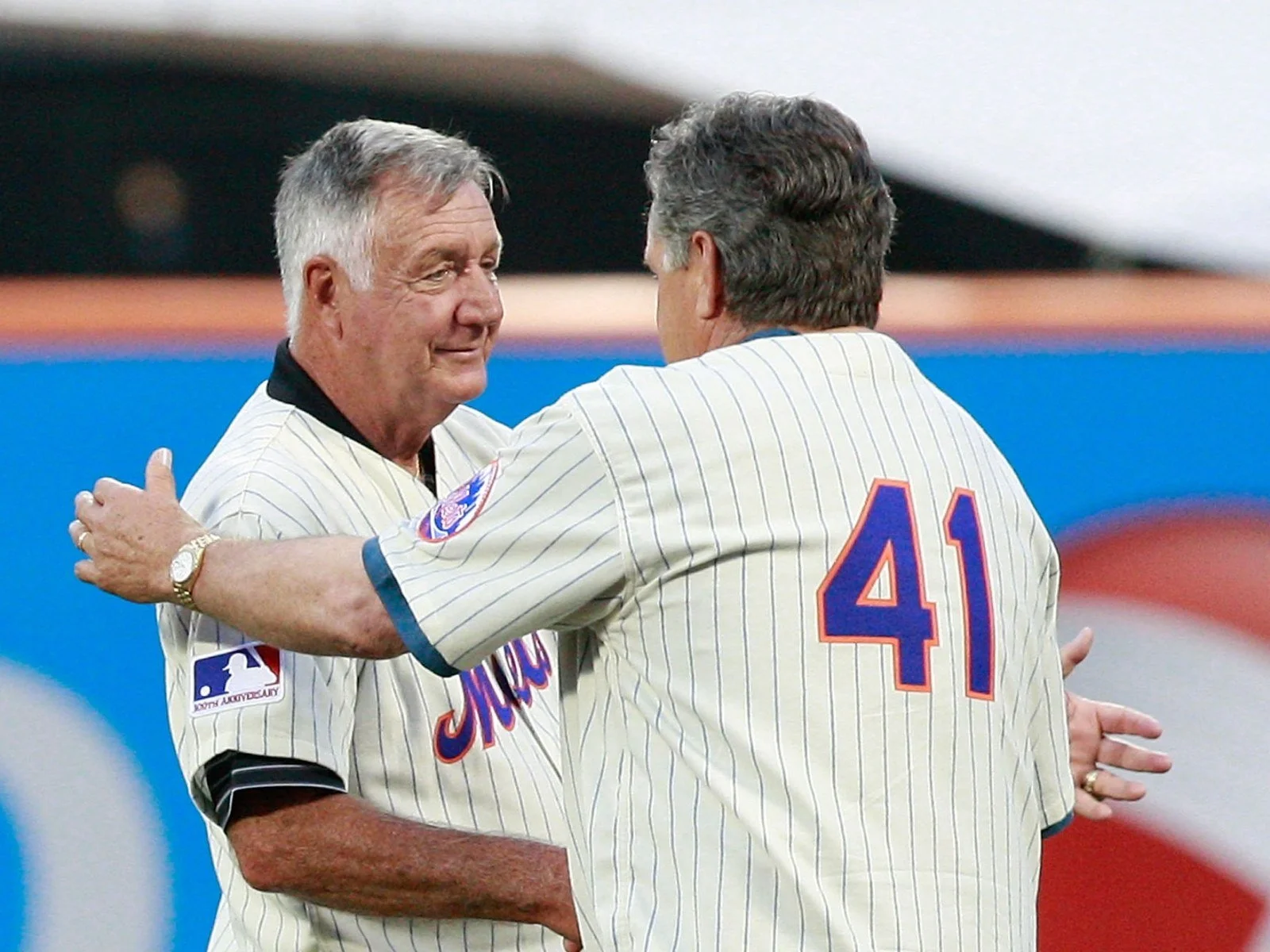
Tom Seaver, right, shakes hands with his friend and teammate Ron Taylor
One spring we were in the coach’s room in Dunedin. A writer asked bullpen coach John Sullivan about “how the Jays will be able to cope without Ernie Whitt?” Sullivan blurted a one-word answer. The writer asked Sullivan the same question — in a different way, as writers tend to do — as Sullivan stood to remove his uniform pants.
“Look the game survived Babe Ruth leaving the Yankees, it will survive Ernie Whitt leaving us,” snarled Sullivan firing his pants into the hamper.
The writer left. No one said a word.
Until Doc smirked and said, “I think you handled that rather well John.”
By now the Doc is upstairs and has probably run into his former Mets teammate Hall of Famer Tom Seaver. And maybe his old pal, former Jays bullpen coach John Sullivan, too.
So upstairs, Doc is talking Sully into squatting to catch “just one more bullpen,” while whispering to Seaver “bounce it.”
Doc Taylor. A good man gone.