
Gallagher: New Netflix documentary examines who “killed” the Expos
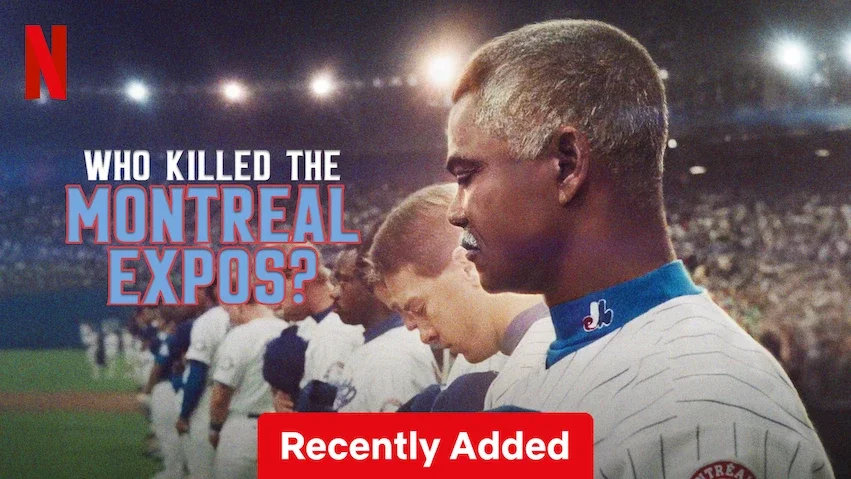
A new Netflix documentary called “Who Killed the Montreal Expos?” was released on Tuesday. Photo: Netflix
October 22, 2025
By Danny Gallagher
Canadian Baseball Network
The release of the Netflix documentary 'Who Killed the Montreal Expos?' on Oct. 21 landed on the doorstep to coincide with the Blue Jays' march to the World Series.
A lot of people in Montreal are putting the blame on certain individuals and circumstances when it comes to the exit of the Expos following the 2004 season and there are a lot of people in Montreal who have no use for Toronto, whether it's the city, the Jays, the Leafs, the Raptors or the Argonauts or the FC United soccer team.
Social media is abound with people complaining about how much they detest the Jays.
In reverse, when have you seen anyone from Toronto criticizing the city of the Montreal, the Canadiens or the Expos when they were in existence?
The Blue Jays were the first team in Canada to win the World Series in 1992 and they followed up by winning again in 1993. The Expos never made it to World Series in 36 seasons of operation.
The documentary omitted one of the many factors in the demise of the Expos. It would have been following the 1984 season when star catcher Gary Carter was traded to the Mets for Hubie Brooks, Floyd Youmans, Mike Fitzgerald and Herm Winningham.
The attendance started falling after the trade. This was after the Expos' quasi-dynasty from 1979-82. Expos attendance was never the same after Carter left. There were pockets of fan passion in 1987 and 1989 and then again from 1992-94 but not that much through the end of the 2004 season.
Expos majority owner Charles Bronfman wanted Carter traded because he didn't want to pay him $2-million per season as part of a long-term contract. Carter was the heart and soul of the Expos for many years and then he was gone.
There's no mention in the documentary about the snafu that erupted when commissioner Bowie Kuhn ruled in the early 1980s that Expos telecasts couldn't be aired by networks in Toronto, Hamilton, Barrie, Peterborough or London, the Blue Jays' coveted territory. This ruling has never been forgotten by Expos fans.
The blame game in the documentary concentrates on the time period 1991-2004 after Bronfman sold the team. Darts were thrown at Claude Brochu and Jeffrey Loria. Thing is, Brochu could not find a single rich owner to take over the team from Bronfman in the midst of a Canadian recession so, he cobbled together a consortium of close to 10 minority shareholders who contributed around $7-million each to the cause. Many were contributing/donating money out of national pride and civic responsibility to save the franchise.
The minority shareholders were upset Brochu had the clout to make decisions on his own, especially when he told GM Kevin Malone not to offer a contract to Larry Walker and ordered him to trade Marquis Grissom, Ken Hill and John Wetteland in the spring of 1995 after the strike was settled.
"We thought they'd trade one or two players but four?'' retired Le Journal de Montreal ace reporter Serge Touchette said, shockingly, in the film.
"I didn't get an offer. I wanted to play for my country,'' Walker said.
It was hard to blame Brochu. He saved the franchise from leaving Montreal. The deal to produce a consortium was a "very complex transaction.''
Touchette said in the documentary something to the effect Brochu owned a Mercedes but had no money to put gas in the car, meaning he was not a rich man when it came to operating a team. He didn't have Bronfman's money.
When there was no money coming in during the off-season of 1994-95, Brochu said the club had very few financial resources. The team was almost bankrupt.
Walker said there would likely still be a team in Montreal if the Expos had been able to finish the 1994 season and make the playoffs.
"We had a monster of a team in 1994,'' manager Felipe Alou said.
Loria and his step-son David Samson were not accepted by the Montreal community in the long run but again, the same minority shareholders under Brochu didn't want to put in any extra money when Loria made cash calls.
Samson said after he and his step-father looked at the financial numbers upon taking over the team and after going through boxes of documents, they discovered the team was millions of dollars in debt.
Famous Expos broadcaster Rodger Brulotte said Loria and Samson "treated us like strangers in our home.'' Samson came across in the film as an arrogant know-it-all.
Alou told of how he was sitting with pitcher Javier Vazquez, who asked him if he knew he had been fired by Loria in June of 2001. That's how shallow Loria was. He leaked the firing to the New York Times before telling Alou. Alou mused he was shocked at all of the TV trucks that showed up at his house after he was fired.
Sportsnet's Jeff Blair called the negativity surrounding the minority shareholders a "shit show.''
Blair still admires Samson because Samson has been a guest on many occasions on the Blair and Barker Show.
What I found compelling was the insightful interview given by former Expos player Orlando Cabrera. He took a jab at the minority shareholders, saying, "They wanted to say, I'm an owner, I'm an owner.' And they'd go to their (suites) boxes. When you're an owner, you have to have heart.''
Great theatre from Cabs, one of the smartest Expos I ever interviewed over the years.
There was nothing really revealing in this documentary. All of the culprits have been mentioned in the past, including former Quebec Premier Lucien Bouchard who ruled he would not support the construction of a new ballpark. Brochu told the film producers Bouchard's decision was "so disappointing.''
The documentary made extensive use of comments from American reporter Tom Verduccci, who has no ties to the Expos. What does he know about the Expos? People like reporters Jeremy Filosa, Alexandre Pratt and Marc Griffin and others put in their two cents worth. Even Youppi was asked for his opinions.
The people at Attraction, the Montreal production house responsible for this terrific film, did things out of the ordinary. Not until the very end of the film did you see any interviewee look straight at the camera. Director Jean-Francois Poisson wanted profile shots from the side of the people being interviewed.
As for the future of baseball in Montreal, Pedro Martinez said, "Montreal is a baseball city.''
"Every time I pitched, there were a lot of people at the stadium. They took me under their arm,'' Dennis Martinez said.
The new Players on Base group in Montreal has been trying to get major or minority investors involved in bringing baseball back to Montreal. So far, there has been no luck. It's similar to the situation in the early 1990s when Brochu had trouble rounding up shareholders.
Danny Gallagher is an Expos historian and a member of the Players on Base group.