
Gerlach makes strong Cooperstown case for Canadian umpire Emslie

Larry Gerlach’s excellent biography of legendary Canadian umpire Bob Emslie (Guelph, Ont.) provides plenty of supporting evidence for Emslie’s induction into the National Baseball Hall of Fame.
July 26, 2025
By Kevin Glew
Cooperstowners in Canada
Baseball historian Larry Gerlach firmly believes that late 19th century and Dead Ball era Canadian umpire Bob Emslie is worthy of a plaque in Cooperstown.
And when Gerlach speaks about major league umpires, we should all stop and listen.
After all, he has written two definitive books on the men in blue*, as well as an award-winning biography about Emslie called “Lion of the League: Bob Emslie and the Evolution of the Baseball Umpire” that was published in 2024.
“Bob Emslie’s life was umpiring . . . And during his lifetime he saw more baseball than any other person in baseball history except Connie Mack,” said Gerlach in a recent phone interview.
In his superb book, Gerlach documents Emslie’s evolution from a 32-game winner with the American Association’s Baltimore Orioles in 1884 into one of the greatest umpires in major league history.
It’s a book Gerlach never intended to write. Until about six years ago, he knew little about Emslie. But in researching a keynote address for the Canadian Baseball History Conference in London, Ont., in 2019, Gerlach was dazzled by Emslie’s long list of accomplishments.
“I was almost immediately taken by how much Emslie was respected, admired and revered by sportswriters and by people in the game during his time,” said Gerlach. “And then I realized the length of time he spent in baseball and that he personified not only the development of the game and the craft of umpiring as we know it, but he also experienced the creation of modern North America as we know it. So I said, ‘This man deserves a biography.’ And I went to work.”
Born in Guelph
Gerlach learned that Emslie, who came from a large family in Guelph, Ont., was obsessed with baseball from a young age. After his family moved to London, Ont., Emslie worked hard to become a standout pitcher.
By 1882, he was one of the most sought-after right-handers in Southwestern Ontario and he landed with the St. Thomas Atlantics who embarked on a barnstorming tour of the Northeastern U.S. that summer. Emslie finished with an 18-8 record on that trip and was so masterful in two match-ups against the Interstate League’s Camden club that he was signed to a pro contract by them.
The then-23-year-old Emslie proceeded to toss a shutout against the American Association’s Baltimore Orioles in his pitching debut with Camden on July 8 and he continued to dominate for Camden that season and for part of the next before the team folded in the summer of 1883. That was when the Orioles, managed by Billy Barnie, signed him.
Employing a devastating curveball, he earned 32 wins – which remains the most by a Canadian in a major league season – with the O’s in 1884. Unfortunately, after that season, he hurt his arm in an exhibition game in New Orleans and he would never fully recover.
Became umpire by chance
After deciding to hang up his playing spikes, he returned to St. Thomas where he became the co-manager of a hotel. But Gerlach shares in his book that on June 30, 1887, Emslie decided to go to Toronto to watch an International Association doubleheader between the Toronto Canucks and Hamilton Hams. When the umpire failed to show, Emslie was summoned from the stands to take his place and performed so well that he was invited to umpire the rest of the International Association season.
Emslie accepted the offer and quickly garnered a reputation as an elite umpire. So much so, that by 1890, he had a choice of what pro league he wanted to umpire in. He opted for the American Association because of his familiarity with the circuit.
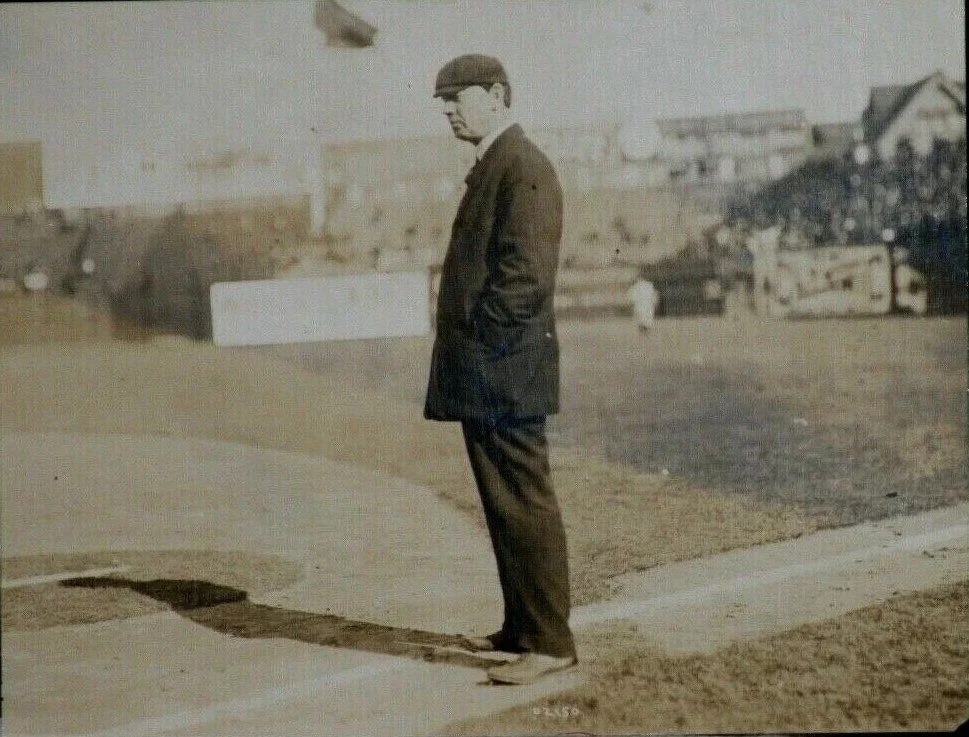
Bob Emslie, where he was most comfortable – umpiring the bases.
His stellar reputation grew from there. Keep in mind that when Emslie started umpiring, he worked games alone. Today, it’s hard to fathom that a single person was asked to call balls and strikes and monitor the baserunners in a professional game.
“That’s what’s extraordinary about him. This man umpired for so long as the only umpire on the field,” said Gerlach. “There was a dedication to the profession that sustained him all those years . . . His dedication, his commitment was just off the charts.”
Emslie moved on to the National League in 1891 and proceeded to umpire in the major leagues for 35 years. That’s a remarkable stretch during a period that Gerlach ranks as the most difficult to be a pro umpire in. On top of the exhaustion of working solo (or later as part of a two-person crew), Emslie and the other umpires were subjected to vicious verbal and physical assaults from players, managers and even fans.
And at the beginning of Emslie’s umpiring career, there was also no standard protective equipment. It’s believed that Emslie pioneered the use of shin guards for home plate umpires.
“Back in the day, there were no substitute umpires like there are now,” explained Gerlach. “There was no vacation time. You worked every day. The grind was just extraordinary . . . Back in the day, Emslie had to arrange his own transportation, book his own hotels. He had to do everything and today, the modern umpire, everything is done for them. So again, the dedication of Emslie was just phenomenal.”
Respected and praised by players
Gerlach also uncovered that Emslie was even-tempered and often used his sense of humor to disarm an argument. He was not quick to eject or fine players or managers and they appreciated this.

Emslie was routinely heralded as the best umpire of his time by players and media members. Pittsburgh Pirates Hall of Fame shortstop Honus Wagner considered Emslie to be the best base umpire he had ever seen. Emslie was also praised by Ty Cobb and Christy Mathewson.
“In my research, I didn’t run into a single ballplayer that didn’t have anything but absolute praise for Bob Emslie,” said Gerlach.
Simply being recognized as the best of an era should be enough to warrant Hall of Fame consideration. But Gerlach offers plenty of further support for Emslie’s Cooperstown case in his book.
He notes that Emslie was considered the authority on the rulebook. Emslie was routinely consulted by the league office and served on the interleague rules committee (National League and American League) for many years.
“Bob Emslie knows more about the baseball rules than all other National League umpires together,” fellow umpire Cy Rigler once declared.
Just how respected was Emslie?
In 1922, he was the first former umpire to be appointed supervisor of National League umpires. He served in that role through 1935.
Stats support Emslie’s Cooperstown case
And Gerlach also supplies a myriad of statistics that support Emslie’s Hall of Fame election. For instance, at the time of Emslie’s retirement from on-the-field duties in 1925, he held major league umpire records for most career games (4,231), most seasons (35) and most games in a season (148 in 1892). He was also the oldest ump to work a game (65 years and eight months).
Emslie still ranks sixth all-time among major league umpires in years of service, tied for 16th in games and fourth in games umpiring home plate (2,356).
Ten umpires have been inducted into the National Baseball Hall of Fame, including four of Emslie’s contemporaries: Bill Klem and Hank O’Day of the National League and Tom Connolly and Billy Evans of the American League. Gerlach says Emslie “achieved more historic firsts than any of them.”
So why with such an impressive resume has Emslie not been discussed as a potential inductee for decades?
Gerlach points out that it has traditionally been difficult for any umpire to be elected, let alone one that worked their last game 100 years ago.
There are also two on-the-field factors that have worked against Emslie. From 1909 to 1925, Emslie almost exclusively umpired the bases.
Secondly, Emslie never umpired in a World Series, an event that didn’t carry nearly as much prestige during his prime umpiring years.
“When the World Series started in 1903, it wasn’t a big deal,” pointed out Gerlach. “One year, Billy Evans was asked to umpire a World Series and he said, ‘Hell no, I’m going home.’”
Gerlach also notes that there are players that have been elected to the National Baseball Hall of Fame – like Fergie Jenkins – who never played in a World Series, so it should not be used against Emslie.
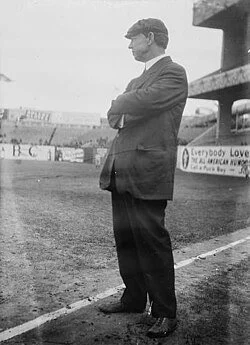
Emslie ranks among the greatest umps of all-time.
Push for Emslie’s induction
Gerlach knows it won’t be easy to get Emslie, a 1986 Canadian Baseball Hall of Fame inductee, elected to the Cooperstown shrine, but that hasn’t stopped him from trying.
The determined baseball historian, who was born in 1941, made a convincing presentation at the Canadian Baseball History Conference in St. Marys, Ont., in November and has also submitted a nomination for Emslie to the National Baseball Hall of Fame’s Classic Baseball Era committee, which will meet next in December 2027.
And Gerlach has been through this process before. He helped convince the Veterans Committee to elect umpire Bill McGowan in 1992.
“Bob Emslie was truly special . . . I hope he gets in and I hope I live long enough to see it,” said Gerlach.
I hope so, too, Larry. You deserve to see it.
*Gerlach wrote “The Men in Blue: Conversations with Umpires” that was published in 1980 and “The SABR Book of Umpires and Umpiring” which was released in 2017.