
Glew: Hawthorn hits home run with new book about Vancouver baseball history
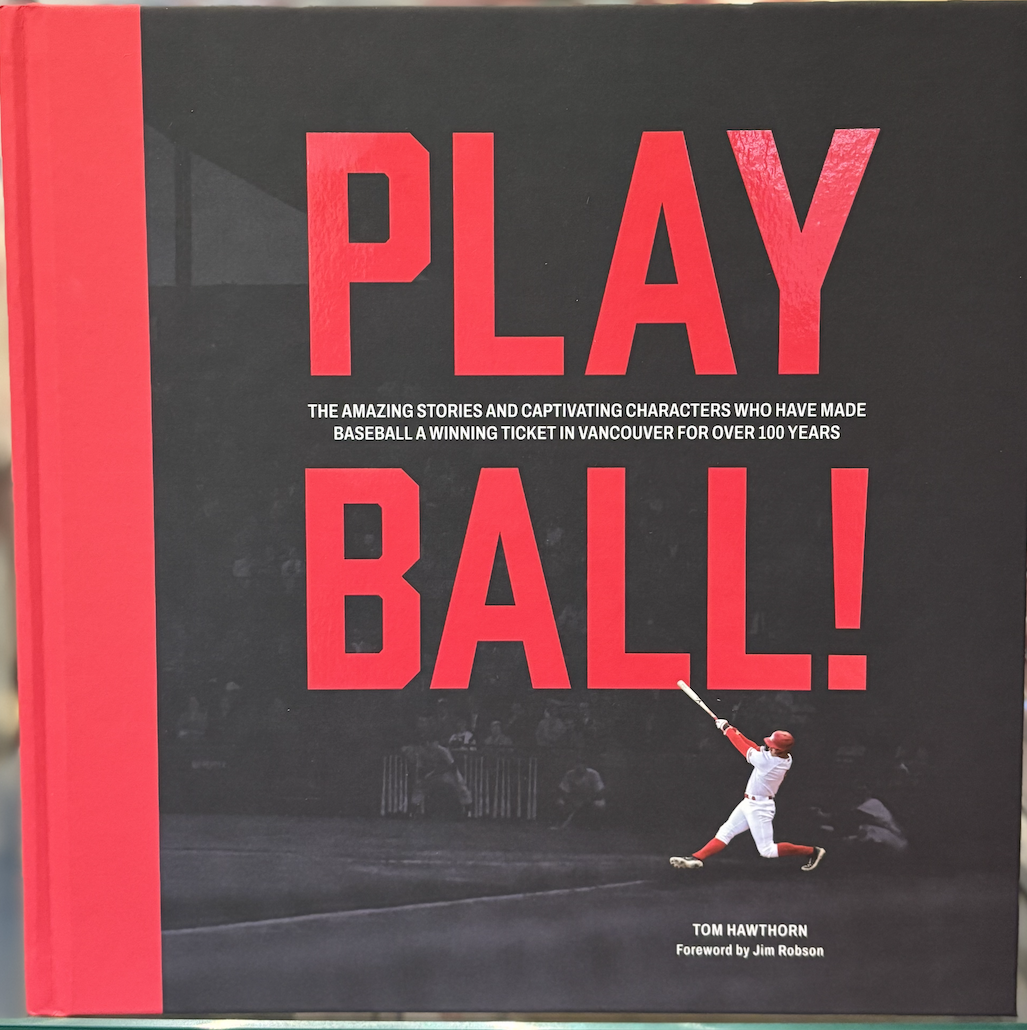
Photo: B.C. Sports Hall of Fame
Book Review: “Play Ball! The Amazing Stories and Captivating Characters Who Have Made Baseball a Winning Ticket in Vancouver for Over 100 Years.” by Tom Hawthorn
August 12, 2025
By Kevin Glew
Canadian Baseball Network
Did you know that the first night baseball game in Canada was played in Vancouver in 1931?
Or that Jackie Robinson was rumoured to be the first manager of the Pacific Coast League’s Vancouver Mounties in 1956?
These are just two of the engrossing and little-told stories shared in an outstanding new book called, “Play Ball! The Amazing Stories and Captivating Characters Who Have Made Baseball a Winning Ticket in Vancouver for Over 100 Years.”
Published as a fundraiser for the B.C. Sports Hall of Fame, the book is written by gifted scribe and passionate baseball historian, Tom Hawthorn, who proves once again that he knows a good story when he comes across one.
This beautifully designed, 274-page coffee table book also offers dozens of rare and captivating photos that highlight Vancouver’s rich baseball history.
With the combination of these photos and Hawthorn’s engaging prose, the book deftly details the story of baseball in Vancouver from its origins to its current Toronto Blue Jays’ High-A affiliate.
With a foreword penned by local broadcasting legend Jim Robson, the book is divided into five chronological chapters, each highlighting the trailblazers, characters, important teams and groundbreaking moments from a specific era.
The first chapter, “The Rush Is On: From Gold Mines to Baseball Diamonds 1856 – 1922” discusses baseball’s roots in the city. While the first documented game in the province was played in Victoria on March 24, 1863, the first team in Vancouver wasn’t formed until 1887.
Hawthorn includes fascinating details about Bob Brown, who was a driving force behind the growth of baseball in the city – so much so that he was eventually nicknamed “Vancouver’s Mr. Baseball.”
Brown purchased the Vancouver Beavers, a Class-B minor league team, in 1910 and spearheaded the construction of Athletic Park, the city’s first major baseball stadium, in 1913.
Brown remains a prominent figure in the book’s second chapter, “The Boom Years: A Golden Age in Sports 1923 to 1955.” In the 1930s, Brown served as president and general manager of the Vancouver Capilanos who captured four Western International League titles.
Brown had lights installed at Athletic Park and the first night game in Canada was played there on July 3, 1931. It predated the first night game in Major League Baseball by nearly four years.
Without Brown’s efforts to grow the sport, Vancouver likely would not have been able to land a Pacific Coast League (PCL) franchise in 1956.
The team, which was moved from Oakland, was called the Vancouver Mounties and their history is detailed in the book’s excellent third chapter, “The Mounties Era: From Nuclear Families to Nuclear Protest 1956 to 1977.”
Before the Mounties’ first season, a rumour circulated that Jackie Robinson would be the team’s first field manager.
“The rumor quickly became a campaign, led unofficially by the board of trade,” writes Hawthorn.
In November 1955, Robinson added fuel to the rumour when he told reporters that he would be eager to come to Vancouver.
But Robinson was never hired and Vancouver baseball fans had to “settle” for former two-time National League batting champion Lefty O’Doul as the team’s first bench boss.
In 1951, Sicks’ Capilano Brewery and the city of Vancouver collaborated on the construction of a new state-of-the-art ballpark (Capilano Stadium) that would eventually serve as the home of the Mounties.
The Mounties were a Baltimore Orioles’ triple-A affiliate when a struggling young third baseman named Brooks Robinson was assigned to them in May 1959. In vivid detail, Hawthorn recounts how the future Hall of Famer’s career also almost ended in Vancouver. While reaching to catch a foul ball in a game on May 17, 1959, Robinson’s forearm was impaled in a metal hook in the dugout railing. Fortunately, Mounties trainer Doc Younker was able to free Robinson and take him to the hospital. After three weeks, Robinson returned to play and eventually ascended into arguably the greatest third baseman in major league history.
The Mounties were a PCL team from 1956 to 1962 and then again from 1965 to 1969. In that final season, they were a triple-A affiliate for the Seattle Pilots and the Montreal Expos. On June 5, the Expos came to play an exhibition game against the Mounties. To that point in the season, Expos outfielder Rusty Staub had not been hitting many home runs. But Hawthorn reveals that it was adjustments Staub made during a batting practice session with manager Gene Mauch in Vancouver that restored his power stroke. Staub went on to club 29 home runs for the Expos that season.
After the Mounties moved to Salt Lake City in 1970, there was no professional baseball in Vancouver until businessman Harry Ornest convinced the PCL to award the city an expansion franchise for the 1978 season. They were to be called the Vancouver Canadians and their logo looked like the label on Molson Canadian beer products.
This interesting era is described in the book’s fourth chapter, “The Original Canadians Era: B.C. Takes the Global Stage 1978 to 1999.”
Ornest actually wanted a big league team for the city. Hawthorn relays that B.C. Place, a domed stadium, was opened in 1983 and the hope was that professional baseball could be played in it.
By that time, the Canadians were a Milwaukee Brewers’ triple-A affiliate. They played a game at BC Place on August 12, 1983 that was part of a larger series of events that included performances by comedian Bob Hope and singer Gloria Loring. An Oldtimers’ game featuring legends like Hank Aaron, Whitey Ford and Bob Feller was also played. The Canadians drew 41,875 fans to the contest, which still represents a PCL record.
The dome, however, proved not to be a good home for baseball and the quest for a big league franchise never gained much traction.
Playing at Nat Bailey Stadium (a renovated Capilano Stadium), the Canadians won PCL championships in 1985 (as a Brewers’ affiliate), 1989 (as a White Sox affiliate) and 1999 (as an A’s affiliate).
The Canadians were rebooted as a Class-A Short-Season Northwest League A’s affiliate in 2000. Seven years later, Vancouver businessmen Jeff Mooney and Jake Kerr purchased the team and were able to switch their affiliation to the Toronto Blue Jays in 2011. This is all documented in the book’s outstanding final chapter, “The Modern Canadians Era: New Horizons for the New Century 2000-2024.”
Many Blue Jays players have since filtered through the Canadians. Current Blue Jays skipper John Schneider managed the Canadians in 2011.
Throughout the book, Hawthorn also skillfully weaves stories of trailblazers with Vancouver links. For example, he writes about Jimmy Claxton, who was born on Vancouver Island, and became the first Black player in organized baseball in the 20th century when he pitched for the Pacific Coast League’s Oakland Oaks on May 28, 1916.
Hawthorn also writes eloquently about the Vancouver Asahi, an inspirational team of Japanese Canadians who competed at the Powell Grounds starting in 1910.
“They were physically smaller than their opponents in the Vancouver senior and industrial leagues, and over time, they developed a style of baseball called brain ball,” writes Hawthorn. “On defence, they relied on savvy pitching and slick fielding. At the plate, they used skill at bunting, speed on the base paths, and nervy risk-taking to scratch out single runs.”
The Asahi were the pride of the Japanese community and they became one of the most popular and successful teams in the city. Sadly, after Japan’s attack on Pearl Harbor on December 7, 1941, all Japanese Canadians were sent to internment camps and many of them lost everything.
“Among the few possessions they were allowed to pack, many of the Asahi players made room for their gloves and shoes,” writes Hawthorn in a poignant passage. “Baseball was played in the camps . . .”
Hawthorn also shares that Babe Ruth visited Vancouver at least twice. The Bambino was there in November 1926 as part of a vaudeville show at the Pantages Theatre. He returned in October 1934 with a team of American League All-Stars who were boarding a ship to play in Japan. Prior to their departure, Ruth and the team competed in an exhibition game in the rain at Athletic Park in Vancouver.
Whether it’s Babe Ruth or Bob Brown, Hawthorn writes about them superbly – with passion and skill – in this excellent book. The stories and photos are fascinating and Hawthorn has succeeded in writing a page-turner that will not only appeal to Vancouver baseball fans, but to baseball fans anywhere.
You can purchase your copy of the book from the B.C. Sports Hall of Fame here.