
Glew: New Canadian Baseball HOFer Stoneman comes “home” for honour
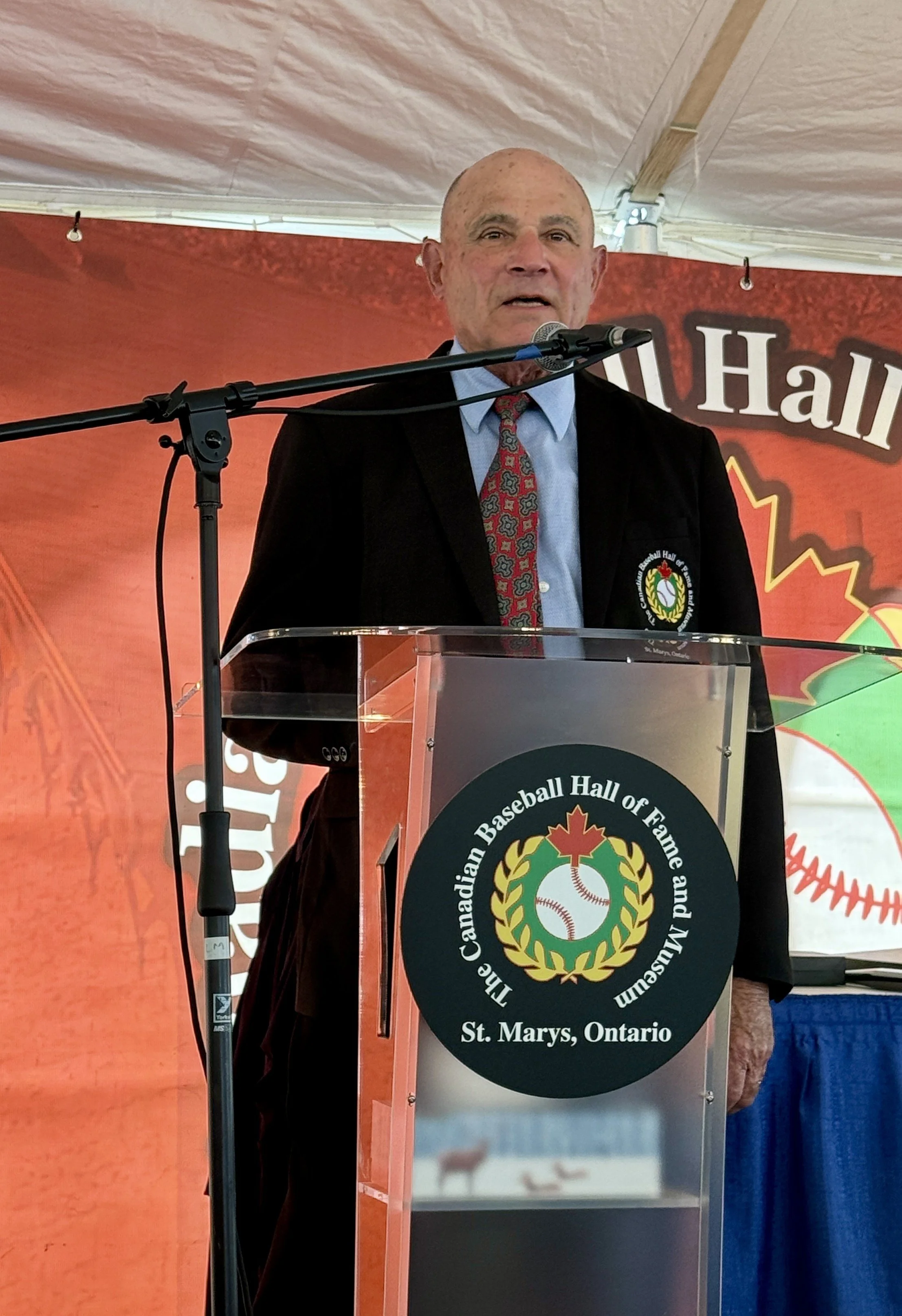
Former Montreal Expos ace and executive Bill Stoneman makes his Canadian Baseball Hall of Fame induction speech on Saturday. Photo: Canadian Baseball Hall of Fame
June 20, 2026
By Kevin Glew
Canadian Baseball Network
Bill Stoneman feels right at home in Canada.
And understandably so, given that the former Montreal Expos ace lived in the country for 30 years.
But his trip to St. Marys, for his induction into the Canadian Baseball Hall of Fame on Saturday, was his first to the quaint Southwestern Ontario town. And after driving around St. Marys on Thursday, Stoneman quickly became an admirer of Stonetown.
“There are a lot of really interesting, older looking houses,” he said at the inductees press conference on Saturday morning.
Later that day, when Stoneman, who now resides in California, looked out from the podium during his induction speech, he saw friends from several walks of life – including many from his time in Canada.
There was former Expos teammate Steve Rogers. Not far from Rogers was Matt Stairs (Fredericton, N.B.), who was signed by the Expos while Stoneman was an executive with the club.
Also present was Bryan Lewis, a longtime National Hockey League referee who was a neighbor of Stoneman’s when the ex-big leaguer was living in Georgetown, Ont., and working as a manager for Royal Trust.
And, of course, there was his daughter, Jill, and her husband, Miguel, who live in Lefaivre, Ont. (near Hawkesbury Ont.).*
And then there were the fans, most of whom remember Stoneman as a workhorse right-hander with the Expos during the club’s earliest years who hurled not one, but two no-hitters.
“Bill was the best pitcher we had on the club,” said Claude Raymond, 89, who was an Expos teammate of Stoneman’s from 1969 to 1971.
Legendary Expos broadcaster Dave Van Horne agrees.
“Bill Stoneman was the guy who led the way in those early years before Steve Rogers came around and wound up establishing himself as a key part of the Expos organization,” he said.
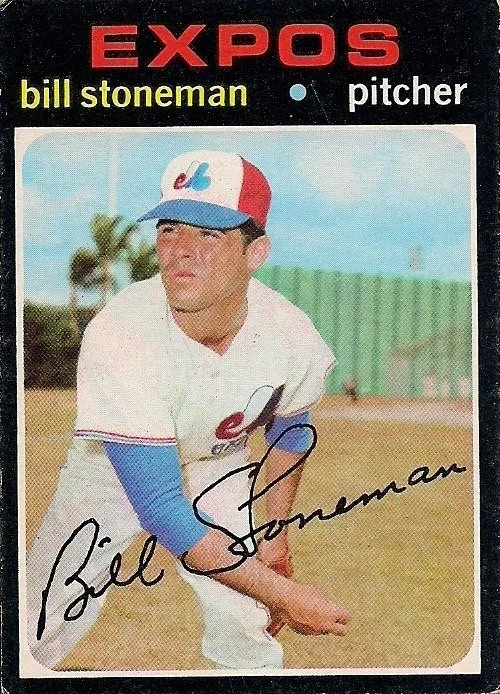
Much of Stoneman’s success could be attributed to his excellent curveball that he had been throwing since he was a 10-year-old in Little League in West Covina, Calif.
“They were telling coaches back then, ‘Don’t have young kids throw curveballs. I happened to throw a curveball in a way that didn’t hurt the elbow .. . . When I got up to the professional leagues and the coaches saw me throwing a curveball, they said, ‘Hey, that’s exactly how you should be throwing a curveball,’” said Stoneman, adding that the key is get your fingers on top of the ball. “The curveball was the easiest pitch for me to throw.”
Stoneman also possessed a good fastball which helped convince the Chicago Cubs to select him in the 31st round of the 1966 MLB draft. In just his second season in the Cubs’ organization, Stoneman was promoted to the big leagues. He’d spend his first two major league campaigns as a reliever with the Cubs before being chosen by the Expos in the 1968 expansion draft.
“When I got the call [from Expos GM Jim Fanning] that I was going to go from the Cubs to the Expos . . . I said, ‘Well, I know Montreal is in Canada. I know Canada is to the north of the United States, but I’m not sure where Montreal is at,’” recalled Stoneman. “So, I pulled out a map and found Montreal.”
And he adapted well to the city.
In 1969, the 5-foot-10 right-hander cracked the Expos’ inaugural Opening Day roster and on April 17th that year, in just the ninth regular season game in Expos’ history, he tossed a no-hitter against the Philadelphia Phillies at Connie Mack Stadium. This made him the first pitcher to throw a no-hitter for a Canadian major league team.
“There were only about four or five thousand people in the stands for that game. They were all Phillies fans obviously, but as we got towards the middle of the game, they recognized, ‘Hey, the Phillies haven’t got a hit yet.’ And they started making some noise and by the seventh inning, they were making a lot of noise. They wanted to see a no-hitter,” remembered Stoneman.
In that first Expos season, Stoneman led the club in wins (11), starts (36), innings pitched (235-2/3), strikeouts (185), complete games (8) and shutouts (five). He also embraced the city and his role as an ambassador for the club.
“The two people that really helped put the Expos on the map with Montrealers and Quebecers and Canadians were Rusty Staub and Bill Stoneman,” said Van Horne. “They were two totally different people, but two that loved being in Montreal and loved representing Montreal out in the public.”
Van Horne recalls that Stoneman even stayed in Montreal following the 1969 season and during that winter Stoneman was part of an Expos charity basketball team that also included John Boccabella, Dan McGinn, Gary Sutherland and Ron Brand.
“They would go out and play high school teachers for a fundraiser or whatever,” recalled Van Horne.
Over the next four seasons, Stoneman was a top-of-the-rotation starter for the Expos. In 1971, he recorded a career-high 17 wins and posted a 3.15 ERA in 39 appearances (38 starts) and established then franchise records in complete games (19), innings pitched (294-2/3) and strikeouts (251).
“Bill wasn’t a big guy,” said Van Horne. “He was about 5-foot-10 and 160 to 170 pounds, but he had a great arm and a great head for baseball.”
During those early years with the Expos, Raymond and Stoneman developed a strong friendship.
“On the road most of the time, we would go eat together and have a beer together,” said Raymond, who can recall attending Stoneman’s wedding in December 1969. “He was a super, super nice guy. He’s always been a nice guy. .. . . He was a class ballplayer and he was always trying to learn something.”
Van Horne also developed a good relationship with Stoneman.
“He was easy to get along with and he was always happy to talk to you after one of his starts,” said Van Horne. “He knew baseball. He came to the Expos a knowledgeable baseball player.”
That knowledge not only helped Stoneman during his standout 1971 season, but it helped him put together another outstanding campaign in 1972 when he registered 12 wins and a career-best 2.98 ERA in 35 starts. He also pitched in two innings in the MLB All-Star Game.
On October 2 of that year, he threw his second no-hitter. This one came at home, at Montreal’s Jarry Park, in a 7-0 victory over the New York Mets. This made him the first pitcher from a Canadian major league team to throw a no-hitter in Canada. It has also made him the only pitcher to throw more than one no-hitter for a Canadian major league team.
“My wife Diane was in the stands with my two youngest brothers during that game. I was the oldest of four kids and all four were boys and my two youngest brothers happened to be out here from California in Montreal staying with us . . . That was neat but I wasn’t thinking about them as I was pitching. You’re just competing and getting hitters out,” recalled Stoneman.
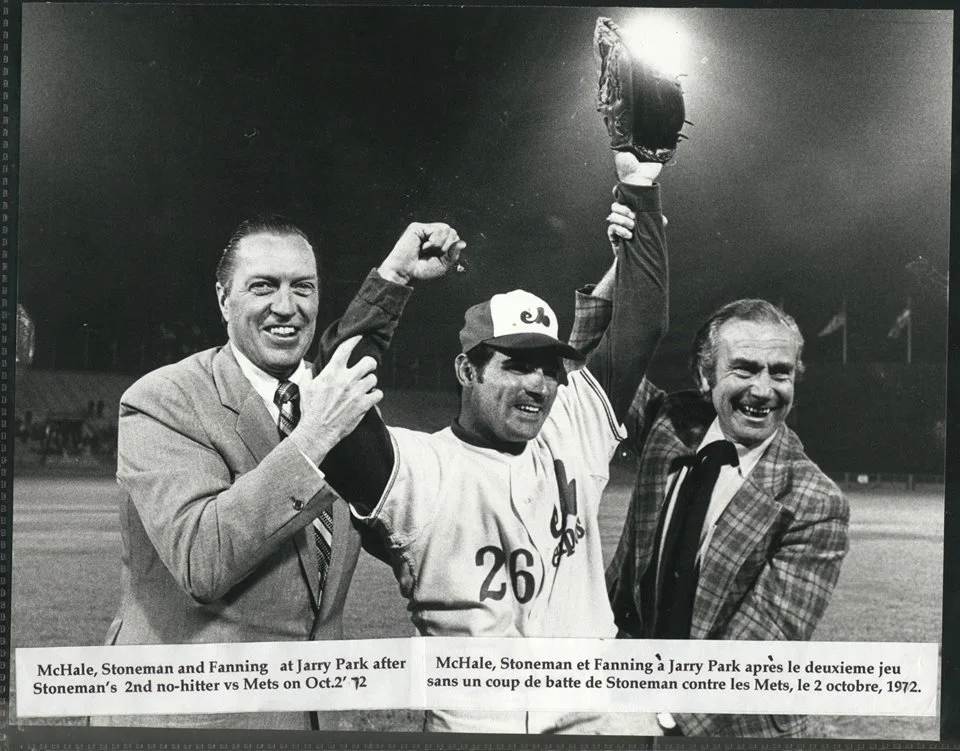
Photo: Canadian Baseball Hall of Fame
After one more season with the Expos, Stoneman completed his playing career with the California Angels in 1974.
Upon his retirement, he came back to Montreal where his wife’s family was and he became a manager at Royal Trust, first in Montreal and later in Toronto.
In 1983, he was on his way home from a family vacation when he decided to drop by Olympic Stadium to visit some friends and former teammates. He bumped into Expos president John McHale who asked him if he’d be interested in a front office position.
Stoneman was and he returned to the Expos as an assistant to the president. In September 1984, he was promoted to the position of vice-president, baseball administration and then later to vice-president, baseball operations. In 1987, he was named the team’s interim general manager and he worked in that capacity until Dave Dombrowski replaced him in July 1988.
Stoneman continued as a prominent Expos executive through the 1999 season when he was hired to be the general manager of the Angels.
In 2002, he assembled the Angels’ only World Series-winning team and continued as Angels GM until 2007. He remains a senior advisor with the club.
Though it’s been more than 50 years since he has played with them, Stoneman has stayed in touch with some of his Expos teammates, including John Boccabella, Steve Renko and Raymond.
“When Vladimir Guerrero got inducted into Cooperstown [in 2018], I sat with Bill for a whole bunch of drinks because we hadn’t seen each other for maybe 10 or 15 years and we talked about everything we could that night,” said Raymond. “And we had so much fun.”
Raymond was also happy that Stoneman would finally be joining him as a Canadian Baseball Hall of Fame inductee.
“I felt great when I heard that he was being inducted and I called him and congratulated him right away,” said Raymond. “He’s a great guy. I think he should’ve been inducted a lot earlier . . . I’ll be there [at Saturday’s ceremony] in thought.”
*Stoneman’s wife, Diane, a Montrealer, was not present on Saturday because she’s still recovering from a broken hip.