
Kennedy: Jenkins’ tenure with Globetrotters included stop in Kingston
May 30, 2026
By Patrick Kennedy
Canadian Baseball Network
In today's baseball world of sky-high salaries and ludicrous nine-digit deals, it's hard to imagine a time when most big-league ballplayers held down off-season jobs.
Often they did so out of financial necessity, supplementing modest baseball salaries with a few months of workaday toil alongside everyday people in everyday jobs.
During the winter, Brooklyn Dodgers star Jackie Robinson worked in an appliance store. Pirates infielder Richie Hebner traded his glove for a shovel and dug graves at his family-owned cemetery, while Yankee catcher Yogi Berra sold hardware for Sears & Roebuck. Flame-throwing pitcher Nolan Ryan installed A/C units. Baltimore Orioles ace Jim Palmer sold suits (in the days before he stripped to his skivvies in underwear ads.)
Chicago Cubs icon Ferguson Jenkins was no different. Soon after the baseball season finished, Jenkins returned to his off-season sideline. It was honest, sweaty work that kept him fit, and like his summer job, it played out before large enthusiastic audiences in vast stadiums, small-town arenas, and in one unique instance on the deck of an aircraft carrier.
Fergie played hoops. And not just with any old basketball team but the world-famous Harlem Globetrotters. He played for parts of three seasons (1967-69), roughly 120 games in total.
“It kept me in shape and the money was very good,” Jenkins points out on his Globetrotter days during a recent telephone interview. “In 1967 my Chicago Cubs salary was $12,000. That winter the Globes paid me $14,000 to play basketball for three months.”
Unlike other big leaguers who suited up with the Globies (Bob Gibson, Lou Brock, even ageless Satchel Paige in a three-piece suit come to mind), Jenkins was more than just a participant in skits and stunts. He played when the basketball tempo changed and the pace quickened. That the Cubs even allowed their linchpin to play basketball – or any sport outside of darts or Tiddlywinks – boggles the mind nowadays, especially considering that in 1969, his final season with the Globies, Jenkins was only halfway through a streak of six straight 20-win seasons during which he averaged a tad more than 300 innings per year. Little wonder why his Cubs manager, baseball lifer Leo Durocher, once called Jenkins “not only the best pitcher today, but one of the best ever.”
Jenkins showcased remarkable consistency, durability and pinpoint control over 19 major league seasons. He posted a career won-loss record of 284-226 (3.34 ERA) and retired in 1983 as the first of only four pitchers with at least 3,000 strikeouts and fewer than 1,000 walks.
In his dazzling 1971 Cy Young Award-winning season (24-13, 2.77 ERA), he fanned 263 batters and issued just 37 walks, six of which were intentional. Fergie and the strike zone enjoyed a long-lasting relationship. That same year he also surrendered a league-high 29 home runs, a hazard for any control pitcher. In the days when pitchers batted, that summer he also belted a half-dozen dingers of his own and added 20 RBIs, What's more, he threw a complete game in 30 of his 39 starts. (By comparison, all major-league pitchers in 2025 managed a cumulative total of just 15 complete games.)
Traded from Chicago following a 14-16 season in 1973, Jenkins rebounded the next season with a 25-12 record for manager Billy Martin's last-place Texas Rangers, finishing runnerup to Jim 'Catfish' Hunter, ace of the World Champion Oakland A's, for Cy Young salutations. Jenkins was elected to the Baseball Hall of Fame in 1991, the first Canadian inductee.
Curiously, it's in Cooperstown on Memorial Day Weekend 2026 where the phone call from Kingston reaches the 83-year-old Chatham native and longtime Texas resident.
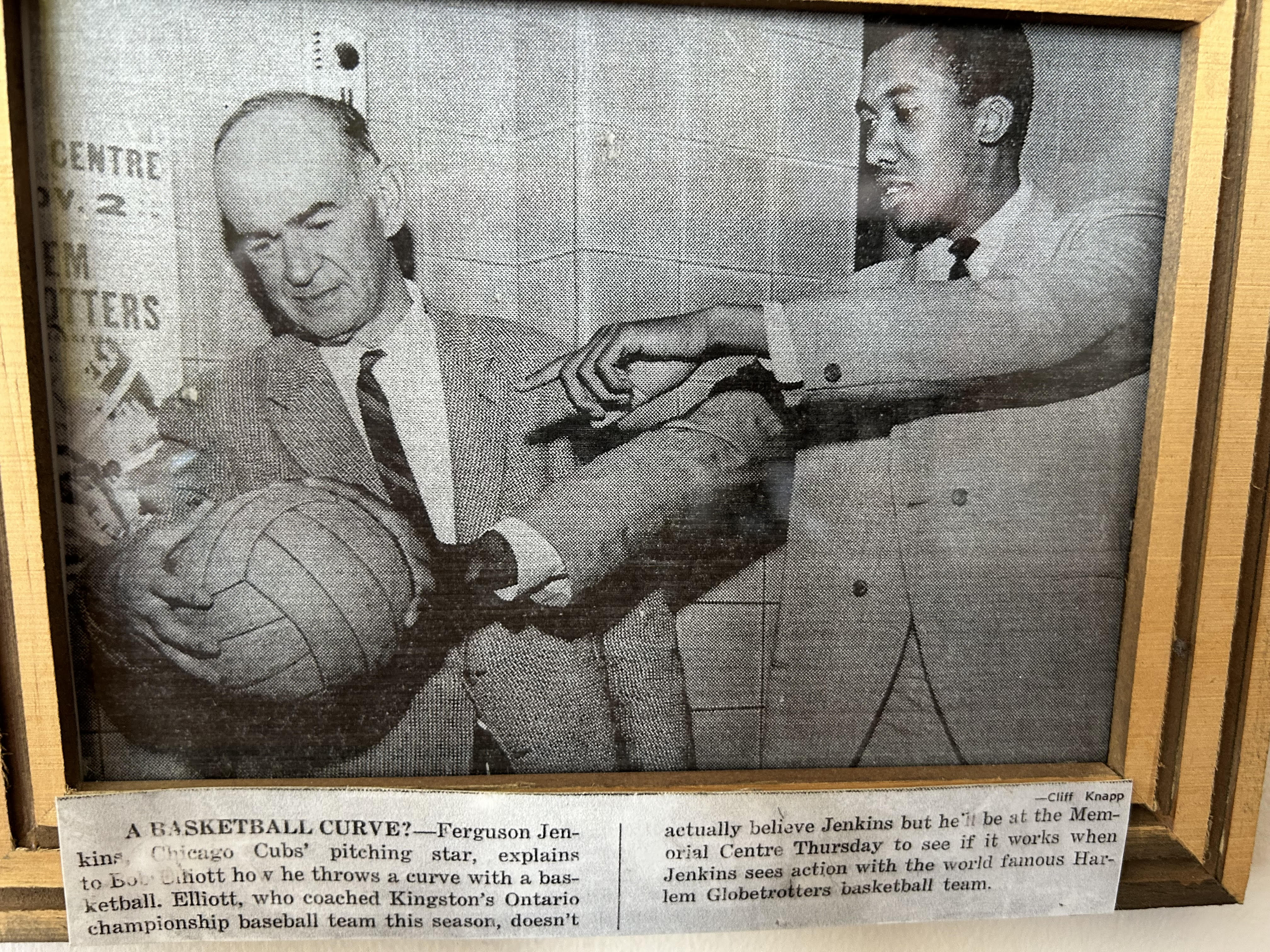
Fergie, fresh off a rain-shortened 14 holes of golf with fellow inductee Rollie Fingers and former Baltimore Orioles outfielder Al Bumbry, is asked about the vintage photograph that appears with this column, a promotional shot by longtime Whig-Standard photographer Cliff Knapp for a 1968 Globetrotters game at the Kingston Memorial Centre. In the photo, the young major leaguer, then 25, palms a basketball and demonstrates to Kingston sportsman Bob Elliott “how to throw a curve,” something Jenkins does during the team's 'pitching skit” that always ends with Globetrotter master showman Meadowlark Lemon clubbing a two-fisted home run.
Fergie doesn't recall the photo or the actual exhibition contest in Kingston, “a long time ago,” he chuckles. “We played a busy schedule, don't forget...so many towns and cities. But I also got to play in places like the (Detroit) Olympia, the (St. Louis) Checkerdome, and of course in Madison Square Garden, which is the Mecca of basketball.”
The mention of his sparkling 'rebound' season in 1974 triggers a story involving the late Billy Martin, who had carved a reputation as a nightclub brawler beginning in the mid-50s and was evidently still padding it.
“We were on NBC Game of the Week one Saturday,” Fergie recalls a time when the Game of the Week was the ONLY nationally televised game of the week. “It's mid-season, we're in last place, and Billy comes into the ballpark late with some woman trailing him. We're all wondering who she is because she's following him everywhere, even into his office.
“It turned out she was a network makeup artist. Apparently Billy had been in a scrap the night before...half an eyebrow gone, bruises on his face, on his neck. That was Billy.”
Jenkins, like Tom Glavine, current Blue Jays infielder Ernie Clement, and a few other major leaguers, played high-level hockey in his teens. He remembers his mother's influence in his decision to ultimately pursue baseball. In particular, he recalls one poignant chat with her one night after the teenager came home from a juvenile all-star hockey game sporting fresh stitches. Delores Ferguson, though visually impaired, spotted a different kind of obstacle ahead in her son's puck-game future. “She said 'Son, this sport isn't for you,' then added: 'Besides, you and the puck are the only black things on the ice.'”
In his 1991 Hall of Fame induction speech, Ferguson thanked his dad, Ferguson Jenkins Sr., a splendid fleet-footed centre fielder with the three-time OBA champion Chatham Coloured All-Stars, and cited his mom's influence on his career.
"My mother knew before I did that the sport of baseball was what I should play," Jenkins said. “Although she was blind, and never saw me play, she always knew this was the game I wanted to do whole-heartedly."
Jenkins maintains a hectic schedule of memorabilia and card shows, golf tournaments, speaking engagements, and public appearances.
“It keeps him going,” notes his wife.
The pitcher who tossed a staggering 264 complete games is still going the distance.
“Gotta keep busy,” says Jenkins. “Like that rolling stone, I'm not gathering any moss.”
Patrick Kennedy is a retired Whig-Standard reporter. He can be reached at pjckennedy35@gmail.com