
Mark Whicker: Realignment would further fuel MLB rivalries
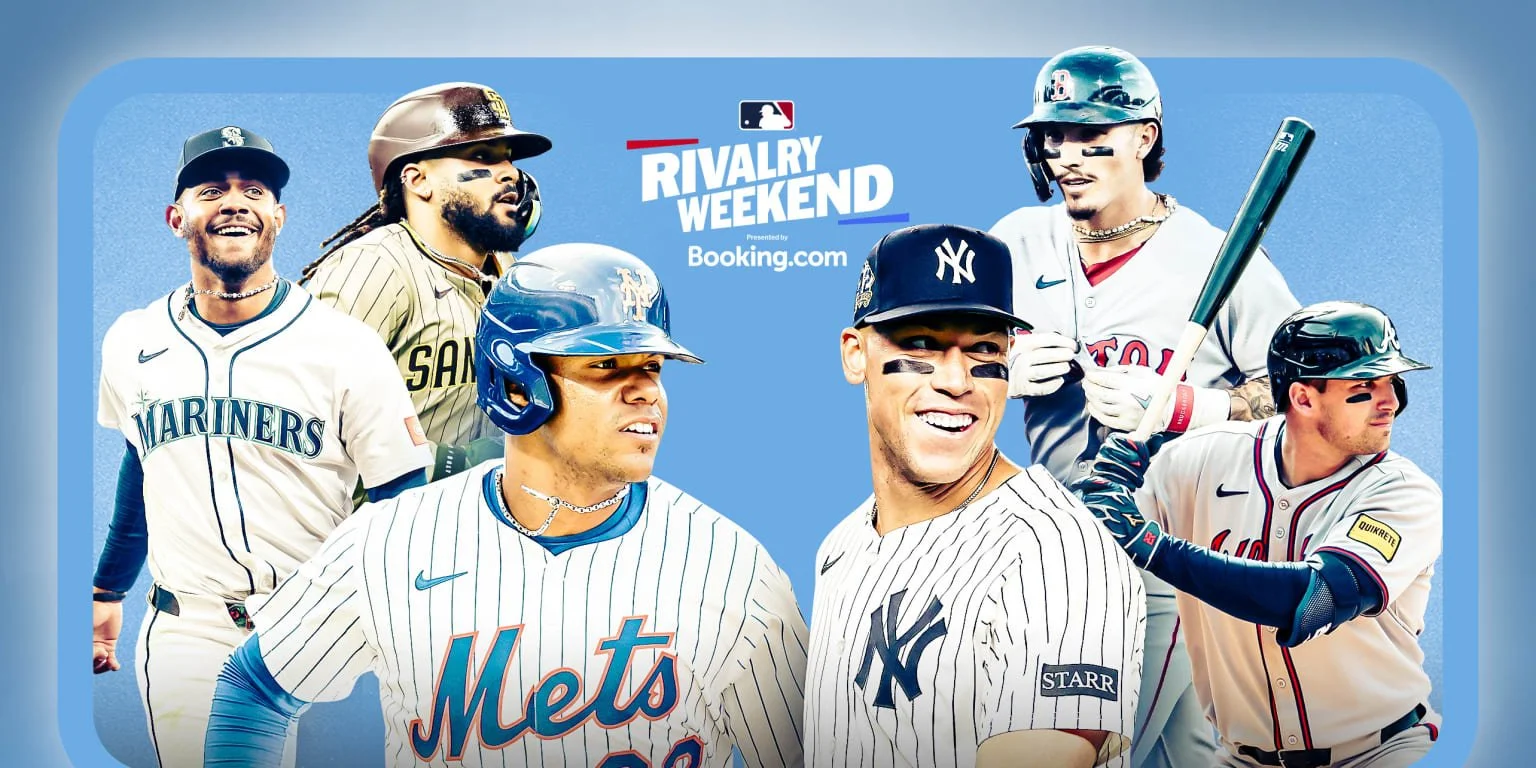
Major League Baseball’s recent Rivalry Weekend was a huge success in the stands and in merchandise sales. Photo: MLB.com
May 27, 2025
By Mark Whicker
Canadian Baseball Network
You could hear the buttons popping on Rob Manfred’s blazer. Major League Baseball had just concluded its “Rivalry Weekend,” and the results were overwhelming.
The average crowd on the weekend of May 16-18 was 35,744, best for any weekend in 10 years. Merchandise sales were up 45 percent from the same weekend in 2024. The Mets-Yankees game was ESPN’s best Sunday Night audience in seven years, although ESPN has generally seemed annoyed that it ever signed an MLB contract in the first place.
There are not enough natural rivalries to stock an entire weekend. Trying to inject animosity into Atlanta-Boston, just because the Braves have played in both cities, is something of a stretch.
San Diego and Seattle tried to spice up their confrontation by giving the weekend winner something called the Vedder Cup, because Eddie Vedder lived in both places, but the Pearl Jam singer is actually a vigorous Cubs fan and has sung “Take Me Out To The Ballgame” at Wrigley Field (then again, who hasn’t?) Nearly every cogent person in San Diego will tell you that the Padres’ only real rival is the Dodgers, but there aren’t enough weekends for the Dodgers to schedule everyone who hates them.
But MLB’s self-congratulation hides an inconvenient truth. If it’s so profitable and sensible for the Dodgers to play the Angels, and for the Cubs to play the White Sox, and for the Yankees to play the Mets, why doesn’t it happen more often? Shouldn’t such rivals be in the same division?
This is the only remnant from the days in which the American and National Leagues operated as independent states within the same protectorate. Each had its own umpiring crews, front office staffs, presidents and rules. Eventually those distinctions were blurred and then disappeared altogether.
That’s why baseball has been aching for a total realignment for years now. Ask the advertisers. Whenever possible, teams should play within their own time zones or, at the very least, one time zone apart. The more 7 p.m. starts, the better.
This would require a huge change in scheduling and it would mean that not all the teams would play each other every year. Sure, it deprives some cities from seeing Shohei Ohtani and Aaron Judge. But not every NFL outpost sees Patrick Mahomes every year, and the league seems to survive.
Granted, it’s a long way from a scratchpad to a stadium, but here’s a shell of what scheduling reality would look like.
First, let’s stick with the six divisions and reshuffle them. The six winners go to the playoffs. There are two (2) wild-cards, which makes for eight teams in the postseason. No more byes. No more best-of-5. Three 7-game series to determine a champion.
Here’s how it shakes out:
SOPRANOS DIVISION: Yankees, Mets, Philadelphia, Boston, Toronto.
KARDASHIAN DIVISION: Dodgers, Angels, San Diego, San Francisco, Seattle.
YELLOWSTONE DIVISION: Arizona, Texas, Houston, Colorado, Las Vegas.
BLUES BROTHERS DIVISION: Cubs, White Sox, St. Louis, Kansas City, Milwaukee.
BARBECUE DIVISION: Atlanta, Tampa Bay, Miami, Baltimore, Washington.
SMOKESTACK DIVISION: Pittsburgh, Cleveland, Cincinnati, Detroit, Minnesota.
In the past, critics of realignment have argued that the powerhouses in the East, particularly the A.L. East, would be disadvantaged by playing each other too often. That isn’t a concern this year, since four teams in the previously impoverished A.L. Central are at .500 or better, and only the Yankees look playoff-worthy in the former confederation of evil empires.
Scheduling is the touchy part of all this, of course. The first adjustment is to forget the sanctity of 162 games. That came along during expansion in the early 60s. Ted Williams and Joe DiMaggio played 154 games each and their numbers have held up.
In this model, teams would play 152 games. The 10 extra dates would be used to either prolong the All-Star break, or to start the season later or finish it earlier, or maybe all three. Doing so would keep the postseason from infringing upon the beginning of the NBA and NHL seasons. (One of my most vivid memories of my previous career was the 2001 World Series, for various reasons, but one of them is Billy Crystal, sitting up against the press box and asking us, every few minutes, how the Knicks were doing against Michael Jordan’s Washington Wizards.)
The new scheduling format goes like this:
Teams will play 18 games apiece within the division. That’s six full three-game series. National League teams did that for years. That makes for 72 games.
The other 80 would be played outside the division, of course. To equalize scheduling, each division would play two other divisions each season, to be rotated as years go on. For instance, the Sopranos might play the Kardashians and Yellowstones in the first year of this plan. That’s eight games apiece against 10 teams, 80 inter-division games in all.
Under this scenario, for instance, the Phillies would play 72 intra-divisonal games, all in the Eastern time zone, and would play 40 road games against other divisions. That’s one four-game series against each team. Let’s say the Phillies are matched up with the Kardashians and the Barbecue. All the Barbecue teams are in the East, too. That means there would be only 40 games, out of 152, in any of the other three time zones. Excellent news for the advertisers, since there would be fewer 10 p.m. EDT starts.
We’ve heard more and more about ballplayer fatigue, brought on by cross-country travel. Granted, these guys aren’t flying Frontier or Spirit. No middle seats and no removal of shoes. It’s almost sinfully luxurious and it should be. These are elite people in their fields of endeavor. But long flights, especially after night games, aren’t conducive to top performance either. Funny, how this has become a bigger issue since amphetamine testing. Anyway, the travel would be condensed and an excuse for bad play would be removed.
All of this is flexible. It also might be easier whenever baseball gets around to adding its 31st and 32nd teams. And, of course, it’s pure fantasy to think that baseball’s owners will accept an actual reduction in postseason teams. But designated hitters and 2 ½-hour ballgames were a fantasy too.
Just file this away for the winter of 2026-27, when MLB will be hashing out a new collective bargaining agreement, a negotiation that promises to be rather chilly. Owners would love to have a salary cap; players vow they won’t accept one. What happens, typically, is that the richest owners can’t find common ground with the merely rich owners, and their disagreements lead to lockouts, which they all blame on the players. During such tense times, any areas of consensus are welcome.
For instance, we can all agree that the Red Sox should never dress like the Ukrainian National team, as they do when the “City Connect” uniforms are mandated. Start there, and then we’ll see if rational realignment will follow.