
McFarland: Expos had Alberta connections
*This article was originally published on Alberta Dugout Stories on Oct. 21, 2025. You can read it here.
October 22, 2025
By Joe McFarland
Alberta Dugout Stories
It’s a question that has sat in the back of the minds of baseball fans for more than 20 years.
Who killed the Montreal Expos?
Different versions of the story have been told over the years, particularly in Quebec, as it never seemed to make sense as to why Canada’s longest-serving Major League Baseball team was just suddenly gone.
In an attempt to get to the bottom of the story, and to maybe provide some context and closure, director Jean-Francois Poisson has put together a new documentary that debuted on Netflix on Tuesday, taking a look back at the decisions and missteps that led the team to relocate to Washington.
As we get ready to pop some popcorn and grab our favourite beverage to hear from the greats like Pedro Martinez, Vladimir Guerrero, Larry Walker and more, we thought now would be a good time to look back at the Expos’ minor league connections to Alberta.
Interestingly, the arrival and departure of affiliated baseball in this province includes the boys in red, white and baby blue.
MAIDEN VOYAGE
One of the first orders of business when the Montreal Expos made their MLB debut in 1969 was to start building out their minor league system.
Right around the same time, the Pioneer League was looking at potential homes for some of its fledgling teams.
The league had struggled to keep organizations afloat, going from seven teams in 1969 down to four in 1972.
When league officials met following the 1974 season, league president Ralph Nelles said the Expos and St. Louis Cardinals were still interested in sponsoring teams out west, with Lethbridge being a leader for the Expos under local baseball builder Reno Lizzi.
“We are very, very proud to be associated with the Montreal Expos,” Lizzi said when the move was announced in November.
“This is a very proud moment for me and an exciting time for baseball in Lethbridge and Southern Alberta.”
It was the province’s first minor league baseball team, with the 1975 Expos going 35-37 on the season under manager Van Kelly and featuring future Hall of Fame outfielder Andre Dawson, as well as Rickey Hill.
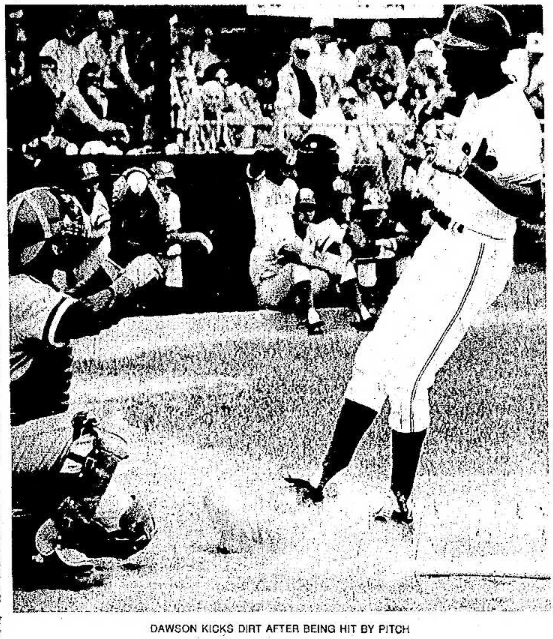
They followed that up with a 30-42 record in 1976.
ALL WASN’T WELL
Simmering under the surface of the first two years being affiliated with the Expos, it appeared some challenges were being felt.
Coming out of the 1976 season, Lizzi had to assure baseball fans that minor league baseball was returning the following summer, despite a dip in attendance.
One of the challenges was a wetter summer, along with big interest in the Summer Olympics.
“Certainly, we had our troubles this season,” he told the Lethbridge Herald on Sept. 4.
“But we had a good many fans tell us they enjoyed a lot of good baseball.”
The rumour mill was swirling about the Expos not wanting to obtain a second two-year affiliation agreement, but Lizzi wasn’t putting much stock in it and refused to call it a “rift.”
“They (Montreal) will assess the year throughout their organization and sometime after the World Series, they will make some announcements,” he said. “Until that time, we are still a development team for the Montreal Expos.”
That time arrived about six weeks later, when it was announced that the Expos were moving on and the Los Angeles Dodgers would make Lethbridge their home for rookie-level pros.
Lizzi later cited several reasons for the Expos’ departure, including lack of communication and a feeling that the parent club “took us for granted.”
The Lethbridge Dodgers made their debut in 1977, along with the new Calgary Cardinals and Medicine Hat Athletics.
A NEW LIFE IN CALGARY
Montreal wasn’t done with the Pioneer League quite yet though.
After serving as the Cardinals’ rookie league affiliate for two seasons, Calgary’s Russ Parker was looking for a new suitor – without warning – at the end of the 1978 season.
Parker had a relationship with Expos’ farm director Jim Fanning for years, and when the opportunity came up, the two got to talking.
However, they weren’t the only team on the hunt.
“We’d be with the (New York) Mets already except that they didn’t move very fast, we didn’t hear from them for more than a week, and the Expos made us an offer,” Parker told the Calgary Herald on Nov. 8.
“The Expos have been aware of the Calgary situation for years, and they’ve been in this league before. They know what’s required to field a competitive ball club here.”
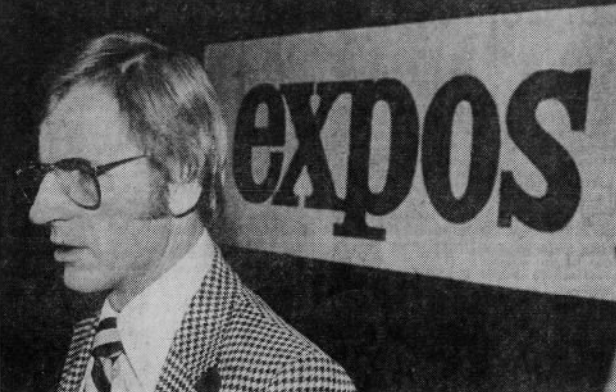
Russ Parker announces the Expos are coming to Calgary. Photo: Calgary Herald
While it was only a one-year player development pact, Parker and the Expos believed a longer-term agreement could be reached shortly.
“There are a lot of benefits to being associated with a Canadian club,” said Parker. “I’m looking forward to a lengthy marriage between us.”
As it turns out, the Expos stuck around until 1984, finishing with the best regular season record in 1981 (46-24) and 1983 (48-28), although they were unable to capture the Pioneer League championship.
The most recognizable player to suit up for the Baby Expos during their days in Calgary was future MLB slugger Andres Galarraga.
ALMOST BACK IN THE ‘BRIDGE
During the 1984 season, Parker’s aspirations for a higher-level of baseball in Calgary became crystal clear.
He made an offer to purchase the Salt Lake Gulls of the triple-A Pacific Coast League, which featured the relatively new Edmonton Trappers.
When the deal was finalized during the summer, the Expos saw the writing on the wall.
“We know we have to move out of here,” Montreal farm director Bob Gebhard told the Calgary Herald on Aug. 22.
“We wish Russ and the Calgary fans the best of luck with triple-A.”
While no decision had been made at that point, Gebhard said he was leaning on taking the league to the Gulf Coast League or the Appalachian League to get them to the East Coast.
He said the travel wasn’t easy on a lot of players looking to make a name for themselves with the organization.
“The road trips are awful,” he continued. “The league has spread out a lot and the schedule is not ideal – it’s a lot of travel and wear and tear on the staff and the players.”
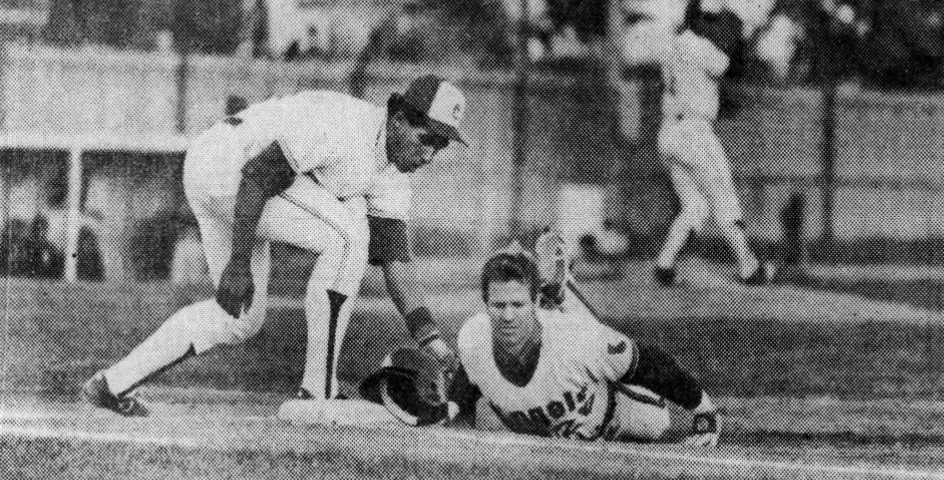
Future MLB slugger Andres Galarraga mans first base for the Calgary Expos. Photo: Calgary Herald
Parker, though, wasn’t willing to give up that easy, as another Alberta community had lost their Pioneer League team in 1983 due to a few issues including a ban on beer sales at Henderson Stadium.
“I’m going down to Lethbridge tomorrow to talk to the city about relocating the franchise there,” said the new Cannons owner. “Since we acquired the triple-A team, Lethbridge has been my first choice. If I can work out a suitable arrangement with the city in terms of a lease, concessions and improvements on the park, then that’s where we’d go.”
To help move the deal along, Parker sold the franchise to Mel Kowalchuk, the general manager of the Trappers, with the hope that they could make Lethbridge happen.
Trying to firm up an MLB affiliation with his new PCL team, Parker was facing the same issue with the Lethbridge squad and needed to focus on one or the other.
“Our situation was that we had no player-development contract for the franchise,” he said on Oct. 23. “I was not willing to operate the franchise as an independent in Lethbridge.”
Kowalchuk went to the MLB winter meetings in Dec. 1984 with the hope of finding a team in need and came up empty-handed.
With the fear of losing more money by operating as an independent in Lethbridge than moving it to the US, Kowalchuk relocated the franchise to Salt Lake City, where the Trappers called home and won four championships as an unaffiliated squad.
TO THE CAPITAL
It would have been impossible to see the free agency facing the Edmonton Trappers following the 2002 season.
They were the last Alberta team standing after the exits of both the Calgary Cannons and Medicine Hat Blue Jays that year.
The Trappers were also fresh off winning the Pacific Coast League championship, their fourth in franchise history, with a strong contingent of future Minnesota Twins, including rising Canadian star Justin Morneau (New Westminster, B.C.).
Less than three days later, the Twins announced they were parting ways with the Alberta capital.
“The Minnesota Twins broke the hearts of Edmonton baseball fans when they agreed to a two-year working agreement with the Rochester Red Wings of the International League,” wrote Norm Cowley on Sept. 18.
He said it was an amicable split, and that assistant general manager Dennis Henke was already in talks with two organizations to become their triple-A affiliate: the Baltimore Orioles and, you guessed it, the Montreal Expos.
The trouble with the Expos was that their future was also up in the air.
“They (the Expos) are owned by the league, and they have some issues, but (this move) shows that they’re dedicated to good, quality, baseball people,” Henke told the Edmonton Journal on Nov. 21, 2002.
AU REVOIR
After a 73-69 record in their first year as the Expos’ top farm team, another bombshell for the “City of Champions.”
It was announced that the Round Rock Express, owned by Hall of Fame pitcher Nolan Ryan and his family, were buying the Trappers and moving them to Texas for the 2005 season.
“Although we are sorry to part ways with the first-class operation in Edmonton, the PCL gains outstanding leadership and a very positive and successful atmosphere in Round Rock,” league president Branch Rickey said in a news release.
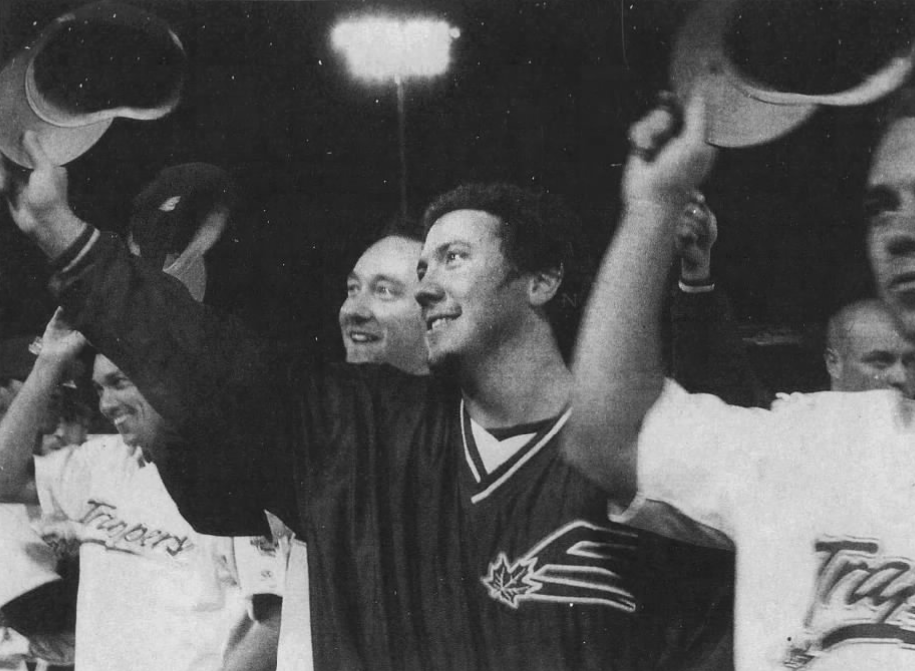
Edmonton Trappers players tip to their caps to their fans at their final home game in 2004. Photo: Edmonton Journal
“There are also significant advantages to bringing in an Austin-area franchise which is much more geographically central to the league than is Edmonton.”
Rickey said Edmonton had been a model franchise since joining the PCL in 1981, but it wasn’t feasible to continue with the struggling Canadian dollar and rising costs.
The Trappers finished the 2004 season with a 69-74 record, missing the playoffs despite having a strong pitching staff, many of whom making their way to MLB in the years to come.
Just not to Montreal, as they were also packing their bags for Washington, D.C., to become the Nationals, ending a run of 35 years as Canada’s longest-serving MLB team.
How that came to be is about to be exposed in the new documentary, which we look forward to watching in the days ahead.