
Montreal baseball group responds to Netflix doc about the Expos
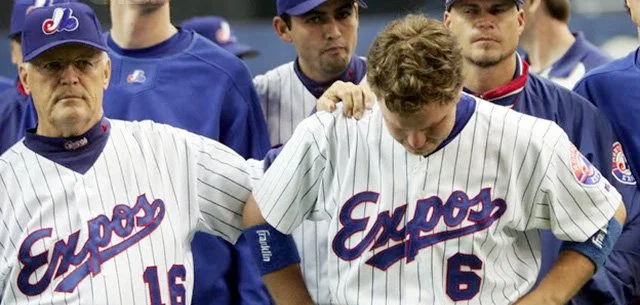
The Montreal Expos played their final game at Olympic Stadium on September 29, 2004.
October 22, 2025
Players on the Bases Working Group News Release
For nearly a year, the “Players on the Bases Working Group”, composed of business leaders and baseball enthusiasts, has been analyzing the requirements and winning conditions for bringing Major League Baseball back to Quebec.
The release of Jean-François Poisson’s film, Who Killed the Montréal Expos, which we had its world premiere at the Montreal New Cinema Festival, offered a unique opportunity to discuss the film’s content with several contributors before and after the screening, gaining a clear understanding of the challenges of hosting major league baseball in Montreal.
As co-founders of the working group, and as clearly shown in Poisson’s film, we remain convinced that Montreal is a major league baseball city, with a 120-year tradition of pro ball, long before the Expos, and continuing today through the phenomenal success of minor and amateur leagues across Quebec. The film, brilliantly directed, highlights the complexity of such a project, as well as the lessons to guide any group wishing to revive this great adventure.
The film clearly shows that, at the time, the corporate investor group – the famous “Québec Inc.” – lacked the interest and willingness to take the necessary risks to advance the team. To succeed this time, a future community-based ownership group must share a long-term vision and give club management real autonomy, capable of building a winning organization both on the field and in terms of long-term investment value growth.
A pro sports team in one of North America’s four major leagues today represents one of the most stable and profitable investments, highly sought after by investors today: over the last 15 years, the average big-league franchise value has grown by more than 480%. At the film premiere, a former Expos investor present shared with us that he had highlighted this point to his partners at the time, yet none had recognized what Forbes was already announcing in 2000 – the beginning of the most significant value growth in the history of Major League Baseball and professional sports in general.
Quebec politicians and media must also recognize that the sporting passion of Quebecers is not limited to hockey. Baseball has its place in Montreal. As elsewhere in North America, investing in modern sports infrastructure does not detract from other collective and social priorities; on the contrary, it creates economic spinoffs, new tax revenues, and stronger social cohesion, particularly through the integration of newcomers into North American values and the community. Professional sports create a strong and positive sense of belonging for society.
The Expos and the Nordiques suffered from a lack of stable political support and clear municipal and provincial engagement. A future project must secure solid partnerships from the outset with the City of Montreal, the Government of Quebec, and Ottawa. Political leaders must understand that sports are not a luxury or only for millionaires: they are a vector of unity and collective pride. The debate should not be limited to player salaries but focus on what sports contribute to society – in taxes, employment, cultural vitality, and social cohesion in an increasingly divided world.
The film also reminds us that the Expos were an exceptional talent and legend factory. From Gary Carter to Vladimir Guerrero, from Felipe Alou to Alex Anthopoulos – today one of MLB’s most respected executives, who began as the Expos’ mailroom clerk – Montreal has produced great players and leaders. The Expos were repeatedly recognized as one of North America’s top organizations (Baseball America):
-#1 farm club in 1973
-Top 5 farm clubs in 1987
-Best organization in 1994
-Best organization again in 2002
With the right people and resources, it is entirely possible to rebuild a competitive organization quickly, without a $200 million-plus payroll. Many baseball insiders have already expressed interest in collaborating if Montreal returns to MLB, as all those the working group has met with love the city, including top-level baseball professionals with tremendous credibility.
We must also stop underestimating ourselves. Quebec is neither too small nor too poor to host a major league baseball team. Montreal ranks 16th in North American TV markets, 14th in metropolitan population, and 22nd in GDP among MLB markets. The film shows that MLB never wanted to lose Montreal, but faced local investors and government disinterest, failing to recognize the impact of losing a sports team. According to Forbes, the Expos and Nordiques would be worth $3.8 billion USD in 2025, compared to their combined sale price of $1G5 million USD. The NHL will ask more than $1.2 billion for an expansion team, and MLB is expected to ask approximately $2.2 billion in 2028. Recent MLB club sales have been around $1.7–1.8 billion USD, and the NBA’s Boston Celtics sold for $6 billion USD without even owning their arena. The upcoming MLB salary cap will further increase team valuations, as in the other four major leagues, including the NBA. Montreal must join the adventure before this next franchise value explosion, like 2000.
Contrary to popular belief, a team also generates U.S. revenues through central revenue-sharing system, which includes 48% of local revenues, as well as from national TV contracts. A Canadian team would therefore receive both Canadian and U.S. revenues, while paying salaries in U.S. dollars, generating substantial tax revenues for Quebec and Canada. We estimate that more than $3 billion in tax revenues over 20 years could have been produced from an initial $200 million CAD investment in 2000 for a modern downtown Montreal baseball stadium – a source of pride for the city and a marquee destination across North America during the baseball season. We estimate all teams receive over $200 million USD per year from central MLB revenues and the 48% local revenue-sharing system.
A modern club must rely on multiple revenue streams: local and digital media rights, sponsorships, premium ticketing, merchandise, and special events. Local broadcasters must also recognize the importance of sports in retaining audiences. Baseball is content for the future, not the past: it nurtures culture, pride, and language, drives subscriptions, and provides family-friendly entertainment every night at a reasonable price compared with NHL, NBA, or NFL games. Local sports networks and online content providers must give space to sports other than hockey to survive and retain audiences year-round. Netflix, Apple TV, and Amazon are not retreating from Canada, and all are watching professional sports closely.
The “Players on the Bases” Working Group applauds the film and the work of Jean-François Poisson and his team, but above all, it forces the question: now, what do we do?
Do we remain in nostalgia and sadness, or do we rebuild a team led by local leaders and investors, passionate about baseball and determined to give back to society?
The Working Group will continue discussions with stakeholders to prepare the ground for the next MLB expansion, expected around 2027–2028, a rare opportunity not to be missed. But this work cannot be done alone. Quebecers must make it clear to Montreal’s next elected officials that baseball is part of the city’s DNA. Turning baseball fields into dog parks or poetic spaces will not move young or old social media addicts in 2025, nor those struggling with mental health issues related to increased cannabis or antidepressant use.
Imagine a magical place in Montreal, a team built on speed and baseball fundamentals, integrating a local talent academy, sports and event technologies proudly made in Quebec by experts recognized worldwide. It would be a must-visit summer destination, showing all of North America that Quebecers can build more than a team – a complete baseball ecosystem, playing and loving baseball – in French and English, here in Montreal – while promoting Major League Baseball across the global Francophone markets including the EU and Africa, projected to exceed 500 million people by 2030.
Congratulations to the director on this exceptional film. We remain fully available to support the next Movie: Montreal’s return to Major League Baseball, and the story of how two baseball enthusiasts from Montréal are challenging the status quo to bring Montreal back to the major leagues.