
R.I.P. Dave Parker
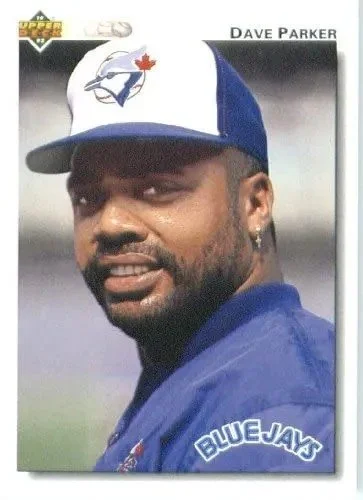
Dave Parker played his final 13 MLB games with the Toronto Blue Jays.
June 28, 2025
By Kevin Glew
Canadian Baseball Network
Longtime big league slugger Dave Parker has died at the age of 74, less than one month before he was to be inducted into the National Baseball Hall of Fame in Cooperstown.
The Pittsburgh Pirates, the team Parker starred with from 1973 to 1983, reported his passing on Saturday afternoon. No cause of death was given but Parker had been battling Parkinson's disease for more than a decade.
"We are heartbroken to learn of the passing of Hall of Famer Dave Parker," said the Pirates in a statement. "A legendary Pirate, Parker spent 11 years in a Pirates uniform, winning 2 batting titles, an MVP award and a World Series Championship in 1979. The Cobra was part of the inaugural Pirates Hall of Fame class in 2022, and will be enshrined in the National Baseball Hall of Fame in Cooperstown next month."
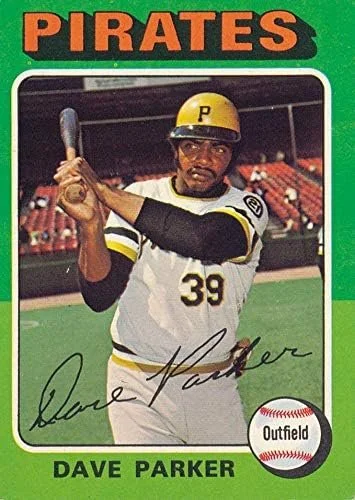
While with the Pirates, Parker was an intimidating 6-foot-5, 230-pound, five-tool right fielder, with a larger-than-life personality. From 1975 to 1979, he was one of the best players in the majors. During that stretch, Parker won two batting titles (1977, 1978), the 1978 National League MVP Award, three Gold Gloves and a World Series ring with the “We Are Family” Pirates in 1979.
Parker also topped the NL in slugging percentage twice (1975, 1978) and registered 20 stolen bases in 1978 and 1979. Defensively, he recorded 26 outfield assists in 1977 – that’s the highest single-season total for an outfielder in the last 60 years.
Parker also enjoyed successful tenures with the Cincinnati Reds, Oakland A’s, Milwaukee Brewers and California Angels before spending his final 13 big league games as a designated hitter for the Toronto Blue Jays in 1991.
After many years of waiting, he was elected to the National Baseball Hall of Fame by the Classic Baseball Era Committee in December. Parker was elected along with former slugger Dick Allen, who died in 2020.
Multi-sport star in high school
Parker was originally selected by the Pirates in the 14th round of the 1970 MLB draft as a catcher out of Courter Tech High School in Cincinnati. Given his size, it’s not surprising that Parker’s best sport in high school was football and he was a heavily recruited running back until he sustained a serious knee injury in his senior season. That injury also cost him his senior baseball season and hurt his draft status.
The Pirates were fortunate that Parker fell to the 14th round and after he joined their organization they converted him into an outfielder. Following parts of four seasons in the minors, he made his MLB debut on July 12, 1973, but it wasn’t until 1975 that he enjoyed his breakout campaign.
As noted earlier, Parker was at his best from 1975 to 1979 and in January 1979, he was rewarded with a five-year contract that made him the highest paid player in baseball. Unfortunately, after that deal was completed, his relationship with Pirates fans soured. His production tailed off in the early 1980s, but his career was rejuvenated when he signed with his hometown Reds prior to the 1984 season.
He set career-highs in home runs (34) and RBIs (125) with the Reds in 1985 and finished second in National League MVP voting. Off the field, however, he was forced to testify in a federal court case against a man charged with selling cocaine to major leaguers. In exchange for immunity, Parker admitted using the drug steadily form 1979 to 1982.
These off-field distractions, however, did little to stop Parker on the field and he added another 31 home runs and 116 RBIs in 1986. He spent one more season in Cincinnati before he was dealt to the A’s on December 8, 1987.
Joins A’s
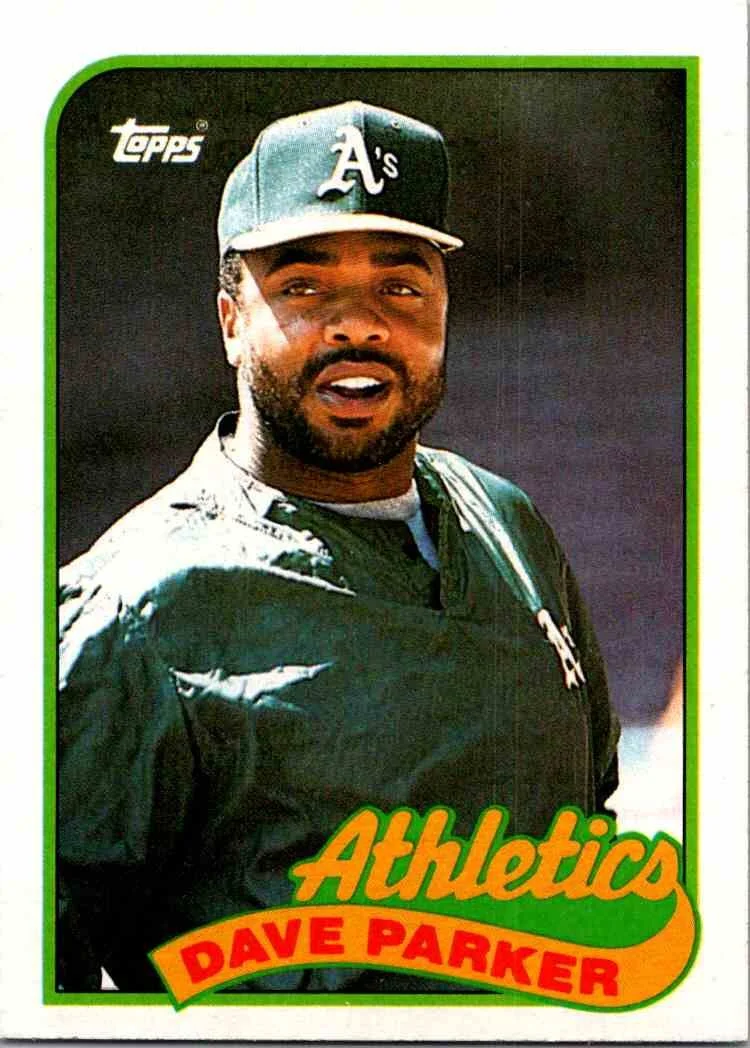
In Oakland, he became the DH in a lineup that also featured Mark McGwire and Jose Canseco and he earned his second World Series ring in 1989. En route to that triumphant Fall Classic, the A’s defeated the Blue Jays in the American League Championship Series and Parker clubbed two home runs. His slow home run trot irked Blue Jays third baseman Kelly Gruber who told the media that Parker was showboating.
“Who’s Kelly Gruber to tell me how I’m going to trot?” responded Parker. “I’ve got kids his age. You know how long I’ve been using that trot? My whole career. Is there some kind of school of baseball etiquette or is Kelly Gruber starting one?”
Signs with Brewers
Following the World Series, Parker became a free agent and landed with the Brewers and was named the American League’s top DH in 1990. The next spring he was dealt to the Angels, but he batted just .232 with 11 home runs in 119 games before being released on September 7.
Lands with Blue Jays
In 1991, the Blue Jays had employed a trio of DHs – Rance Mulliniks, Mookie Wilson and Pat Tabler – and sat atop the American League East standings, with the Boston Red Sox and Detroit Tigers battling for second.
Initially after Parker was released, Blue Jays GM Pat Gillick said the club was not interested in the veteran slugger. A week later, he changed his mind.
“We decided: ‘Why not?'” Gillick told reporters. “He’s intimidating, and with him sitting on the bench, the manager on the other side may change his pitching strategy.”
The club had picked up Parker after September 1, so he would not be eligible for post-season play.
“He’ll add something in terms of leadership and, hopefully, bring some offence in here, too,” said Gene Tenace, who was serving as the Blue Jays’ manager while Cito Gaston was recovering from a back injury.
Parker had already started his winter workout routine when he got the call from the Blue Jays. He was looking forward to coming to Toronto and he told reporters he had no imminent plans to retire.
“My goal is to play two more years and hopefully get 3,000 hits, ” said Parker, who had exactly 2,700 hits when he arrived with the Blue Jays.
As for his war of words with Gruber, Parker had spoken with the Blue Jays third baseman at the 1990 All-Star Game in Chicago.
“Those things were said in the heat of the battle and that’s not something people hold a grudge about,” said Parker.
Parker reported to the Blue Jays on September 15 for the final game of a series against the A’s at SkyDome. When he emerged from the Blue Jays’ dugout to pinch hit for shortstop Eddie Zosky in the seventh inning, the fans gave him a standing ovation. And they rose to their feet again when he singled up the middle off A’s right-hander Mike Moore to score Derek Bell. Parker’s single narrowed the Blue Jays’ deficit in the game to 5-4, but they eventually lost 10-5.
“Walking to the plate and getting that ovation made it a lot easier to take that first at bat,” Parker told reporters after the game. “I thought I was going to get the call in September. I got my unconditional release from the Angels last week and I was ready to shut up shop for the year. I was even thinking about some hedges I was going to cut. But after getting an opportunity to come to a first-place club, you don’t sneeze at that.”
DHing for Blue Jays
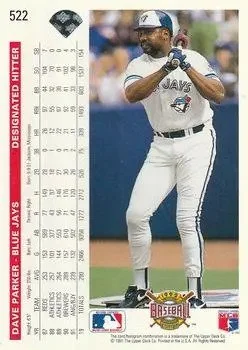
Parker became the Blue Jays’ primary DH for the rest of the season. He’d make his first start and go 2-for-5 against the Seattle Mariners at the Kingdome on September 16. It was his first of three, multi-hit games with the Blue Jays.
On September 23, Parker pinch-hit for Tabler in the fifth inning and proceeded to go 2-for-3 to help the Blue Jays climb back from 7-0 first-inning deficit. He doubled in the seventh and should’ve had another two-base hit in the ninth, but he was called out on a close play at second base. The replay revealed that Parker was safe.
“He blew the call,” Parker said of umpire Jim Evans’ effort on the play after the Blue Jays’ 10-9 loss. “I was on the corner of the bag and he didn’t even tag me the first time. It’s an important time of the year and I hate to see that happen, but you can’t take out the human element.”
Even with the loss, the Blue Jays maintained a 1 1/2 game lead over the Red Sox in the division.
Four days later, Parker had his best game as a Blue Jay, going 2-for-2 with two doubles and a walk in the Blue Jays’ 7-2 win over the Minnesota Twins at SkyDome. The win lowered the Blue Jays’ magic number to clinch the division to six.
During the stretch run, Craig Daniels, of the National Post, wrote about the leadership and wisdom that Parker, who had played on five post-season teams, was bringing to the Blue Jays’ clubhouse. The article ran on October 1 when the Blue Jays were on the cusp of clinching the AL East.
“At this point it’s like, I’m a tiger in the jungle,” Parker told Daniels about the Blue Jays being so close to clinching the division title. “I’ve stalked this prey all this time. I get close – and I know I’ve got to close in from all sides – and then the kill is there. This is when the killer’s instincts come forward.”
Parker said Blue Jays players should embrace the pressure and pounce on the opportunity they have to advance to the post-season.
“I think as far as controlling emotions go, you should make it happen now,” said Parker. “Hey – feel it. Because you’ve got to work hard to get it. You’ve worked hard for the kill.”
That “kill” would come on October 2.
Parker started at DH and went 1-for-2, with a double, as the Blue Jays rallied for a 6-5 come-from-behind, walk-off win over the Angels at SkyDome, to clinch the division title.
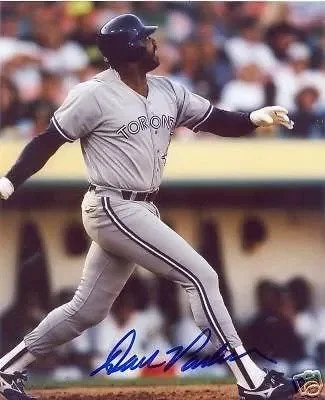
In all, in 13 games for the Blue Jays, the veteran slugger went 12-for-36, good for a .333 batting average.
But with Parker ineligible for the post-season, the Blue Jays employed Rance Mulliniks as their primary DH in the American League Championship Series. They lost to the eventual World Series champion Twins in five games.
End of playing career
For Parker, those 13 games with the Blue Jays would be the last of the 2,466 he played in the big leagues. In 19 major league seasons, Parker collected 2,712 hits – including 339 home runs – and finished with a .290 batting average.
But despite his strong resume – which also boasts seven All-Star selections, an MVP Award, three Gold Gloves and two World Series rings – he failed to garner more than 24.5 per cent support from baseball writers in any of the 15 years he was on the Hall of Fame ballot.
In 2013, Parker revealed that he had been diagnosed with Parkinson’s disease and he and his wife, Kellye, have set up the Dave Parker 39 Foundation to help raise money to help find a cure.
After being a finalist on multiple Veterans Committee ballots and falling short in the past, Parker finally received his call to the Hall of Fame on December 8.
“I’m looking forward to being there,” Parker told the MLB Network on that same day. “I’ve been holding this speech in for 15 years.”
Unfortunately, it was not to be.
The Hall of Fame issued a statement on Saturday after Parker’s passing.
“We join the baseball family in remembering Dave Parker. His legacy will be one of courage and leadership, matched only by his outstanding accomplishments on the field,” said Jane Forbes Clark, chairman of the National Baseball Hall of Fame and Museum. “His election to the Hall of Fame in December brought great joy to him, his family and all the fans who marveled at his remarkable abilities. We will honor his incredible life and career at next month’s induction ceremony in Cooperstown, where his legacy will be remembered forever.”
Parker is survived by his wife, Kellye, and six children.