
Whicker: Beltran elected to Hall of Fame but difficult to separate him from Bonds
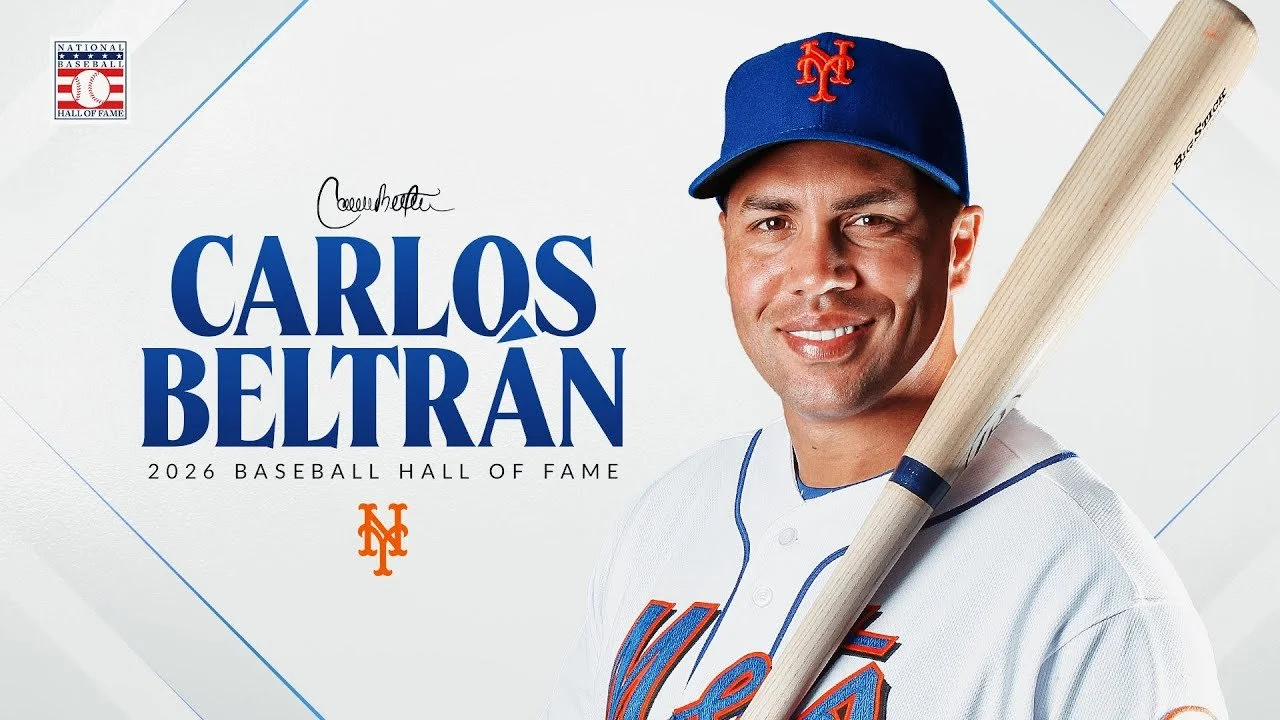
Former big league slugger Carlos Beltran was elected to the National Baseball Hall of Fame on Tuesday. Photo: YouTube/New York Mets
January 23, 2026
By Mark Whicker
Canadian Baseball Network
You’re forgiven for being surprised when Carlos Beltran was elected to the Hall of Fame on Tuesday.
He piled up 2,725 hits during his 20 years, and hit 435 home runs, too. Seven times he scored 100 runs, and eight times he drove in 100. He won four Gold Gloves and was a prolific and high-percentage base-stealer.
But he led his league in nothing, except his 162-game perfect attendance year in 2002, and he was a Top-5 MVP vote-getter only twice. He was a compiler, sneaking up on those numbers, and that’s perfectly fine. A more complimentary term would be “grinder.” At the very least he was one of the better centre fielders of the last 30 years. Andruw Jones, a lesser one, also got elected.
On the field Beltran is best remembered for a torrid 2004 postseason in Houston. He went 20-for-46 against Atlanta and St. Louis and hit four home runs against each. Then he hit .444 for the Cardinals in a 2012 Division Series win over Washington.
But the reason you might have trouble processing Beltran’s election by the Baseball Writers Association of America, which gave him 84 percent of the vote when he needed 75, is that you’ve been convinced that a Hall of Famer has to be morally flawless. And there’s this Houston thing, with Astros banging on trashcans to tell teammates which pitch was coming. Beltran was at least the co-founder of this enterprise.
Remember the sign-stealing mechanism that the Astros set up near the end of the previous decade? The one that outraged the Dodgers, who lost to Houston in the 2017 World Series, and brought universal boos to the Astros, even those who weren’t around at the beginning? Beltran’s involvement in the Bang The Can Loudly affair might be why it took him five years to get elected. Voting him in took a moral contortion on the part of the voters.
Beltran did pay a price, of sorts. He was all set to manage the Mets in 2020, but the true scope of the spying came to light just before that, and the offer was withdrawn. Bench coach and first lieutenant Alex Cora, who had won the 2018 World Series managing the Red Sox, was suspended for a year.
The Yankees were found guilty of “illicit use of technology” when Beltran was there, but, again, MLB didn’t take enforcement seriously. When Beltran got to Houston he observed that the Astros were behind the times electronically, and he, Cora and the others modernized the process. Beltran retired after the 2017 season and joined the Yankees’ front office, bringing the blueprint from Houston. Cora jokingly called Beltran “the off-season acquisition of the year” in the A.L. East.
In 2022 Beltran was interviewed by YES network and indicted himself: “We felt in our hearts we were being more efficient than any team out there. We all did what we did. Looking back, we were wrong.
“A lot of people always ask me why you didn’t stop it. The answer is, I didn’t stop it the same way no one stopped it. This is working. Why are you going to stop something that is working for you?”
In the end Beltran was miffed that he was the only Houston player named in the MLB investigative report, and that the rest of them kept playing while he was kept from managing.
Electing Beltran requires an abandonment of the BBWAA’s insistence that Hall of Famers should be flawless. Either that or someone changed the catechism between services.
Barry Bonds, the all-time home run leader and the seven-time MVP, remains radioactive. So does Roger Clemens, who won seven Cy Young Awards, his first when he was 23 and his seventh when he was 41. Clemens never tested positive for steroids. The voters take his trainer’s word for it. Bonds did take performance enhancers in a time when, as the Mitchell Reporters indicate, steroids were almost as prevalent as sunflower seeds. A lot of hitters, and pitchers, were using. He’s the only one who took statistical norms and broke them over his knee.
The steroid cheaters have been stonewalled by the voters and the Hall itself. Bonds never made 75 percent. Interestingly, the Hall changed the period of eligibility from 15 to 10 years. They did that in Bonds’ third election. The five extra years might have allowed some attitudes to soften, some minds to change. Jim Rice, Red Ruffing and Ralph Kiner all got elected in their 15th year.
Bonds’ next recourse was the Veterans Committee, a 16-person board of players, executives and a few media types. It votes anonymously. Its members are the ones who, in December, elected Jeff Kent, who often batted behind Bonds in San Francisco and benefited from those intentional walks.
Anyway, the Veterans Committee hasn’t had any time for Bonds either, and the Hall decided last year that if a player gets fewer than five votes, he isn’t eligible to be considered again for three more years and, if he fails again, will fall off the map forever.
The upshot is that steroid use, in the voters’ eyes, is an unpardonable offense. Corked bats are OK, as are spitballs, slippery elm and hair tonic.
And, as of Tuesday, so is electronic surveillance.
Bonds and Beltran were both trying to alter the competition through unnatural means. Beltran said the Astros were acting somewhat in self-defence because other teams were in the spy game, and the Brewers accused the Dodgers of similar cheating in 2018. Obviously, sign stealing is as old as chewing tobacco, and if a team feels it’s being disadvantaged, just change the signs, as the Nationals did when they won four games in Houston for the 2019 Series title. The “everybody else is doing it” excuse doesn’t work for Bonds or Beltran.
But here’s the thing about sign-stealing. It’s a skill. Dugout detectives spend long hours breaking down a pitcher’s glove position, or the differences in his release point, or how many times he nods to the catcher. Reading a pitcher is part of the game, if done organically. Beltran bypassed the skill part. He lured an entire clubhouse to the video monitors, and when teammate Brian McCann objected to the plan, Beltran ignored him. In doing so Beltran smudged the whole franchise and turned their glory days into something distasteful.
So it’s difficult to separate Bonds and Beltran. If baseball and the Hall of Fame belong on some ethical Olympus, then neither man deserves induction. If they acknowledge the fact that each player was among the best of his time and, in Bonds’ case, of all-time, they both do.
Instead, the baseball writers have chosen to designate Bonds’ behavior as permanently disqualifying and Beltran’s behavior as naughty but irrelevant. Whatever explanation they have isn’t worth hearing.