
Whicker: Negotiating new MLB CBA sure to pit owners against owners
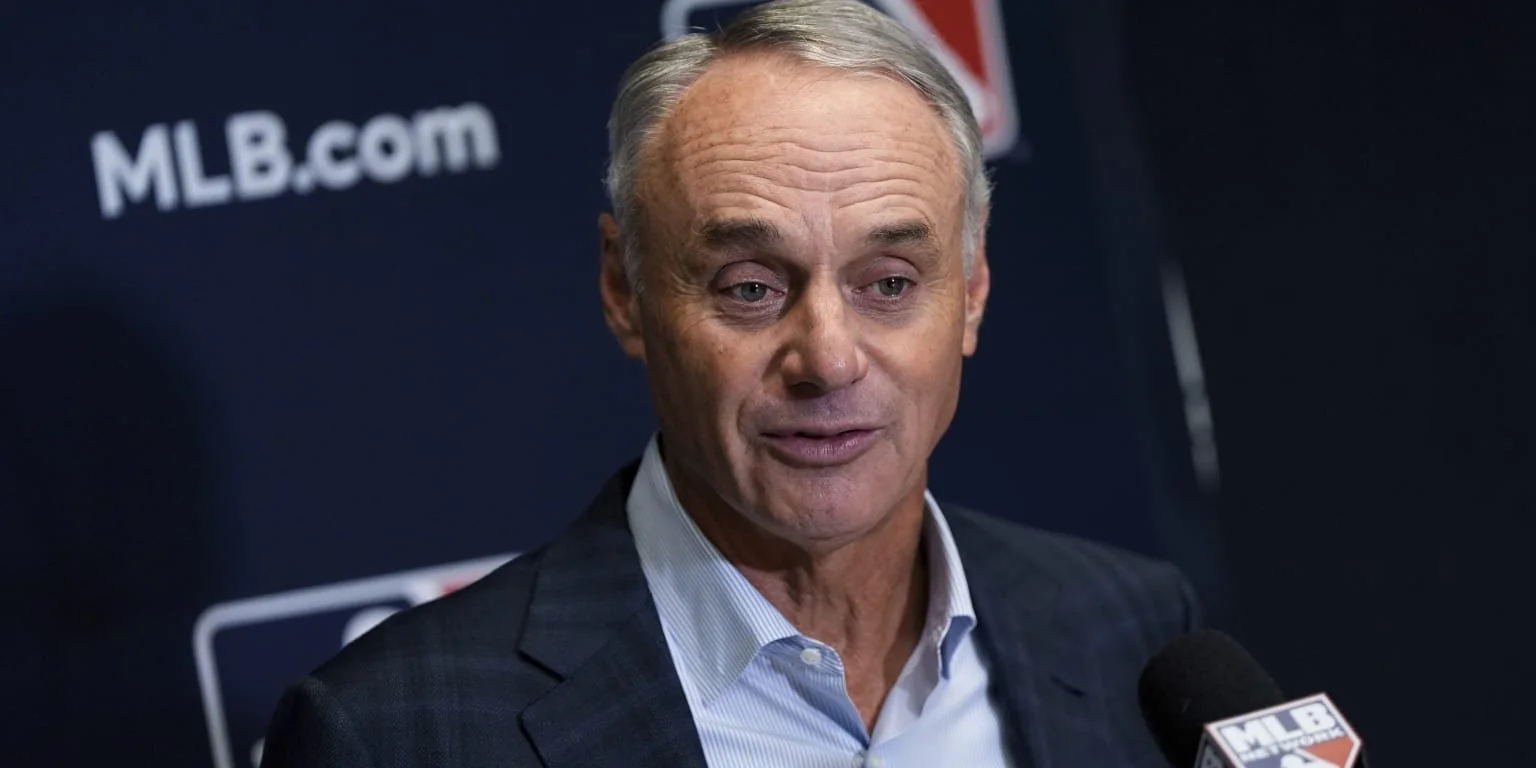
MLB commissioner Rob Manfred wants a hard salary cap to be included in the next Collective Bargaining Agreement. Photo: MLB.com
May 28, 2026
By Mark Whicker
Canadian Baseball Network
By now you’ve heard about the first rules of engagement in baseball’s proposed Money War.
The collective bargaining agreement expires at the end of the season, and the curtain goes up on the biggest off-field rivalry in the game: Owners vs. Owners.
The players are the scenery, although the Players Association is never easy to persuade. For its part, the hired help has proposed a $1.5 million minimum salary, free agency for five-year players who are 30 or over, and something called a Pre-Arbitration Performance Bonus Program that will enrich over-achieving kids who have played fewer than three years.
Although some of the ideas might be modified, their proposal will last about as long as your receipt from the cleaners. The real issue, as always, is the salary cap, which sends the players out of the room faster than a bunt sign.
The official MLB wish list includes a hard salary cap of $245.3 million, including benefits which are thought to average $23 million per club, and also a hard salary floor of $171.2 million. Revenues would be split 50/50. Local TV revenue will be pooled and shared equally, which is a first.
The dimensions of all this are not trivial. The Dodgers and Mets would have to trim payroll by about $150 million, and six other teams would need a haircut as well. But 12 franchises would have to add significantly to reach the floor. According to Fangraphs, the Marlins have a $74 million payroll. They will have to swell that figure by 97 percent to comply.
The Dodgers will cough up tens of millions, at least, by sharing all their local TV revenue. But since they’re estimated to spend $580 million on players, due to the luxury tax, they’ll reduce their outlay by almost half, even if they have to subject their back-to-back championship roster to heavy triage.
So it’s actually difficult to figure out who really likes the MLB proposal, except for commissioner Rob Manfred, whose idea to cut back game times has been an extraordinary success, just as a busted clock is right twice a day and only momentarily.
When something isn’t broken you don’t fix it, and when something is wildly successful you don’t take a blowtorch to it. Manfred likes to cite the NHL, the NBA and the NHL as leagues that thrive with a salary cap. But the NBA’s cap is pretty much like a “Speed Limit 55” on the Autobahn, since there’s a thicket of exceptions and several “aprons” that allow the profligate spenders to keep spending.
The NFL might be the most successful business venture in the USA, not just in sports, and shouldn’t be compared to anything else. Its player contracts aren’t fully guaranteed either. As for hockey, commissioner Gary Bettman pushed its hard cap because it was self-evident that some franchises were legitimately hurting. The NHL still lost an entire season and a playoff, and only regained its footing with extreme rules changes that made the game watchable.
Manfred says the lack of a cap hurts franchise values. His definition of “hurts” is that NBA and NFL teams have a higher uptick in sale price than baseball teams do. According to the annual Forbes Magazine survey, all 30 MLB teams are worth more than $1 billion, with the Yankees leading the way at $9.4 billion. Only ten years ago the Yankees topped that list at $3.7 billion. Revenues will approach $13 billion this year, industry-wide, and MLB says that figure has increased 247 percent since 2003. In that span, player salaries have increased 149 percent.
A salary cap, at least a hard one, provides cost certainty. Since rich pitchers have a way of suffering career-threatening injuries, baseball will have to create a Long Term Injured Reserve list, as hockey does, that doesn’t count against the cap
There will be a large argument over what constitutes baseball-related income. The Braves make a fortune off The District, the restaurants and shops that ring their ballpark in Cobb County. Sure, that has nothing to do with baseball, but The District wouldn’t be there if the Braves weren’t there.
There also is no provision about staff sizes, or at least it hasn’t been specified. The Oklahoma City Comets, who are the Dodgers’ triple-A affiliate, have 10 coaches, including two hitting coaches and two “performance” coaches. Even the Marlins have 12 coaches, including three who deal with hitters. This might be a cause of correlation and not causations, but some of us remember when there was one hitting coach per team and maybe four .300 hitters in the lineup. If you want to go after expenses, put a magnifying glass on every club’s staff directory.
Most of all, MLB needs to turn away from the charade about equalizing the competition. At this writing, the high-rolling Cubs and the pennywise White Sox have virtually the same record. The Mets, with the No. 2 payroll, are two-and-a-half games behind Miami, with the No. 30 payroll. The Brewers had the No. 23 payroll last year and the No. 1 regular season record, and they have the third-best record in the National League. Tampa Bay leads the Yankees in the A.L. East, playing way above its ledger. The Giants have the No. 9 payroll and are 22-34. And the Tigers, who had the No. 14 payroll last year, came within a 15th-inning single of going to the A.L. Championship Series.
Even with the NHL’s salary cap, the Buffalo Sabres stretched their non-playoff streak to 15 years before they broke through. Pittsburgh and Chicago have won three Cups since the 2004-05 work stoppage, and Los Angeles and Florida have won two apiece. Wise personnel moves and injury luck determine champions, as they always have, but a salary cap puts a premium on what team-building really means. As mentioned before, the Dodgers’ Andrew Friedman would be the first in line to sign up for a hard cap. He built a year-to-year winner in Tampa Bay with a brutally fixed income.
People close to the situation are alarmingly fearful about the precarious 2027 season. It’s true that the MLB proposal is almost guaranteed to spread unanimous discord. But it’s also true that all parties, from dugout to boardroom alike, are more prosperous than they’ve ever been. Canceling a season, in a livelihood where seasons are perishable and finite, is only conceivable when the alarms are sounding. And, even though it’s never happened, there might come a time when a lockout drives them away from the ballpark once and for all, considering the truly outrageous concessions, ticket and parking prices.
Two minority opinions: There will be no work stoppage. And if there is a work stoppage, with all the potential for cleansing the palate and reminding people just what baseball used to mean, it won’t be the worst thing.