
Whicker: Chapman, The Cuban Missile, still throwing ICBMs past hitters at 100 mph
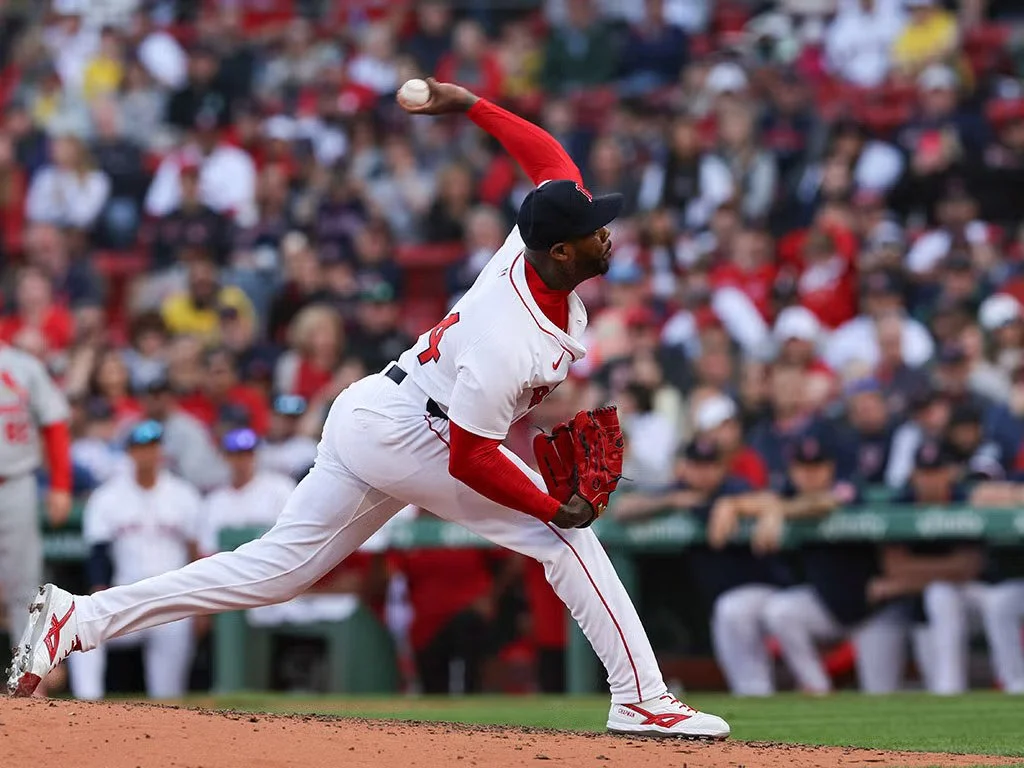
Boston Red Sox flame thrower Aroldis Chapman, 37, has 19 saves for the Boston Red Sox.
July 31, 2025
By Mark Whicker
Canadian Baseball Network
Once upon a time, the 100 mph pitcher brought a gold rush of scouts, frantically checking the batteries in the radar gun, breathlessly calling the home office over what they witnessed.
Now a pitcher almost needs to hit 100 to coax them back from the popcorn stand.
In the spring, Chase Shores threw 47 pitches that hit triple digits. He was a reliever at LSU. Minnesota’s Jhoan Duran averaged 101.8 mph on his four-seamer in 2023.
This year, nine major league pitchers average 99, with the Athletics’ Mason Miller leading the launch at 101.1.
The average is 94.4, an increase of 5.4 mph over the past 23 seasons. Four rookie starters have hit 100 at least once. And three high school pitchers got to 100 this spring, including Jack Bauer, not to be confused with Kiefer Sutherland. Bauer is from Frankfort, Ill. and became the first prep lefty to be timed at 103 mph. He’ll pitch at Mississippi State next year, with surgeons at the ready.
So it’s difficult to remember the ruckus that greeted Aroldis Chapman when he brought an ICBM to Cincinnati in 2010. He made his debut on Sept. 1 and got through Milwaukee’s Jonathan LeCroy, Craig Counsell and Carlos Gomez in eight pitches. Four of those pitches surpassed 100. Naturally he was nicknamed The Cuban Missile, without the crisis.
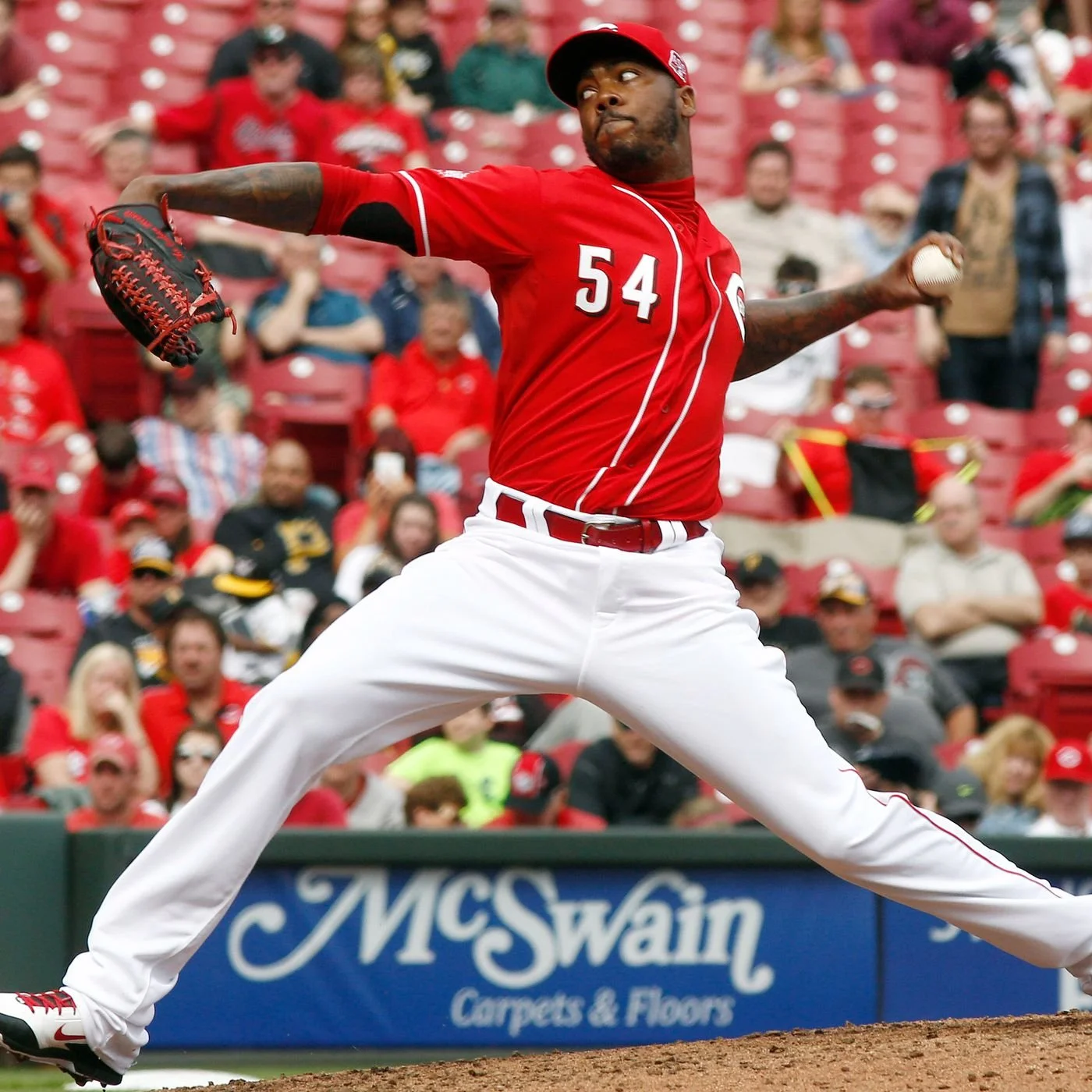
Chapman broke in with the Cincinnati Reds
Dusty Baker was his first manager and Joey Votto (Etobicoke, Ont.) was the Reds’ best player. Hall of Famer Scott Rolen was at third base. Big Arthur Rhodes, at 40, was the prime lefty in the pen. All of them put down their sunflower seeds when Chapman ambled into the fray.
“He’s the Usain Bolt of baseball,” proclaimed fellow pitcher Bronson Arroyo, who was more correct than he knew.
Bolt turned out to be a long-playing hit, nine seconds at a time, with eight Olympic gold medals spread over three Games and 12 years. Chapman is 37 today, pitching for the Red Sox, his fourth team in four years. He has had two shoulder flareups and an Achilles inflammation, but he’s dodged the injury knockouts for the most part.
The Red Sox anticipated using Chapman as a trade deadline lure, but now they look around, find themselves in a wild-card scrum, and don’t see an available closer better than Chapman, who is third alltime in strikeouts by a reliever, behind Hoyt Wilhelm and Goose Gossage.
His 0.816 WHIP is his second-best in his 17-year career, and opponents are hitting .145. For all pitchers who have turned in 40 innings, Chapman is the leader in strikeout ratio, sending down 38.4 percent of the batters he’s faced.
Thirteen years after he made his first All-Star team, Chapman made his eighth. And his average heater still cooks along at 98.5 mph, 14th highest in baseball. In the first 15 years of his career, Chapman was the source of 48.8 percent of the 100-plus mph pitches throughout the majors.
There have been bumps, inevitably. He took a 30-game suspension for domestic violence. In 2016 Chapman nearly drove Chicago off the top of the Sears Tower, giving up a two-run homer to Cleveland’s Rajai Davis that tied Game 7 in the eighth inning. The Cubs had traded Gleyber Torres, perhaps their top prospect at the time, to the Yankees for Chapman, who had a 1.01 ERA for Chicago, and at season’s end Chapman went back to The Bronx.
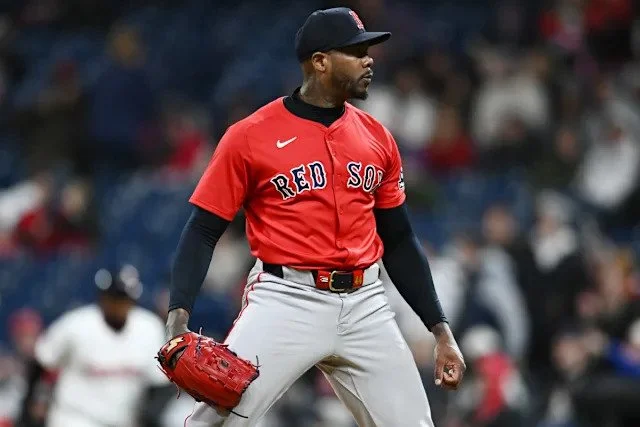
He was also hit-and-miss with the Rangers, the year they won the World Series. But last year, playing incognito in Pittsburgh, Chapman was able to crank six consecutive 100 mph pitches against San Diego’s Manny Machado, who finally began laughing at the absurdity of it. For his career Chapman has (A) limited hitters to a .167 average (B) struck out 39.9 of the hitters he’s faced (C) saved 353 games in 403 appearances, which works out to 87.5 percent (D) and has given up 468 hits in 801 innings.
Last Sunday, Billy Wagner celebrated being the eighth fulltime reliever to enter the Hall, as he made it in his 10th and final try. Given a fair look, it shouldn’t take Chapman that long.
Chapman left the Cuban national team during a tournament in Rotterdam, 16 years ago. He walked out of his hotel and into a waiting car, and wound up in Andorra, a speck on the map in the Pyrenees, where he established his residency and was able to remain a free agent. Cincinnati signed him for six years, $30 million, before he threw a pitch in organized baseball.
It was audacious, for sure, but at that time his weapon was near-ultimate. Now, velocity doesn’t scare anyone, primarily because pro hitters have already dealt with it on their journey upward. But, overall, it still wins.
Last year’s cumulative major league batting average was .243, fifth-lowest in history and lowest since 1967. In 2000 that average was .270. There were seven .300 hitters in all of baseball last season and there are eight, at this point, this season. In 2000 David Segui hit .335 and was 10th in the majors.
Chapman is not beating people with drop shots. His slider is in the high 80s, his splitter is in the low 90s and, according to the pitch stats, he does not appear to have thrown a change up since 2023.
That doesn’t mean that power wins, or that absolute power wins absolutely. Chapman was well-schooled in Cuba, and there were two months in this season when he threw more sinkers than four-seamers. He knew he had to reduce his walks to keep his closer persona, so he’s done that, from 14 percent of batters last year to eight percent this year.
“That took a lot of hard work in the offseason,” Chapman said. “I had to work on getting the first guy out.”
He has blown two saves in 2025, and the Red Sox came back to win one of those games. Their investment in him was $10.75 million for one year. One can expect inflation to set in next year, thanks to Chapman’s preparation and his keen instinct for show business. The lead entertainer gets to close the show.