
Whicker: Deaths of Mazeroski, Face reminder of Pirates’ rich history, Skenes, Griffin offer hope for return to glory
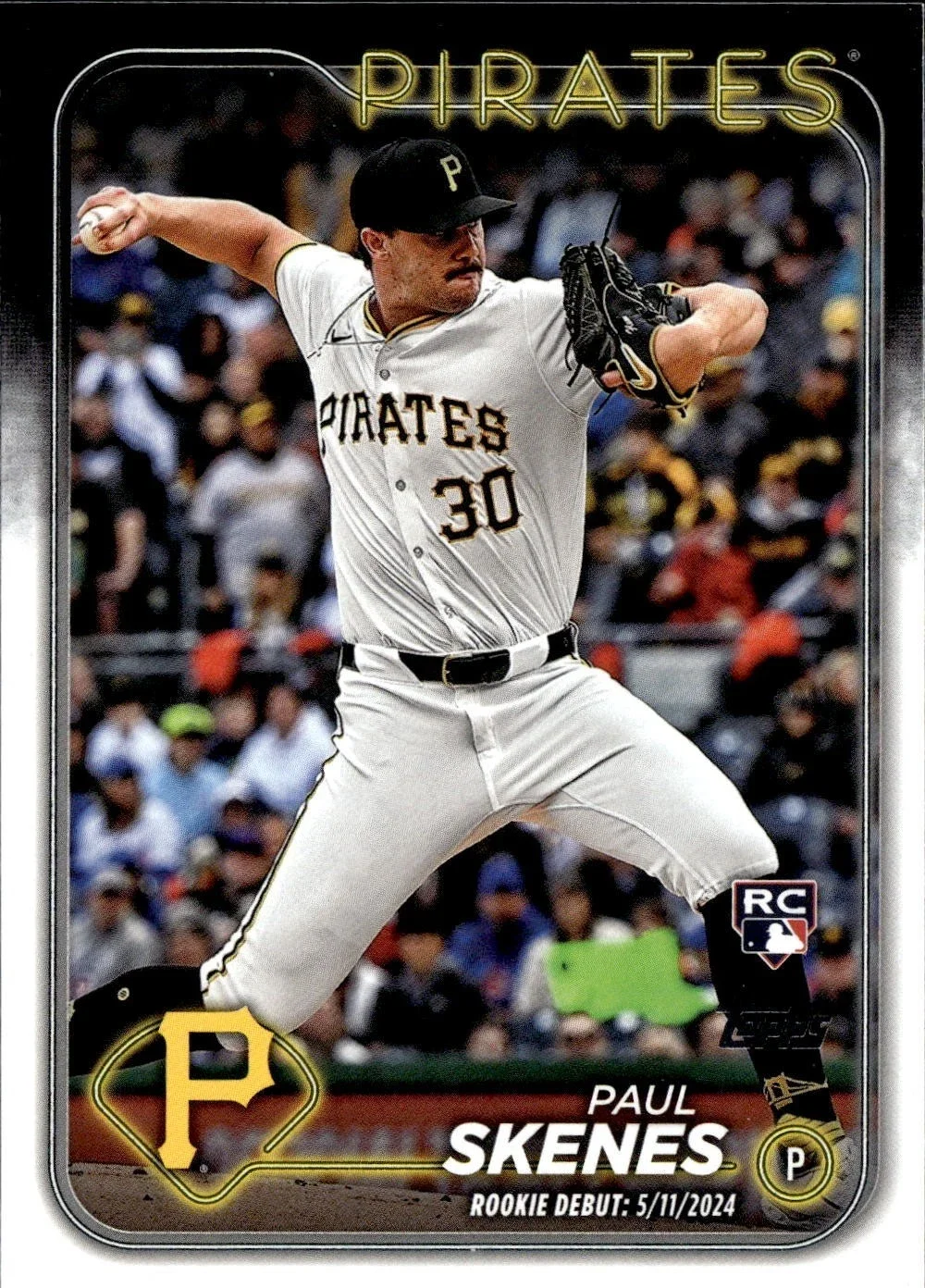
Pittsburgh Pirates ace Paul Skenes won the National League Cy Young Award in 2025. He has given long suffering Pirates fans hope that the club could soon return to the postseason.
February 25, 2026
By Mark Whicker
Canadian Baseball Network
There is still October baseball in Pittsburgh. It usually lasts one day.
On Oct. 13, a troupe of Pirate fans, of various ages, gather at the site of Forbes Field and call up the radio broadcast of World Series Game 7, 1960, with Chuck Thompson and Jim Quinlan at the microphone. They observe the seventh inning stretch. They visualize the desperate pitchers of the Pirates and Yankees, trying to get somebody, anybody out. At the end, Bill Mazeroski hits the home run, like he always does, and everybody goes home happy. The rest of the month is devoted to watching others play. The Pirates themselves haven’t lost a World Series game since 1979.
Mazeroski died last week, at age 89. There are only a handful of truly universal home runs in baseball history, ones that stopped the clock of a nation, or two. Bobby Thomson hit one in 1951, Kirk Gibson in 1988, Joe Carter in 1993. Mazeroski’s, off Ralph Terry and into the left field seats for a 10-9 victory, has his own place because it came against the high and mighty. For fans of run differential, the Yankees outscored Pittsburgh, 55-27, in that World Series and still lost. They hit .338 for the Series and Mickey Mantle hit .400 with three home runs. Game 7 itself was a riot, with Hal Smith slamming a three-run homer in the eighth to put the Pirates ahead 9-7. Mantle and Yogi Berra had RBIs in the top of the ninth, and Mazeroski led off against Terry.
Berra, playing left field, could only look up at the winning drive, which landed under a Longines clock at 3:35 p.m. (Nostalgic sigh.)
Mazeroski hit .320 in the Series, but had only 11 home runs in 1960. He was a lifetime .260 hitter with 2,016 hits in 17 years, all of which were spent in Pittsburgh. He did have eight Gold Gloves at second base and was known as a fearless, unerring relay on the double play, with legs like sequoias. But the only reason Mazeroski is a Hall of Famer is Oct. 13 and, when you think of the length and breadth of that home run, that might be reason enough. No one had ever ended a World Series with a homer before, and those Pirates are the last Pittsburgh team of any sort to actually win a championship at the confluence of the Allegheny, the Monongahela and the Ohio.
Elroy Face also left us this month, on the 12th. He was 97. Face was one of baseball’s original closers, thanks to the foresight of manager Danny Murtaugh, who is one of the two best managers who isn’t in the Hall of Fame (Davey Johnson). He got acclaim in 1959 when he went 18-1, but he was better in 1960, when he had 24 saves and a WHIP of 1.061. Chicago baseball writer Jerome Holtzman had invented the save rule in 1959 and denigrated Face’s wins, because he got some of them by falling behind. But Face had three saves in the 1960 World Series. Neither he nor Mazeroski was named World Series MVP. Bobby Richardson of the Yankees was. Talk about voter fraud.
Face pitched 17 years, 15 with Pittsburgh, and still leads the franchise in appearances and saves. He had been a carpenter in those off-seasons and, when he retired, became a carpenter full-time.
The ‘60 Pirates drew 1.9 million fans to Forbes Field, a healthy number back then. The Pirates also won World Series in ‘71 and ‘79. When they built themselves into a wild-card playoff team for three years beginning in ‘13, they drew well over 2 million and peaked at nearly 2.5 million in ‘15. But the Pirates let their best players go, and they’ve had one winning season since then. Last year they drew 1.5 million and, for the fifth consecutive year, ranked 14th in attendance in the 15-team National League.
Today the Pirates are the poster child for what might become the first serious baseball work stoppage since 1994. Their payroll ranked 26th in baseball last year, and that was their highest rank since 2018, even though Robert Nutting is the 10th richest owner in the game. Because the Pirates and other stragglers have shown little interest in paying players, baseball owners are pushing hard for a salary cap, and the players have just as stoutly rejected it. The Pirates are worth $1.35 billion, according to Forbes magazine, and got through 2025 with $326 million in revenue.
If big money automatically equaled winning, this would be a serious problem. The Milwaukee Brewers derailed that equation, at least in 2025, by posting MLB’s best win-loss record with the 20th highest revenue stream. The road to winning is still paved with scouting shoe-leather and player development, and sharp player evaluation. Nutting has at least built an academy in the Dominican Republic. He knows how to read the hymnal. Maybe he’s even learned to sing.
Two years ago the Pirates had the No. 1 pick in the draft for the seventh time. They had taken enough Brian Bullingtons, Jeff Kings and Henry Davises to keep their fans from getting too excited. This time they were presented with a no-brainer: LSU righthander Paul Skenes, who has a 1.96 ERA in 55 starts in ‘24 and ‘25. Skenes won last year’s Cy Young Award with a 10-10 record because he led the N.L. with a special 0.948 WHIP.
Skenes was joined last season by Bubba Chandler, a third-round pick in 2021 who made seven starts, won four and had a .926 WHIP. Those two, plus veteran Mitch Keller and rehabbing righthander Jared Jones, provide at least a chalk outline of hope.
On Tuesday, Konnor Griffin launched two home runs against Boston in a Grapefruit League game. Griffin was Baseball America’s Minor League Player of the Year in 2025, when he breezed through Class A and double-A with a .942 OPS and 21 home runs. Still 19, Griffin can play shortstop or centre field, and he’s 6-foot-4 and 215.
This is how the Pirates built their best clubs, and you don’t have to go back to Honus Wagner, Pie Traynor and the Waner brothers. Joe E. Brown was a comic actor who appeared in Some Like It Hot and once estimated that he had played Elwood, in Harvey, over 2,000 times on stage. But he was also a baseball fan, and his son Joe L. was, too. When Joe L.’s baseball career expired, he fell under the formidable wing of Branch Rickey. Eventually Joe L. became the Pirates’ general manager, and he threw himself into the player marketplace.
Rickey had also brought Howie Haak from the Dodgers to Pittsburgh. Haak didn’t talk, he croaked, and he didn’t know a lot of Spanish, but he went deep into the Caribbean and South America to get players. Brown accompanied him, twice a year. Haak signed John Candelaria and Bob Veale from the States, but his Latino signings included Tony Pena, Manny Sanguillen, Omar Moreno, Tony Armas and Al McBean.
Another scout, Clyde Sukeforth, was keenly watching an outfielder named Roberto Clemente. The Dodgers had signed Clemente as a “bonus baby” but had to keep him on the roster for two years to protect him. They stuck him in Montreal, their triple-A team, and gambled that no one would notice, but Sukeforth did, and Pittsburgh took the future Hall of Famer in the Rule 5 draft.
The Pirates became the first team to play nine Black or Latino players in the same lineup, in 1971. But in 1961, Brown released a utility man named Gene Baker and made him the manager of a Class D club in Batavia. He became the first Black manager. It was easy for Black fans to identify with the ‘79 Pirates, with Willie “Pops” Stargell in charge and with Dave Parker by his side, an extroverted bunch that swung loud and talked louder. But as baseball lost its appeal to inner-city kids, the Pirates lost that identity, or any other.
Going into 2026, the Pirates are dead even. They’ve won 10,910 and they’ve lost 10,910. Their history outweighs their raw numbers, but it’s hard to sell memories to a generation that thinks baseball began with David Ortiz.
How close are we to the day when the Oct. 13 parishioners pack up their folding chairs and head downtown to a real live postseason game? Closer than you think, perhaps, but hurry up. Some of those folks were actually there in 1960, and have been told that history can repeat.