
Whicker: WBC should replace MLB All-Star Game in alternate seasons
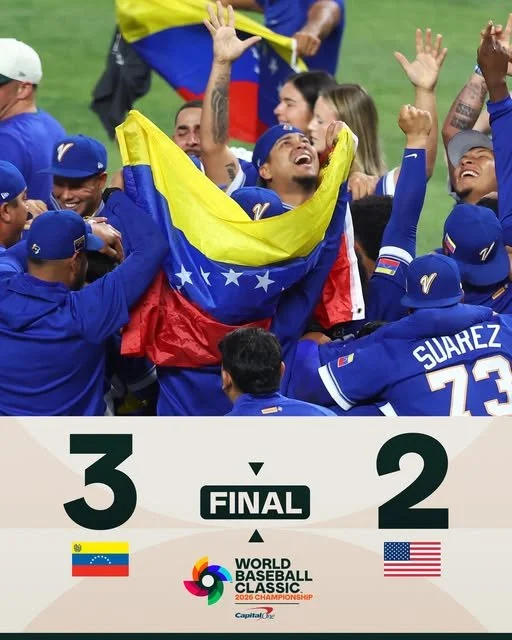
Venezuela defeated the U.S. 3-2 to win the 2026 World Baseball Classic on Tuesday night. Photo: World Baseball Classic
March 18, 2026
By Mark Whicker
Canadian Baseball Network
The World Baseball Classic is out of the nest. Now is the time to let it fly.
The American victory over the Dominican Republic, in Sunday’s semifinal, was shown opposite the Academy Awards and still drew a bigger viewing audience than the 2025 All-Star Game did. If that isn’t a mandate for change, how about the jam-packed crowds in Miami to watch the Dominicans, Puerto Ricans and Venezuelans? It’s proof that Miami loves baseball, as long as it’s not played by the Marlins. But it also launches the WBC into something that we should pencil in, at least once every two years. And not at the shank of spring training, either.
No, the WBC should replace the All-Star Game in alternate seasons, right there in the middle of July, when everyone is lathered up and in rhythm, when there would be no pleas from the MLB team executives to hold people out of competition, when baseball is the lone focus and when every other major sport is dormant.
Complications? Yes. The competition will take at least a couple of weeks. In response, forget Czechia and Great Britain and even Italy. The Italians played great baseball during this WBC and got to the semifinals, but their roster was peppered (and sauced) with players who qualified because they’d eaten chicken cacciatore sometime in the past six months. One could assemble a pretty good Irish team off MLB rosters, too.
Cut the field down to the U.S., Venezuela, Mexico, Puerto Rico, the Dominican Republic, Canada, Japan and South Korea. (If you need a qualifying event in the spring to accommodate Chinese Taipei, Australia, Panama and Aruba-Curacao, do it.) That’s two four-team pools. You could have a double round-robin to decide the top two finishers in each group, then play the semis and finals. That’s a maximum of eight games, and only for the finalists. That would fit comfortably within two weeks, particularly if everyone is on the same continent, and the games would be in Toronto, San Diego or Los Angeles with the medal round in Miami.
This would be contingent on a general MLB realignment, which we’ve outlined in previous columns. It is possible to sketch out a 154-game schedule, the kind that MLB played before the 1961-62 expansions. A tight squeeze, yes, but there’s nothing wrong with an occasional scheduled doubleheader, like there used to be, every Sunday afternoon. It just depends on how much MLB wants the WBC and what its true value is. The past two Classics, with Shohei Ohtani striking out Mike Trout in the ninth, and with the Venezuelans shoving across the winning run on a walk, a steal and a double in the eighth, would indicate it’s not just valuable, but essential.
The suits in the NHL offices don’t like Olympic hockey, either, because they get no money from it and they often lose players on the eve of the playoffs. Never mind that Auston Matthews and Leon Draisaitl got hurt after the Olympics, during regular 82-game play. The 2010 and 2026 Olympic hockey finals were among the best half-dozen games anybody’s ever seen, and the 2025 Four Nations Cup goes up right beside them. And it only happened because the game’s best players campaigned for it.
Although Ken Griffey Jr., Chipper Jones, Roger Clemens and Derek Jeter played in the inaugural WBC 20 years ago, most of the Americans wore the uniform awkwardly. It was a weird concept, playing for one’s country instead of some consortium of billionaires, and the fans had trouble grasping it, too. But then Japan played Korea in Anaheim, and suddenly 39,000 people were there, a majority of them Korean, chanting and dancing and finally smiling after their heroes beat Japan, which eventually won the gold. At that point you realized the WBC had unlocked something, or maybe just illuminated it.
The next night Mexico eliminated Team USA, 2-1, with the Americans getting three hits, if that sounds familiar. The Mexican fans celebrated as the Koreans had. They also outnumbered the U.S. fans. That was not the case when the Americans won their only WBC title, at Dodger Stadium in 2017, over Puerto Rico as Marcus Stroman pitched six shutout innings. There was lots of U-S-A going on, with Jim Leyland managing and Adam Jones selling the concept.
The WBC slowly gained traction every three years. This year Aaron Judge and Paul Skenes pretty much shamed the best players into participating. Nobody in baseball has more to lose, from a next-contract standpoint, than Skenes, and yet he was first in line, while incipient free agent Tarik Skubal, consumed with angst, decided to pitch only once, against the Murderers’ Row from Great Britain. And when the ninth inning arrived on Tuesday, U.S. manager Mark DeRosa went with Boston’s Garrett Whitlock, who had been outstanding, instead of the nuclear Mason Miller, because the Padres had maintained that Miller had pitched enough.
On the other side, several ballclubs beseeched Venezuelan manager Omar Lopez to shelve his relievers as well. That’s the reason the third run, driven in by Eugenio Suarez, was so vital. It created a ninth-inning save situation that David Palencia could close, because that’s the deal the Cubs made with Venezuela: Palencia pitches in a ninth inning save situation or not at all. The U.S. pretty much lived on the home run throughout the tournament. The most dramatic was Bryce Harper’s two-run bomb in the eighth that tied the final, 2-2. Wilyer Abreu of the Red Sox was the power man for the Venezuelans and had a solo shot on Tuesday, but the champs got their second run on a wild pitch by Nolan McLean and a run-scoring fly ball by Maikel Garcia. (Vin Scully never called it a sacrifice fly because he said the batter was never trying to give himself up. So we shouldn’t either.)
The third run was set up when Luis Arraez walked and was removed for pinch-runner Javier Sanoja, who isn’t known for his speed. But fortune favors the bold, and Sanoja indeed took off despite the arm talent of U.S. catcher Will Smith. Sanoja was safe by a toenail, a call too close to overturn. Suarez followed with a double off Whitlock. Once again, the trophy went to the team that knows that, sometimes, it takes a village to score. The launch-angling Americans were 10-63 in the two medal-round games with 25 strikeouts, and they were 0-for-3 in scoring-position situations. Make that 0-for-0 against Venezuela.
The Venezuelans didn’t bring their best, either. Starting pitcher Jesus Luzardo and closer Robert Suarez weren’t around. Neither was Jose Altuve, their Godfather, who turned 35 last year and thus couldn’t be insured for the Classic. The same was true of Miguel Rojas, who is 36. But, hey, one miracle homer per lifetime.
Several Venezuelans, including starting pitcher Eduardo Rodriguez, said the WBC championship was more gratifying than a World Series. Jeter, now working for Fox, said if you actually believe that, you’ve never played in a World Series. In the booth, John Smoltz wasn’t as dismissive. He was a 38-year-old dealing with elbow issues in 2006 and eventually decided to sit out the first WBC. Now he’s the lead analyst (and, no, he wasn’t on a word count), in baseball’s biggest events, of which the WBC is now a proud member. He looked down on Venezuelan ecstasy and, quietly, said, “What a ballgame.”
One imagines he’d have no trouble clearing his schedule for July. Same for the rest of us.