
Wilson: McFarlane and the McGwire ball bonanza
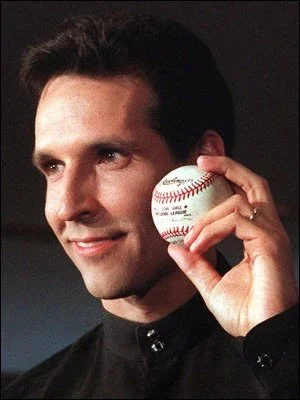
Calgary native and comic book creator Todd McFarlane paid over $3 million for Mark McGwire’s 70th home run ball in 1999.
*This article was originally published on Alberta Dugout Stories on January 12, 2026. You can read it here.
January 14, 2026
By Ian Wilson
Alberta Dugout Stories
It was memorabilia mayhem.
Calgary-born Todd McFarlane was right in the middle of the collectible chaos and emerged with one of the most sought-after pieces of sporting history.
This is a story of a slugger, his incredible feat, and baseball fanaticism run amok. Only those with the fattest wallets were invited to this party, and the ensuing media attention grabbed more headlines than a celebrity scandal.
More simply, this is just a tale about a baseball. And yet, it is so much more than that.
To set the scene, we must go back to the summer of 1998. The biggest story in the sports world that year was the chase to break the single-season record for home runs, which Roger Maris set in 1961 with 61 long balls. Ken Griffey Jr., Sammy Sosa and Mark McGwire were in hot pursuit and it was “Big Mac” who came out on top with 70 homers to smash the record. Griffey Jr. finished with 56 dingers and Sosa ended the campaign with 66. The back-and-forth between McGwire and Sosa was big news and helped rejuvenate a sport that was badly damaged by a Major League Baseball (MLB) strike that resulted in the cancelation of part of the 1994 season and the World Series that year. The home-run hunt brought fans back to the game in a major way.
Along with the homer hysteria came the dog-piling pursuit of long balls in the outfield bleachers as fans clamoured for a piece of baseball history. With a circumference of 9.2 inches, 108 stitches, and weighing just 5.19 ounces, it’s hard to believe that the Rawlings-produced baseballs – which were manufactured in Costa Rica with leather from Guernsey cows – could cause such a stir. Of course, it wasn’t so much the balls themselves that drove people wild. It was what guys like Griffey Jr., Sosa and McGwire were doing to them. The bashfest was a welcome sight for sports fans who were ready to move on from labour disputes and embrace the American pastime in all its dinger-delivering glory.
Getting a hold of the right ball also opened the door to several unique opportunities. You could shake hands and get a picture with one of your sports heroes and trade it in for other signed paraphernalia, such as jerseys, bats and other baseballs. You could also seek season tickets from the MLB team in your city. Maybe you could arrange to throw out the ceremonial first pitch at a game, or take part in batting practice with the Cardinals or Cubs. If you were feeling charitable, you could donate it to the National Baseball Hall of Fame, which had a keen interest in preserving the historic orb. Or you could just sell it. After all, it could offer up a life-changing amount of money.
Phil Ozersky had to ponder all these options when he got a hold of McGwire’s 70th blast, which came off of a Carl Pavano first-pitch fastball in the seventh inning of a Sept. 27th game between the St. Louis Cardinals and Montreal Expos at Busch Stadium. Attending an office party at the “Batting Cage” party box in the left field stands, the research scientist was able to gather the baseball after it bounced off the back wall and rolled under the metal bleachers where his co-workers were seated.
After the euphoria and pandemonium of the moment wore off, Ozersky set his mind to the fate of the historic baseball. His decision was no easy task. There were countless media requests and offers that poured in, and making a choice nearly became a full-time job. Ultimately, he decided to put the ball up for auction and test the market.
DRAWING INTEREST
While McGwire spent the 1980s establishing himself as a baseball force – as a first baseman with the University of Southern California (USC), a 10th overall pick of the Oakland Athletics, a member of the American baseball team at the 1984 Summer Olympics, and a World Series champ in 1989 – McFarlane was chasing his own dreams.
The artist also had baseball aspirations. Upon his graduation from Calgary’s William Aberhart High School, McFarlane hoped to catch on with Gonzaga University as a ball player. He was a solid fielder, with speed, but his hitting needed work. Instead of joining the Bulldogs, McFarlane went to Spokane Falls Community College for a year and a baseball scholarship then took him to Eastern Washington University in 1981, where he studied graphics and art. An ankle injury in his junior year hobbled his athletic hopes and pushed him towards a path in comic books, although McFarlane did try out for the Medicine Hat Blue Jays – the rookie-level affiliate of the Toronto Blue Jays – in 1984.
McFarlane began working for both Marvel Comics and DC Comics in the mid 1980s and he gained recognition for his artistry of The Amazing Spider-Man by the end of the decade.
McGwire continued to garner fame as one half of the “Bash Brothers” – the name given to the slugger and teammate Jose Canseco in Oakland – until the A’s dealt him to St. Louis for pitchers Eric Ludwick, T.J. Mathews and Blake Stein on July 31, 1997.
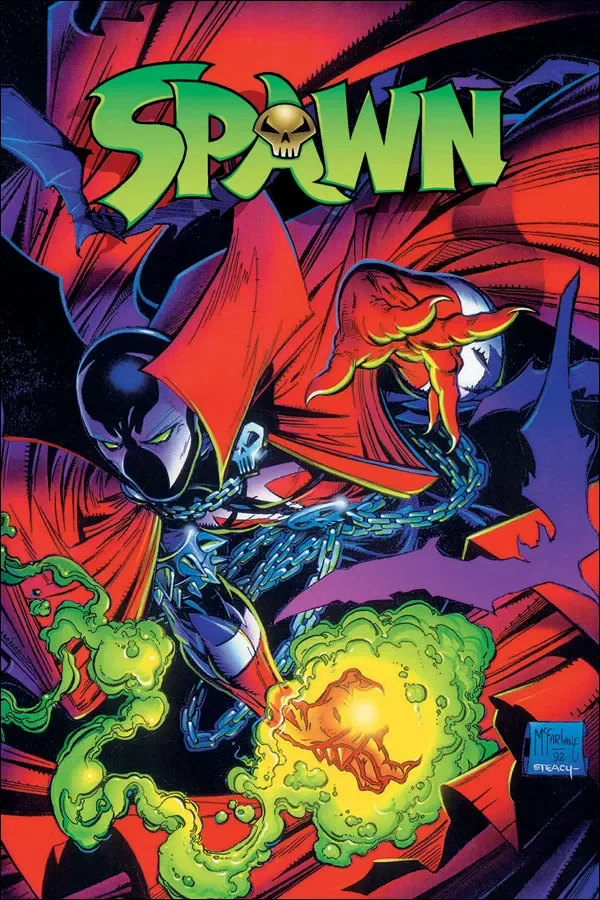
Cover art from Spawn No. 1 comic book
McFarlane, meanwhile, was also charting a new path in the 1990s. He teamed up with six other artists to create Image Comics, an umbrella company for Todd McFarlane Productions, Inc. and other publishing houses. In 1992, Spawn No. 1 was released and sold 1.7 million copies. The comic took off from there and McFarlane then focused his efforts on the creation of a new action-figure company in 1994, which was initially called Todd Toys and later became McFarlane Toys. Originally intended to offer up three-dimensional likenesses of Spawn characters, the company expanded into the realm of music, movies, TV series and sports.
The day after McGwire was dealt to the Cardinals, Spawn was released in theatres as a major motion picture. An animated series for the character followed, as did music videos from Todd McFarlane Entertainment, including Pearl Jam’s Do the Evolution and Korn’s Freak on a Leash.
Things were looking up for both McFarlane and McGwire when Ozersky inadvertently sought to bring the two together.
HIGHEST BIDDER
By the time the calendar flipped to 1999, it looked as though things would be looking up for Ozersky, as well.
The arrangements had been made for Guernsey’s auction house to handle the sale of McGwire’s 70th home run baseball, along with a series of other balls that both Sosa and McGwire sent over the fence in 1998. A number of older baseballs – including one signed by Babe Ruth and Lou Gehrig and another autographed by Ruth and Hank Aaron – were also a part of the action. In addition, Aaron’s 755th career home run ball was up for grabs.
The auction took place on Jan. 12th at Madison Square Garden in New York, with about 300 people in attendance. Auctioning paddles were issued to 85 registered bidders and another 10 would-be buyers participated by phone.
Sale prices varied on the items. The minimum bid on Aaron’s 755th homer ball was not met at this event, but it did sell at another Guernsey’s New York auction for $650,000 in April of 1999.
The older items sold for much less than that. The ball signed by Ruth and Gehrig went for $12,000, while the one signed by Ruth and Aaron garnered $7,000. A baseball that was autographed by Ruth and Maris was purchased by Irwin Sternberg, a necktie manufacturer from New York, for $60,000.
When it came to Sosa and his collection, his 55th homer sold for $4,500, his 61st saw bidding rise to $15,000, and his 64th went for $24,000. Sosa’s 33rd home run baseball – which marked his 20th homer from the month of June in 1998, a major-league record for round trippers in a month – sold for $20,000. The outfielder’s 66th homer – which remains a Chicago Cubs record – was bid on for three minutes and the action closed at $150,000.
As for McGwire, his 16th home run of 1998 earned $20,000. That ball represented the longest shot of his career, a 545-foot blast that was the furthest homer to be launched out of Busch Stadium.
McGwire’s other balls saw an increase in the bidding. His 63rd and 67th homers went for $50,000 each, while his 68th long ball topped out at $55,000.
The star of the show – McGwire’s 70th home run – was expected to generate a return of at least $1 million. The bidding started at $400,000 and took off from there, with offers and counter offers taking place for 10 minutes.
When the dust settled, the winning bid finished at $2.7 million, plus the $305,000 commission for Guernsey’s auction house, resulting in a total payment of $3,005,000 from the buyer. Sternberg was involved in the bidding right until the end but stopped after offering up $2.6 million.
It was the most money ever spent on a sports collectible, with the previous record established by Ruth’s first home run at Yankee Stadium. That baseball sold for $126,500 in November of 1998.
“Tell them I’m a heck of a baseball fan,” the anonymous buyer said through a spokesperson after the auction closed.
MYSTERY MAN
The crowd at Madison Square Garden was buzzing over the massive expenditure on McGwire’s 70th home run ball, but it wasn’t immediately clear to the public who made the purchase.
McFarlane, who had been calling in bids on the phone, knew what he’d done and footage of the back-and-forth moments leading up to the securing of his big prize was captured by friend Al Simmons in the 2001 documentary The Devil You Know: Inside the Mind of Todd McFarlane.
“I just made the biggest plunge of my business career,” said McFarlane after setting down the phone when bidding closed.
“Holy (expletive), that’s gonna be over $3 million for that ball … gotta make that ball work for us.”
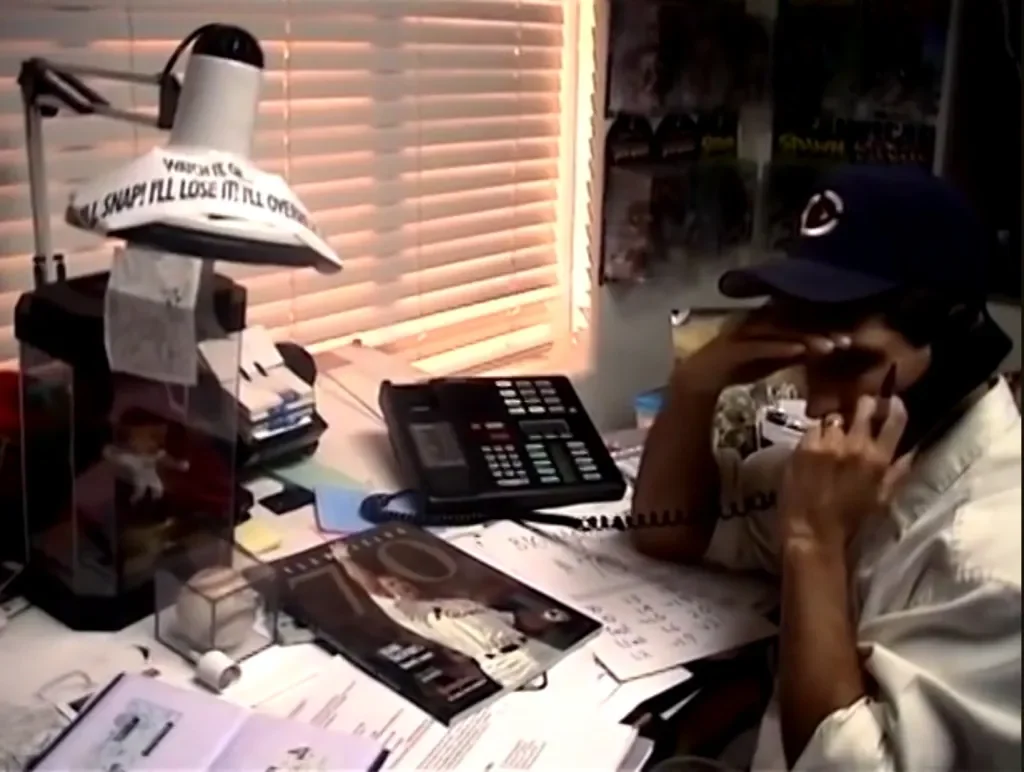
Still frame from the documentary The Devil You Know: Inside the Mind of Todd McFarlane. McFarlane is seen here bidding on McGwire’s 70th home run ball.
McFarlane further described the auction process several months later during an interview with the Calgary Herald.
“I thought I would get it for $1.6 million. I wrote down on a piece of paper beside the phone, ‘Do not spend more than $2.1,” he said.
“So at $1.5, everybody was gone except for me … and one guy. He went way too far out of his zone, too. We were like dumb and dumber.”
Added McFarlane: “When he said $2 million, the cheer was so loud I had to take the phone away from my ear … it was like a frenzy, it was like Joe Carter hit the home run again. I went, ‘Oh oh, this guy just got rejuvenated.’ The whole place is like, ‘Yeah, yeah, yeah!’ And he’s thinkin, ‘If I win this bid, I’m getting the Gatorade shower, I’m walking outta here the local hero.'”
In the days that followed, speculation was spreading that McFarlane was indeed the buyer. An article in the Jan. 22nd edition of the National Post newspaper linked the comic-book creator to the expensive baseball.
When contacted at his Calgary home, Bob McFarlane – Todd’s father – said: “Who let the cat out of the bag?”
The elder McFarlane confessed that his son planned to bid on the ball, but he also said that Todd’s secretary indicated they are denying that they have the ball.
In February, the younger McFarlane finally admitted that he had made the purchase, and described the acquisition as a combination of business and pleasure.
“It was a mixture of business, charity and self indulgence to the nth degree,” said McFarlane in a front-page article in the Calgary Herald.
“When people see what I do with this in the next couple years, it’s bigger than just a fool who bought a ball for three million dollars.”
McFarlane, who was a resident of Tempe, Arizona at that point, said he wanted to make the ball available to charities for fundraisers and lend it out to the National Baseball Hall of Fame, as well as individual MLB teams, for display purposes.
“I’d like to be able to take 20 swings in every major league ball park,” said the self-described “psycho fan” and “sports geek.”
GETTING TO KNOW YOU
With McFarlane now confirmed as the buyer, the media sought to learn more about him and his bold move, which included the purchase of nine home run balls in total. In addition to McGwire’s 70th homer, he nabbed the slugger’s first, 63rd, 67th, 68th and 69th from the 1998 season. McFarlane also ponied up for Sosa’s 33rd, 61st and 66th homers. The total cost for all of them, including buyer’s premiums, was $3,609,800.
“One thing about Todd, the kid goes left when most people go right. He just doesn’t go left for the sake of going left. He thinks things out. Just like this baseball. He’s going to do some good with it,” his father told the Herald.
“If you gave him a choice of going to a fancy restaurant or a set of cleats and going to play ball with the boys, he’d do the latter.”
Curtis McFarlane, Todd’s older brother, confirmed his younger sibling’s love of the sport: “He would trade everything he had for baseball.”
It was a sentiment that Todd declared, as well, in The Devil You Know: Inside the Mind of Todd McFarlane.
“I pretty much would throw everything that I have business-wise away tomorrow if I could play centre field for a major-league ball team, in a heartbeat,” he said.
During a press conference at the Plaza Hotel in New York on Feb. 8th, McFarlane expanded on his motivations and his plans for his collection.
“I don’t want to keep these balls hidden,” said McFarlane.
“I don’t want them to be mine … I want them to travel, to be out there.”
Added McFarlane: “I blew my life savings on this … I don’t have a lot of cash, but what I do have, you see in these balls right here.”
When asked about what would happen if McGwire’s record fell in the near future, McFarlane acknowledged his move was a major gamble.
“I go from being the idiot that spent three million dollars on the crown jewel of sports memorabilia to the idiot that spent three million dollars on a five-dollar ball. I’m here to tell you that I made the biggest bet in the world that the record won’t fall anytime too son. If it does, I’ve got nine good months underneath me, but if it gets too close, then again, I saw what Tonya Harding did a few years back. There are options,” he was quoted as saying in Daniel Paisner’s book The Ball: Mark McGwire’s 70th Home Run Ball and the Marketing of the American Dream.
McFarlane, who participated in a Baltimore Orioles fantasy camp in Florida before participating in the press conference, also described his love of sports to reporters.
“Sports are one of the few things in the world that makes us forget about death, taxes, politics, and all the other garbage that sometimes goes on in our life,” said McFarlane, who was a minority owner of the Edmonton Oilers and designed the National Hockey League (NHL) team’s original third jersey in 2001.
“All the walls, all the barriers we have as individuals, as humans, go down, and when you talk about sports, it’s just sports, and the only arguments you really have are: was Babe Ruth a better ballplayer than Roger Maris, or Mark McGwire? Was Gordie Howe better than Gretzky? Was Chamberlain better than Michael Jordan? Those are the only arguments you really have, and those are kind of silly … it just shuts us down and makes us forget the drudgery sometimes that’s there.”
CELEBRITY STATUS
If he wasn’t already known globally as the creator of Spawn, or in Alberta as a part owner of the Oilers, McFarlane’s foray into the sports collectibles market made him an even bigger personality.
Those in McFarlane’s orbit sought to attach themselves to the home run ball hype.
The Calgary Cannons, a Triple-A team in the Pacific Coast League (PCL), invited McFarlane to their home opener at Burns Stadium in April to throw out the ceremonial first pitch, while the Calgary Booster Club wanted to display the McGwire ball as a major attraction at their 46th annual sports dinner in March.
“We thought this would be an ideal situation for him, being a Calgarian, to bring it back to Calgary,” said Booster Club director John Konihowski.
John Traub, vice-president of the Cannons, was excited about the opportunity to celebrate “a local kid who’s done very well for himself.”
The phones at Todd McFarlane Productions in Arizona were ringing non-stop as people called about charitable causes, displaying the ball at their stadium, or to sell off more collectibles.
“Oh my, it’s worse today than yesterday,” Kellie Perica, the special events coordinator for the company, told the Herald in a Feb. 10th article.
“You have no idea how many calls I’ve fielded like that.”
McFarlane, whose net worth was estimated to be more than $114 million in 1999, was still working out plans for his collection in mid-February.
“We haven’t started planning the tour of the ball, but we plan to have it in the public 365 days a year for 20 years and use it for philanthropic and charitable purposes. I’d like to bring it to the Calgary Stampede and have it on display near the gate but not charge people anything to view it. And it’d be cool to have it at the Saddledome,” he told Herald reporter Gyle Konotopetz.
His celebrity status also gave him the opportunity to discuss his baseball roots, which included time playing in Calgary’s Northwest Little League Association.
“I was a little rabbit, batting first or ninth. Cleanup? You kiddin’ me? If you saw my biceps, you’d laugh. My biceps are the size of McGwire’s thumb. No, that’s only when they’re flexed. When they’re not flexed, they’re the size of McGwire’s little finger. What kept me going in baseball was that I could run like the wind and beat out singles,” said McFarlane.
“I’m not even in the same world as McGwire.”
In August, McFarlane returned to Calgary for his brother’s wedding and he also stopped by Burns Stadium to throw out the ceremonial first pitch ahead of a game between the Cannons and the Albuquerque Dukes.
Media speculated at the time that McFarlane might buy the Cannons, as owner Russ Parker had announced his intentions to sell the Triple-A franchise.
“I have to look at it like, should I be self-indulging all the time? Am I doing this because Todd wants to do this, or am I doing this because it would be good for the company? I have 120 employees, and would this be beneficial to those 120 people?” mused McFarlane to Herald scribe Lori Ewing.
“When I do want to self-indulge, like the McGwire ball, I can give you a thousand reasons why it would be good for my company … I’m not saying I can’t blur the line very easily.”
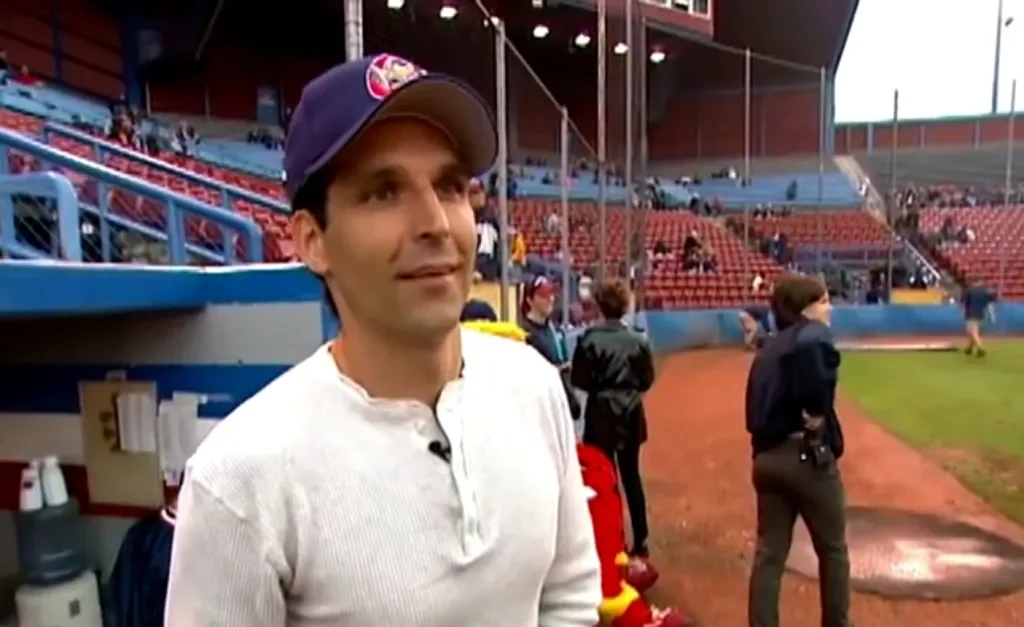
McFarlane visits Foothills Stadium during a scene from The Devil You Know: Inside the Mind of Todd McFarlane.
McFarlane had plenty of sentimental reasons to self-indulge in Calgary baseball. He first met his wife, Wanda, at Burns Stadium, which was previously known as Foothills Stadium. McFarlane was a groundskeeper for the Calgary Cardinals and she was a bat girl for the team when she began to flirt with him in the stands.
The artist signed autographs during the Cannons game and discussed how his life has changed since he bought the McGwire ball.
“Gives people enthusiasm that you can live a pretty long life before you have to give up your boyish way,” he said.
“I’m doing all the things that I think the average person who’d won the Lotto would be doing.”
GOING ON TOUR
As promised, “The McFarlane Collection” went on a tour of baseball stadiums, starting with a June 4, 1999 opening date at Dodger Stadium in Los Angeles, where McFarlane took part in batting practice.
“Todd is mainly concerned that the balls get out to the public,” said Donna Meier, senior partner at Javelin Inc., the company responsible for managing the tour.
The exhibit included a 24-foot, double-sided wall between two archways that displayed the baseballs, while video monitors rotated through a series of photos from The Sporting News. Sound effects featured cheering crowds and play-by-play broadcasts.
“There are two armed guards at each event, one at each end,” said Rick Kargus of Pingel Displays, who oversaw the production of the exhibit.
Another security measure was the installation of four photoelectric beams that sounded ear-piercing alarms if they were broken, as well as shock sensors.
The ALS Foundation, which supported research into Lou Gehrig’s disease, received proceeds from the tour.
“All I’ve done is what any real fan would do. I’d hope that, if some other die-hard baseball fan like me had bought the balls, he would have done the same thing,” McFarlane told the Vancouver Sun newspaper during a September tour stop in Las Vegas.
The Nevada stop saw McFarlane take batting practice at Cashman Field ahead of game three of the Triple-A World Series between the Vancouver Canadians and the Charlotte Knights. The Canadians ultimately won the championship in five games, thanks in large part to a complete game victory by pitcher Mark Mulder in the final game.
A FOOL AND HIS MONEY
McFarlane was living the good life at the turn of the century.
His collection of hugely popular baseballs was on tour, his Freak on a Leash video for Korn won a Grammy Award in 1999, and he was selling millions of action figures.
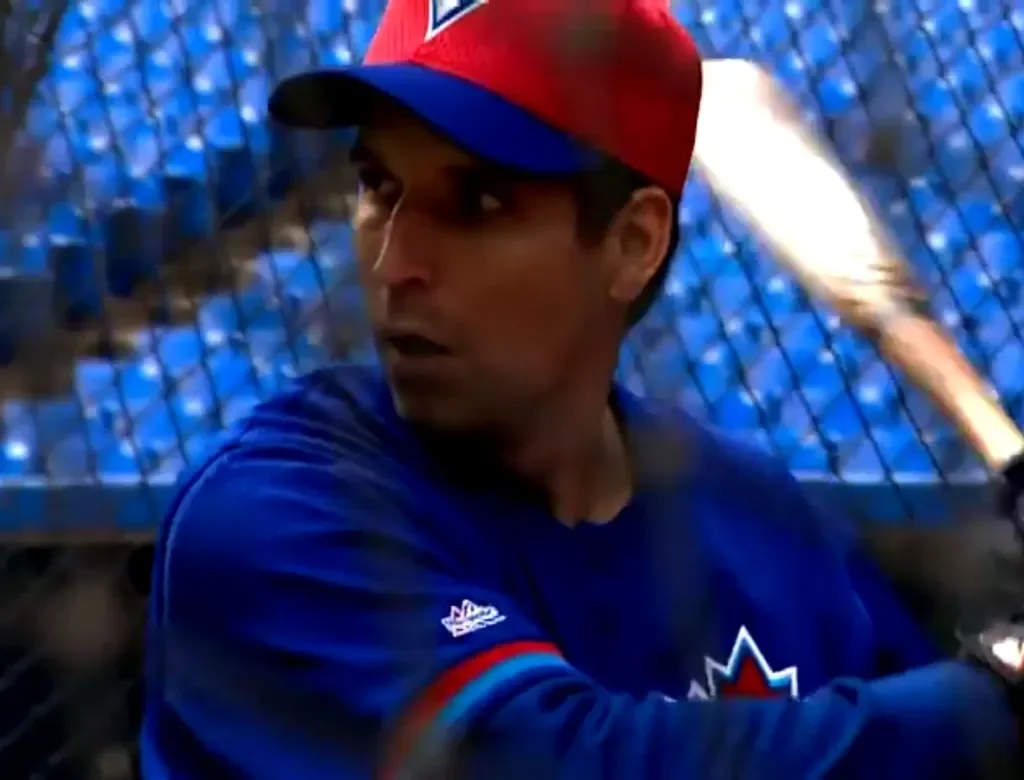
McFarlane takes batting practice at the Skydome in a scene from The Devil You Know: Inside the Mind of Todd McFarlane.
Then along came Barry Bonds in 2001.
McFarlane had mentioned on several occasions how his purchase of McGwire’s 70th home run was a massive bet, a wager that the record would stand the test of time.
But what happens if another big-biceped ball player surpasses the record set by the strongman with the St. Louis Cardinals?
“Then I drop my head on my shoulder and I slink off and I look like a bigger fool than I do today,” McFarlane said during a newspaper interview in March of 1999.
“Somebody hits 71, and I’m the fool who owns a $5 baseball but paid three million bucks for it.”
He added: “I just made the biggest bet in the country, in North America, in the world, that it won’t be broken. If I thought there was any chance of that record being broken, then I just foolishly spent a lot of money on something that I know will become immaterial some time in the future.”
McFarlane’s gamble seemed safe in the summers that followed. McGwire and Sosa were at it again in 1999, but McGwire finished with 65 round trippers and Sosa ended up with 63, thus preserving McFarlane’s investment for another year.
The 2000 MLB campaign was even less homer happy. Sosa led all sluggers with 50 bombs, while Bonds finished just behind with 49 dingers.
The 49 home runs for the left fielder with the San Francisco Giants were a career best total, so what happened in 2001 seemed impossible.
Bonds achieved the unthinkable that season and finished the year with 73 home runs. He accomplished the feat while drawing a major-league record 177 walks.
The value of McFarlane’s McGwire ball was suddenly greatly diminished.
Yet, McFarlane didn’t slink off like a fool. Instead, he doubled down on his collection of baseballs.
When the 73rd home run ball of Bonds went up for auction in June of 2003, McFarlane bought it. And this time it came much cheaper.
“I knew it would go for a fraction of the other ball,” said McFarlane after paying $517,500 for the baseball, including commissions.
This auction, conducted by Leland’s, took place at the ESPN Zone restaurant in New York’s Times Square. There were 12 registered bidders and McFarlane made offers again via phone. The minimum bidding began at $200,000 and increased by $25,000 increments.
“It’s not that this ball came cheap … it’s that the McGwire ball was overpriced. If it weren’t for me and another guy, the McGwire ball would have sold for $1.3 million.”
McFarlane didn’t appear gun shy after that purchase either.
The Bartman ball – a foul ball that deflected off of fan Steve Bartman and prevented Chicago Cubs left fielder Moises Alou from recording a crucial out in Game 6 of the 2003 National League Championship Series at Wrigley Field – went to market in December of that year.
This time, however, McFarlane’s bid of $88,303 was surpassed by Grant DePorter, who shelled out a total of $113,824 for the cursed collectible. He bought in on behalf of Harry Caray’s Restaurant Group.
“This is the first time I had to put my hand down (in an auction) and say, ‘No, I don’t win this one. I’m out,'” said McFarlane following the auction.
The ball was publicly detonated on Feb. 26, 2004 in an attempt to rid the Cubs of yet another curse that prevented the team from winning a World Series.
STILL AT IT
McFarlane remains plugged into the baseball collectible market.
During a 2024 interview with The Athletic, he was considering buying a Shohei Ohtani artifact – the 50th home run ball from the Japanese superstar’s season that saw him record 54 homers and 59 stolen bases to become MLB’s first 50/50 player.
“I’ll tell you what my interests are in (baseballs) and the Ohtani 50/50 ball falls into that category,” said McFarlane.
“It’s records that are done in a season, not in a career. Because a career, somebody can play 15 years and then somebody can play 22 years and beat you by one because they (played) seven more years. For me, the great thing about season records in any sport, is that everyone gets a reset. If you don’t break that record, everybody gets reset to zero the next season and you try it again. But there’s a start and a finish, which is a season … so, Ohtani, doing what he did, 50/50, now the race is, can somebody do it again? I don’t know. Will Superman come along and do 60/60? hard to imagine.”
McFarlane also said he had no interest in Aaron Judge’s 62nd home run ball from 2022.
“I have the Major League record ball. I’m not looking for the American League record,” he said.
“What Ohtani did was a Major League record and I think there’s a tremendous value, plus he’s sort of the hot topic in baseball. He’s the face of MLB.”
From McGwire mania, McFarlane spawned madness.
Where the baseball market goes from here, may be completely up to him.