
Antonacci: Late Canadian Baseball Hall of Famer Asay was “superhero” on field and in forestry field
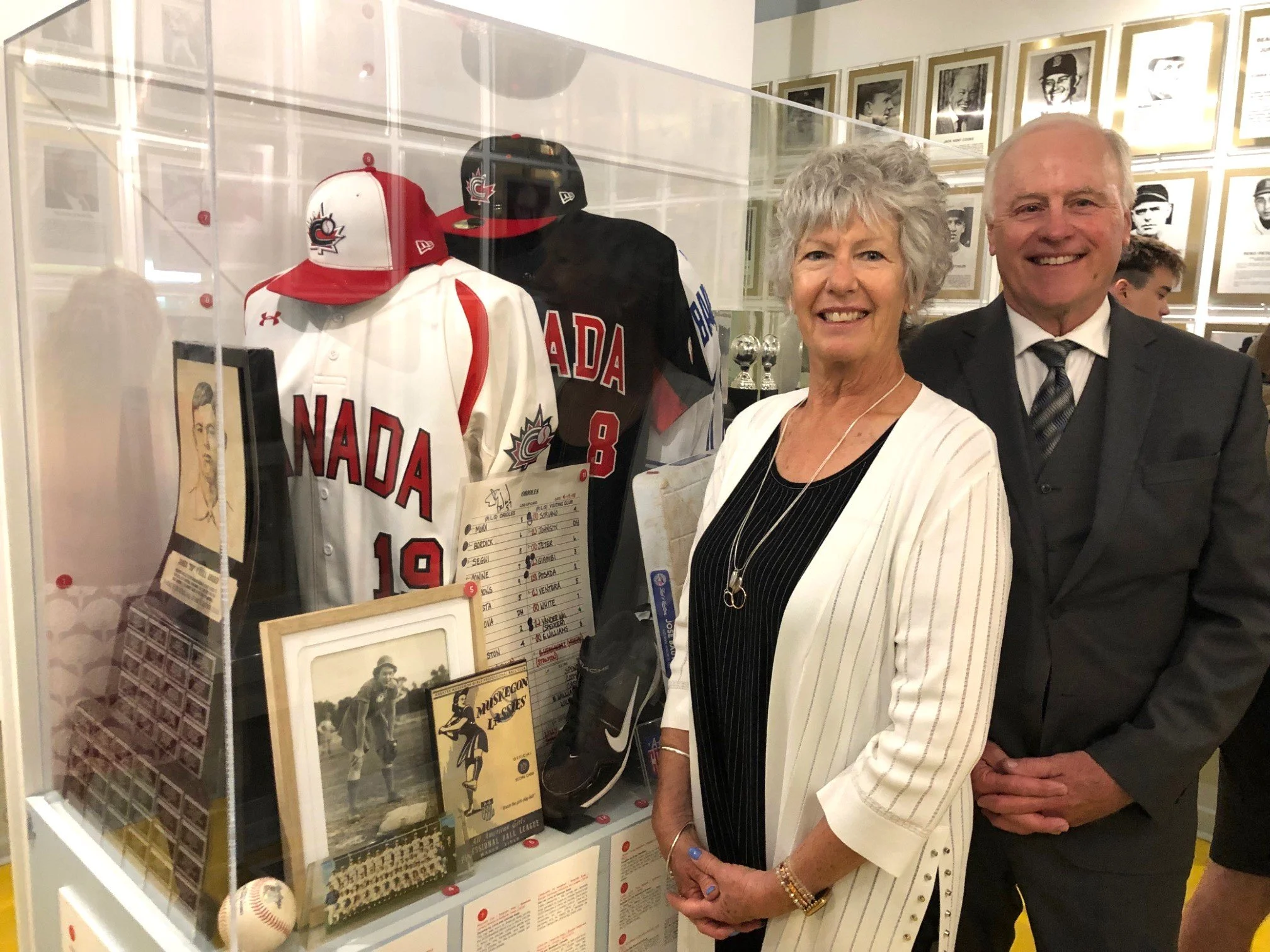
Loris, left, and George Asay stand by a display case containing their daughter Amanda’s cleats and white Team Canada jersey inside the Canadian Baseball Hall of Fame and Museum in St. Marys, Ont. Photo by J.P. Antonacci
June 7, 2025
By J.P. Antonacci
Canadian Baseball Network
On the rare occasion young Amanda Asay balked at doing her homework, her parents knew just what to do.
“Well, we had the hammer – if you don’t do your homework, you don’t go to ball,” George Asay said with a smile.
It was an ultimatum the Asays hardly ever had to issue, since the future Women’s National Team star was as keen about her studies as she was about baseball.
“She was awesome,” said George, who as Amanda’s first coach put a swift end to pushback from some boys skeptical about playing with a girl.
“She had a coach that wouldn’t tolerate any of that,” George smiled. “You were not to badmouth any teammate.”
The chirping quickly ceased when five-year-old Amanda outshone boys and girls several years her senior. From the diamonds of Prince George, B.C., to the podium at the Pan Am Games, Asay’s skill always spoke for itself.
She joined Team Canada in 2005 as a 17-year-old and a year later earned MVP and all-tournament honours at the Women’s Baseball World Cup. Many highlights followed over her 16 years on the national team, including five World Cup medals and a silver medal at the 2015 Pan Am Games.
As fearsome on the mound as she was at the plate, Asay was ranked the seventh-best female baseball player in the world in 2017 – the only Canadian on Baseball America’s list – and twice was named the Women’s National Team player of the year.
Off the field, she studied trees.
While taking human biology at Brown University in Rhode Island thanks to a hockey scholarship, Amanda became taken with the work of Dr. Suzanne Simard, a professor at the University of British Columbia who studies forest ecology and plant intelligence.
Asay decided to turn her academic attention to understanding how trees communicate with each other and share nutrients through underground networks of fungi.
“She was in human biology, so the whole forestry realm was a new thing for her,” George Asay said.
“But if you know Amanda, she can get excited,” Loris added. “If you hear Suzanne speak, she’s very passionate. So Amanda, I think, took on that passion.”
Asay followed her passion to UBC to work with Simard, who supervised Asay’s graduate work in forestry.
Under Simard’s tutelage, Asay gathered data to prove so-called “Mother Trees” direct a higher proportion of nutrients to their genetically similar offspring – essentially finding that trees play favourites in the forest.
“Only Amanda could have pulled off the work – her big beautiful brain and heart sorting out the many nuances and interactions between related and unrelated trees, exploring the kind of intricate relationships that make forests so fascinating,” Simard said of Asay’s research in an online tribute on the UBC website.
Spending her academic life tending to seedlings in the woods was a perfect fit for their nature-loving daughter, George told Canadian Baseball Network.
“Oh yeah, she was very outdoorsy,” he said. “She loved camping, hiking, kayaking, snowshoeing – anything outdoors.”
Asay completed her PhD in forestry in 2019 but was not the only doctor in the Team Canada clubhouse.
“That 2018 team had more degrees than a thermometer,” George said, listing off a medical doctor, plastic surgeon and fellow forestry specialist among Amanda’s highly educated teammates.
“So it would’ve been very intimidating for a manager to deal with this academic group,” George laughed.
The national team was “a very closeknit group” that pushed each other to excel on the field and in academia, Loris added.
“Because women don’t get paid (to play ball),” she said. “You’ve got to do something.”
As her playing days wound down, Asay got into coaching and discovered a new passion while instructing young ballplayers at camps in Cuba, Toronto, Nelson and back home in Prince George.
“It became so natural for her,” Loris said. “She could take the kids and just have them become very excited about the sport, because she was.”
George said he was “amazed” to see rambunctious kids become “glued” to Amanda as she took them through their paces on the field.
“After her first day coaching in Nelson, the next day a couple of kids come running up to her (and said) ‘do you know you have a Wikipedia page?’” George laughed.
“They were just awestruck. Because nobody knew she played for the national team. They didn’t know she played NCAA hockey or CIS hockey. They didn’t know she was a doctor. These things all came as news to them.”
After graduating from UBC, Asay got a job in Nelson with B.C.’s ministry of forests as a silvicultural systems researcher. She was outside doing what she loved when she had a skiing accident near Nelson in January 2022 and died shortly thereafter at age 33.
In her online eulogy for Asay, Simard spoke of the “devastating loss” felt by staff and students at the faculty of forestry, where Asay mentored hundreds of students as a teaching assistant.
“Amanda was just like the trees she studied: making the world a better place for us all,” Simard wrote, calling Asay the “anchor” of her research group.
“She was our bright light, our inspiration, our grounding, our solace. She always had a joke, a wisecrack, and her dimples quick to shoot out a laugh at any moment,” Simard said.
“She was our superhero.”
Baseball Canada’s Women’s National Team program retired Asay’s number 19 shortly after her death, while UBC set up a memorial fund and the Prince George Community Foundation established two memorial awards in Asay’s honour for local students pursuing post-secondary education.
As they looked at their daughter’s jersey and cleats on display at the Canadian Baseball Hall of Fame in St. Marys, Ont., Loris and George Asay reflected on what it meant to see Amanda posthumously inducted on June 7, with fellow inductee Ashley Stephenson and other former teammates on hand to celebrate Amanda and support her family.
“It’s incredible. It’s really hard to put these things into words, right? Because it’s a huge feeling,” George said. “It still hasn’t totally sunk in. It’s baseball royalty up there, you know? And she’s in with them.”
Loris said the whole experience was “very emotional” for the family.
“I just wish she could be here. That always comes to our minds,” Loris said. “She so deserves it, and I wish she could’ve been here. Hopefully she’s feeling it.”