
Book Review – Cut to Black: A Legendary Life in Sports (and Maybe a Few Beers) by Rod Black
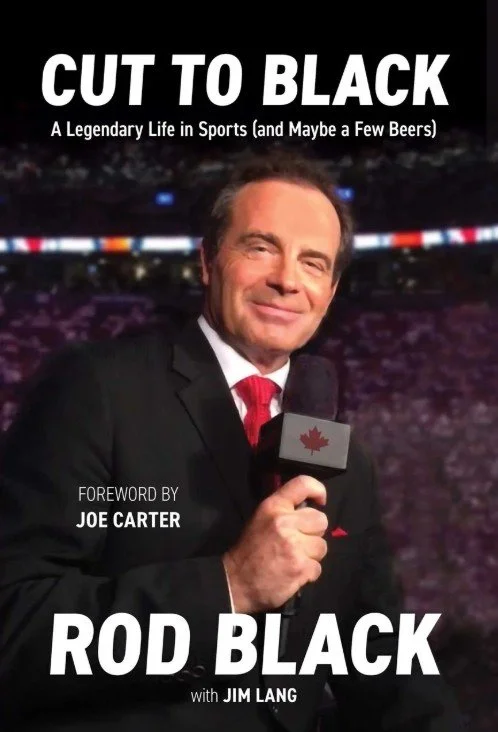
Legendary broadcaster Rod Black reveals in his new memoir that baseball is the sport he is most passionate about.
August 11, 2026
By Kevin Glew
Canadian Baseball Network
Over the course of his long and successful career, Rod Black has broadcast almost every sport.
But baseball is the sport he's most passionate about, he writes in his excellent new memoir, Cut to Black: A Legendary Life in Sports (and Maybe a Few Beers).
"It's a game I've had a love affair with since my boyhood days in Winnipeg, watching my heroes like Pete Rose, Johnny Bench, Reggie Jackson and Rod Carew (who earned my affection through our shared first name)," writes Black.
Many Canadians, however, know Black best for calling other sports. He has broadcast everything from golf to alpine skiing, from boxing to figure skating. He has hosted Winnipeg Jets games, Toronto Raptors telecasts and CFL coverage.
"Give me a sport, I am sure I have called it," writes Black. "And that includes pickleball, which I called off a stream."
So, it's not surprising to learn in his heartfelt and engrossing new memoir that he grew up in Winnipeg, obsessed with sports.
Black was a talented athlete during his youth, especially on the basketball court where he came close to attending Bemidji State University, a Div. II college in the U.S., on a scholarship before enrolling in the Red River Community College Creative Communications program.
In the book, Black shares that he grew up with two loving parents, Jack and Bonnie, and younger brothers Derrick, Sean and Ryan in the Winnipeg suburb known as Transcona. He played and watched as many sports as he could and he found himself mimicking the great broadcasters he heard – like Foster Hewitt, Danny Gallivan, Vin Scully, Howard Cosell and Don Chevrier.
"It may sound like crazy stuff, but I did that almost every day with every sport," writes Black. "I'd be on the rink, in the field, on the diamond, or in the street and I'd find my special place, tune into the broadcast booth in my brain, and then do what every kid should do – play and dream."
Black's first paid broadcasting gig was as a DJ at a local roller-skating rink. He then added a second gig at the Golden Oak, a local bar which unbenownst to 17-year-old Black, sometimes transformed into a strip club.
Word of Black's talents spread and in 1982, at the tender age of 19, he was hired by CKY-TV, a Winnipeg station, to be a sports reporter and late-night anchorman. Shortly thereafter, he became the host of the station's Jets' telecasts. It was while doing this that he met Gus Badali, Wayne Gretzky's agent, who encouraged him to move to Toronto to enhance his career.
Black eventually took Badali's advice. In November 1990, he was hired by CTV Sports in Toronto. Early on in his Toronto tenure, he shared a condo with Maple Leafs defenseman Dave Ellett. The home became party central for Leafs players with Black a very willing participant - so much so that Black received an angry answering machine message from Maple Leafs head coach Pat Burns asking him to tone things down.
"Just do me a f-ing favour: Make sure my f-ing defenceman gets some f-ing sleep at f-ing night," Burns' message said in part.
Black did settle down and became a star for CTV Sports.
In 1991, he got one of his dream jobs when he became the host of Toronto Blue Jays games on CTV.
On December 5, 1990, the Blue Jays dealt Fred McGriff and Tony Fernandez to the San Diego Padres for Joe Carter and Roberto Alomar in a blockbuster trade. So, 1991 was an exciting year for Black to work his first spring training.
"The most difficult decision I had all day was whether to use a 25 or 50 SPF for my sunscreen," writes Black in an example of his engaging writing style. "If any reporter complained to me about the grind of reporting from spring training, I immediately wanted to kick them in the shins."
That same year, Black hosted CTV's coverage of the MLB All-Star Game played at SkyDome in Toronto for the first - and, so far - only time.
Black recalls speaking with Joe DiMaggio and Ted Williams before the game.
"For a young TV guy from Winnipeg who had dreamed about being in the big leagues, that whole night could not have been any cooler," writes Black.
One of the best stories Black shares illustrates his superhero-like devotion to his job.
In late July 1991, the Blue Jays had an afternoon game against the Chicago White Sox. Black didn't have to be in the downtown CTV studio until the middle of the fifth inning, so that morning he agreed to make an appearance for the network at the Lionhead Golf Club in Brampton, Ont., to promote an upcoming skins game.
But Black lost track of time and didn't leave the golf course until 11:30 a.m. On a good day, it was a 45-minute drive from Brampton to the CTV studio.
Black was making good time until he hit Lakeshore Boulevard where traffic was at a standstill. After barely moving for 30 minutes, he called his producer on his big clunky car phone to reassure him he'd still be at the studio on time.
But half an hour later, traffic was still stalled and the game was moving along quickly.
"It was in the top of the second inning when I decided I had to make a move," writes Black. "Desperate times call for desperate measures, I pulled over to the shoulder of the road, got out of the car still wearing my golf clothes, grabbed my suit, which was on a hanger, and then dashed through the maze of cars. People were probably wondering where this nutbar had come from and where he was going.
"I clumsily hurdled the concrete barrier and then, like a scene from Tom Cruise's Mission: Impossible, I had to dodge traffic going full speed the other way to make it across the road. I vaulted over another cement wall, continuing my sprint uphill for another kilometre until I hit a major intersection where I was fortunate enough to be able to hail a taxi."
His taxi would set "a land speed record" and get him to the front of the CTV building before the start of the bottom of the fourth inning.
He ran inside, mopped off the sweat, managed to get his shirt, tie and jacket on and did his studio job in the fifth inning wearing his golf shorts and spikes under the desk.
"Craziest thing of all is that around 6 p.m., when I returned to Lake Shore, fully expecting my car to have been towed away, there she was, still on the shoulder, middle of rush hour – no tickets, no damage, just waiting for me to take her home," writes Black.
Now that's devotion to a job, and also just one of the fantastic behind-the-scenes tales Black shares in the book with his natural story-telling flair.
Serving in a similar role on Blue Jays' broadcasts the following season, he got to experience the club winning their first World Series. The Blue Jays captured the title in Game 6 in Atlanta and Black was dispatched to the clubhouse to conduct interviews amidst the champagne showers.
He was in the middle of the clubhouse again the following year when the Blue Jays captured their second consecutive championship.
In the book, Black recalls that prior to Game 6 – in which Joe Carter would belt his walk-off World Series-winning home run – the Blue Jays slugger winked at him and said, "Rodney, we got this."
And that wouldn't be the last of Black's baseball highlights. In 1999, CTV Sportsnet (neither Sportsnet or the Blue Jays were owned by Rogers yet) secured the rights to a few dozen Blue Jays games and they asked Black to do the play-by-play, alongside Joe Carter (who has become a close friend and wrote the book's Foreword).
Black would later slide over to TSN and call Blue Jays games with Pat Tabler.
Black also includes a poignant passage about what it was like to watch his son, Tyler, make his major league debut with the Milwaukee Brewers.
And, of course, there's much more to Black than his great baseball stories. Black writes humorously about his life in broadcasting and the characters he has befriended, including Charles Barkley. He has interviewed presidents and prime ministers. And he even devotes a page to his legendary, trademark moustache.
"People tell me to this day, 'I don't recognize you without your moustache,'" writes Black. "Meanwhile, I haven't had one for twenty years."
Towards the conclusion of the book, Black is refreshingly candid about the callousness of the sports media industry in Canada. He sheds light on the ruthless way TSN/Bell Media let him go after more than three decades with them.
But the charismatic 63-year-old Black ends the book on a more positive note.
"My entire life has been about sports," he writes. "From my childhood to the present day. To this day, I will cover and announce for whatever sport and whatever game comes up. Because I love them all. Have microphone, will travel!"
And Canadian sports fans are fortunate that he will. Because not only have we have been lucky enough to witness his extraordinary career for close to four decades, but now he has pulled back the curtain on it for us in this heartfelt and hilarious memoir.
You can purchase the book here.