
Elliott: Remembering Tim Harkness -- Updated
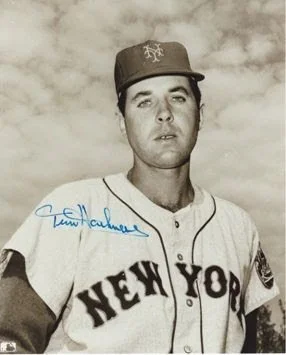
Former New York Mets Tim Harkness, born in Lachine, Que., spent two years with the Los Angeles Dodgers and two with the New York Mets.
December 1, 2025
By Bob Elliott
Canadian Baseball Network
Tim Harkness could light up a room.
He could brighten a major league clubhouse as he did with the New York Mets and Los Angeles Dodgers. Ditto for the Toronto Maple Leafs of the Intercounty League clubhouse at Christie Pitts.
At a Major League Scouting Bureau camp or an indoor workout, he was easy to find ... he was seated in the laughing section and it was Timmy telling the stories which created the laughter.
Timmy would always say how he didn’t know pitching and could not evaluate pitchers. But he spotted RHP Shawn Hill (Georgetown, Ont.) at a camp in Milton in 1999 and he was throwing over 90. Timmy drafted him in the 33rd round of the draft. Hill did not sign.
The next winter, at another camp Hill’s velocity jumped. He was the stud of the night due to his increased velocity. After the workout the scouts went to eat.
“How about Shawn Hill, wow, and to think I offered him $10,000 last summer,” Timmy lamented.
Someone at the other end of the table joked “but Timmy all he wanted was $10,500.” Of the 12 people at the table, the person who laughed the most and the loudest -- eventually -- was Timmy.
In 2000, Montreal Expos scout Alex Agostino (St-Bruno, Que.) took Hill in the sixth round and gave him a six-figure bonus. Hill pitched seven years in the majors making 44 starts for the Expos, Washington Nationals, Toronto Blue Jays and San Diego Padres.
Both Harkness and Agostino won Canadian Baseball Network scout of the year honours.
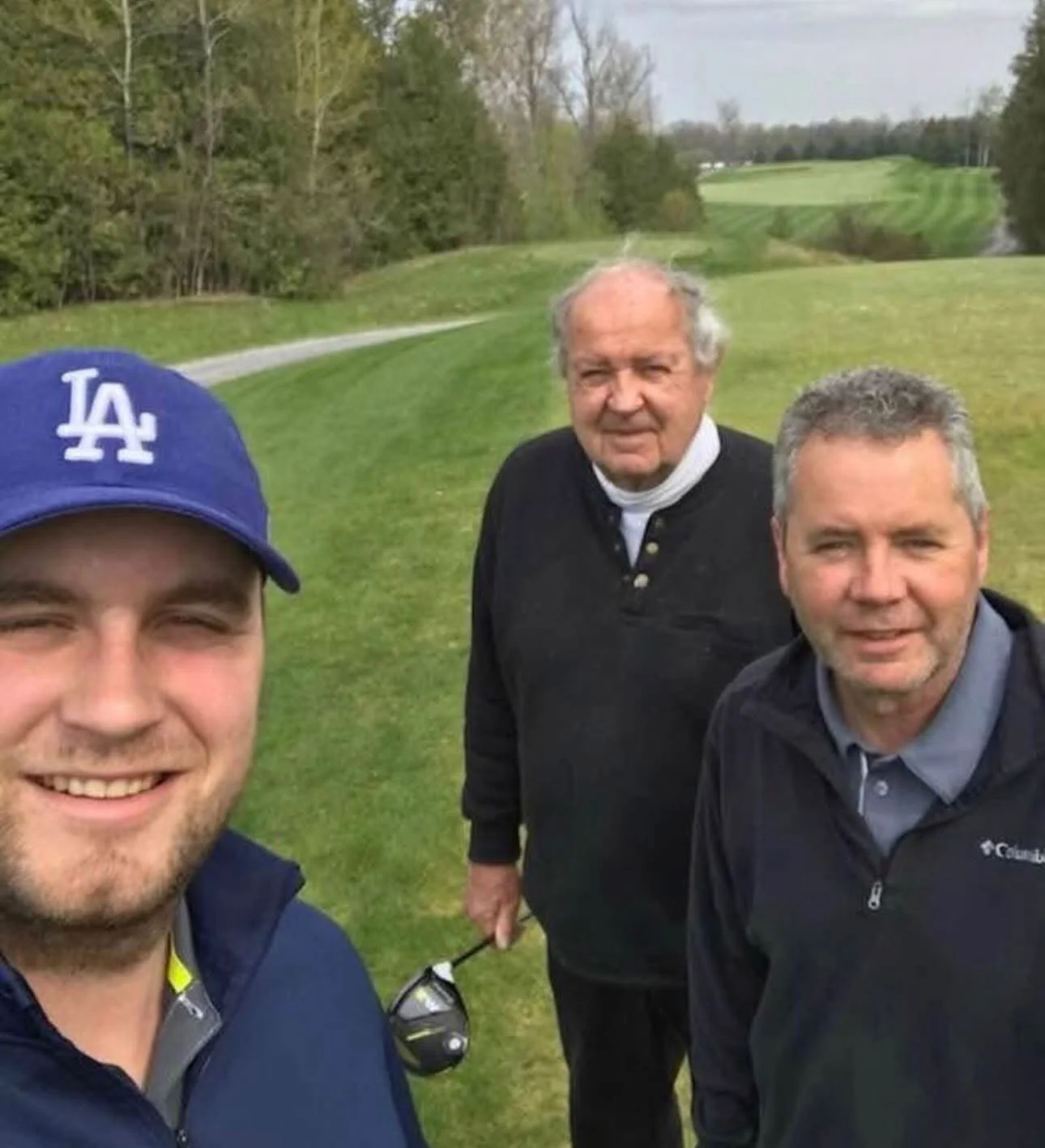
Brodie Harkness, left, grandpa Tim Harkness and Tim Harkness, Jr. on a golf outing.
* * *
ARE YOU TALKING TO ME? _ Timmy showed up for a fall league game for the Padres in Burlington in 2002. Jim Ridley (Milton, Ont.) of the Minnesota Twins, Rick Birmingham (Sarnia, Ont.) of the Dodgers and Ed Heather (Cambridge, Ont.) of the Blue Jays and I were standing behind the backstop long after the game was over.
I complimented Timmy, who had finished his first year managing the ball Leafs at Christie Pitts for not showing in the headlines. “I didn’t read where you got kicked out once, I’m glad to see you have mellowed.”
Timmy explained how he almost got into a bench clearing brawl during a game against London and as he explained it, his volume level went it.
“I TOLD THAT BIG PALOOKA, YOU COME HERE AND SAY THAT AGAIN TO ME ... I”LL KNOCK YOUR BLOCK OFF.”
The scouts and I were listening, enthralled when all of a sudden in this empty ball park (first and third base dugouts were empty) the groundskeeper raking the plate area maybe 50 feet away began yelling at Timmy “YOU TALKING TO ME?”
Our group laughed and Ridley said, “Timmy, you are the only man I know who can almost get into a fight in an empty ballpark.”
Timmy had moved to Oshawa and eventually Courtice.
* * *
Does Lasorda belong in the Cooperstown? _ Timmy grew up in Lachine, Que. and played triple-A for the Montreal Royals. When his teammate Tommy Lasorda was elected to the Hall of Fame by the veteran’s committee in 1997, there were lots of arguments: Did Lasorda belong?
We called Timmy to ask.
The Royals were the first team to go to Havana after Fidel Castro ousted the government of Fuelgencio Batista on New Year’s Eve 1958. The Royals arrived the third week of April 1959 to play the Sugar Kings. They found parked cars riddled with bullets. Armed guards patrolled sidewalks and were stationed at each end of the dugout at Havana’s Pan-American Stadium.
With the Royals holding a three-run lead in the bottom of the ninth, the Sugar Kings loaded the bases, bringing up OF Tony Gonzalez, who later played for the Phillies.
“These guards, great big lugs, who had been in the jungle for months, are in our dugout with automatic weapons,” Timmy said. Gonzalez hit a ball deep to left. It was home-run distance easy, but the ball curved foul.
Players in the first base dugout who could see down the line sat back, relaxed. Whew. Close call. Except the crowd in right field and centre kept cheering and cheering. Timmy said they looked at the ump, an American. Suddenly, he was signaling a homer. Grand-slam. Montreal loses.
“The crowd intimidated him,” he said.
The manager of the Royals was 6-foot-4 Clay Bryant, who, incensed, leapt off the dugout bench and cocked a fist to punch the air in disgust. As he threw his punch, a soldier stuck his head around the dugout post.
Down went the guard as if felled by Mike Tyson. Stunned, the guard jumped up. Screaming in Spanish, he pointed his gun at Bryant and the rest of the Montreal dugout.
“I was beside the post,” Timmy said. “The guard had his gun pointed at me. All he knew was that he’d been hit and he was ready to spray the dugout. I froze.
“All of a sudden from the other end of the dugout comes Tommy running, talking in Spanish, telling the guy it was an accident, how Bryant was upset at the ump,” Timmy recalled. “Tommy was the only guy in the dugout who spoke Spanish. Finally, the guard calmed down. We were upset at the call, but it could have been worse ... if not for Tommy.”
A dominant triple-A pitcher, Lasorda became a fair manager, a dominant major-league talker, story-teller, motivator and first man out of the dugout after a walk-off win. Bobby Cox, Cito Gaston, Tom Kelly, Tony La Russa and the like would turn and shake the hands of their coaches. He wasn’t perfect.
* * *
A Baseball family _ Timmy told me he learned the game from his grandfather Bill, saying “My grandfather from Ireland studied all the sports when he came over, he thought baseball was the most demanding sport to play. He grew up with soccer, but said baseball was the greatest, because of the split-second timing required.”
My grandfather said “to play the game it took the eyes of an eagle, the heart of a lion and the reflexes of a cat.” Timmy passed the love on to his family and the next generation.
He read about BALCO, about Barry Bonds and about steroids.
“This is all greed, to raise stats,” Harkness said. “This is a slap in the face to Ted Williams, who missed five years and still hit over 500 homers. This is a slap in the face to Willie Mays. I played against Mays. Bonds is no Willie Mays.”
Timmy remembers going to spring training with the 1957 Brooklyn Dodgers at 6-foot-1 “and a half,” 187 pounds. “Everyone of those Dodgers who walked by me -- Carl Furillo, Gil Hodges, Duke Snider, Andy Pafko, Frank Howard -- made me feel like a midget. Those guys never lifted any weights. They lifted beer bottles.”
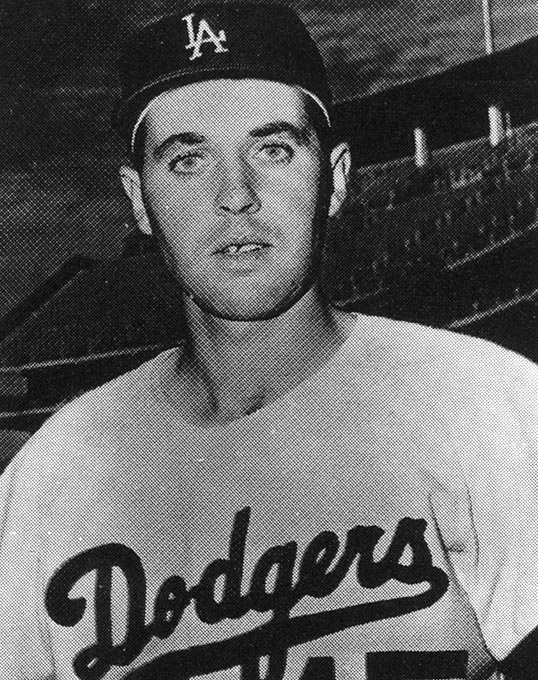
Timmy played 1961 and 1962 with the Dodgers and then was with the Mets in 1963-64 for Hall of Famer manager Casey Stengel.
“I was fortunate enough to play against Hank Aaron, Stan Musial, Roberto Clemente and Don Newcombe, they never needed any help,” Timmy said. “In our day, we did not see opposite field homers.
“This hurts the game of baseball. The thing that bothers me is that some guys have busted their end, lifted weights, improved now they are being slighted,” he said. “Taking steroids is like playing Russian roulette with your body.”
Timmy was an excellent storyteller. Like when Hall of Famer Duke Snider, stuck on 399 homers, hit his 400th career homer wearing a Mets uniform. There was little fanfare for the momentous achievement on the sad-sack team. Jimmy Piersall, who had 99 homers, promised he’d do something special when he reached triple figures and he did. Piersall hit No. 100 and toured the bases running backwards. On Piersall’s baseball card, Timmy the on-deck hitter is trying to shake Piersall’s hand.
Timmy told stories about the Dodgers’ 1963 season. How the Dodgers won 102 games and failed to win the National League pennant. The Dodgers were up four games with seven to play and lost. How reliever Stan Williams wouldn’t pitch, Don Drysdale rushed to the bullpen to pitch in his place and how first baseman Frank Howard struggled the final week.
With coach Leo Durocher attempting to take over the team and players attacking manager Walter Alston to the point of pounding on the door to the manager’s office with bats. Timmy told stories about actresses Doris Day, Ann Margaret, Tina Louise and Juliet Prowse attending parties with Dodger players.
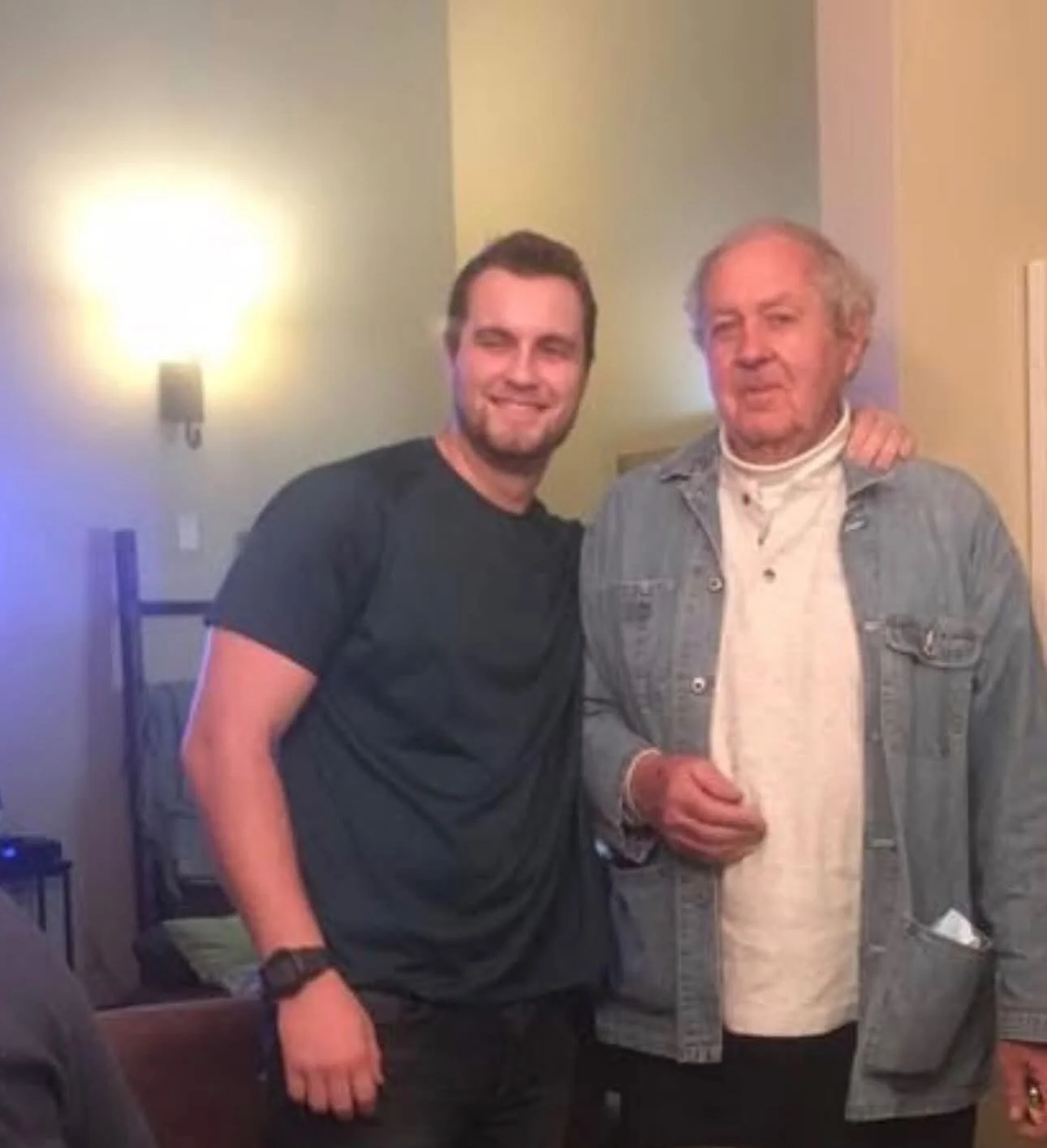
Brodie Harkness and grandpa Tim.
* * *
What’s wrong with his swing?: One wintry Sunday night I met Timmy at the Mini-Domes in Oakville. We went to see Bobby Smyth’s team work out.
Three of us were standing behind one of the cages -- Timmy, myself and an unknown father. I asked Timmy who was the hitter?
“Well, that’s Ryan Hay from Niagara Falls, I saw him last fall and liked his swing,” Timmy said. “But Smyth changed him and has ruined it.”
About five minutes later along came Smyth and Timmy greeted him with: “Bobby what did you do to Ryan Hay’s swing, you ruined the poor kid.”
Smyth replied elbowing the man we did not know, “Timmy. I want you to meet Ryan Hay’s father.”
* * *
Timmy the prankster: A regular at the Shrine, known as Talbot Park remembers Howie Birnie working the canteen during a game. A woman from Kitchener arrived to complain about people near her smoking.
Seated in a chair near by was Timmy. He had a lit cigar at his side. As the lady complained, Timmy would take a haul on his stogie and blow smoke into the conversation.
There was laughter all around — after the woman departed.
* * *
Remember the Night: My friend Steve Hirdt, a New Yorker, emails memories from his youth:
As a grade-schooler, I went to a Mets game against the Milwaukee Braves at the Polo Grounds in September 1963. It lasted 16 innings and the Mets won, 6-4, on a game-ending homer by Harkness.
Earlier that season, on June 26, Harkness came up in the bottom of the 14th against the Cubs, with the Mets trailing 6-4, with two outs, the bases full and a 3-2 count. He hit a grand-slam homer to win it, 8-6.
Pretty good in the clutch. By the way, I remember seeing a Mets fan carrying a bedsheet banner addressing this very subject: “Hit One Into The Darkness, Harkness”.
* * *
R. I. P. _ Tim Harkness was 87 when he passed.
His son Tim Harkess, Jr. coached the 16U Elite Oshawa Legionaires as well as the Durham College Lords. Grandsons Dylan and Brodie Harkness loved the game. Brodie pitched for the Junior National Team, the Evansville Purple Aces and Durham.
Deepest sympathies are extended to the Harkness family.