
Glew - Whicker's new Drysdale biography discusses legend's time in Montreal
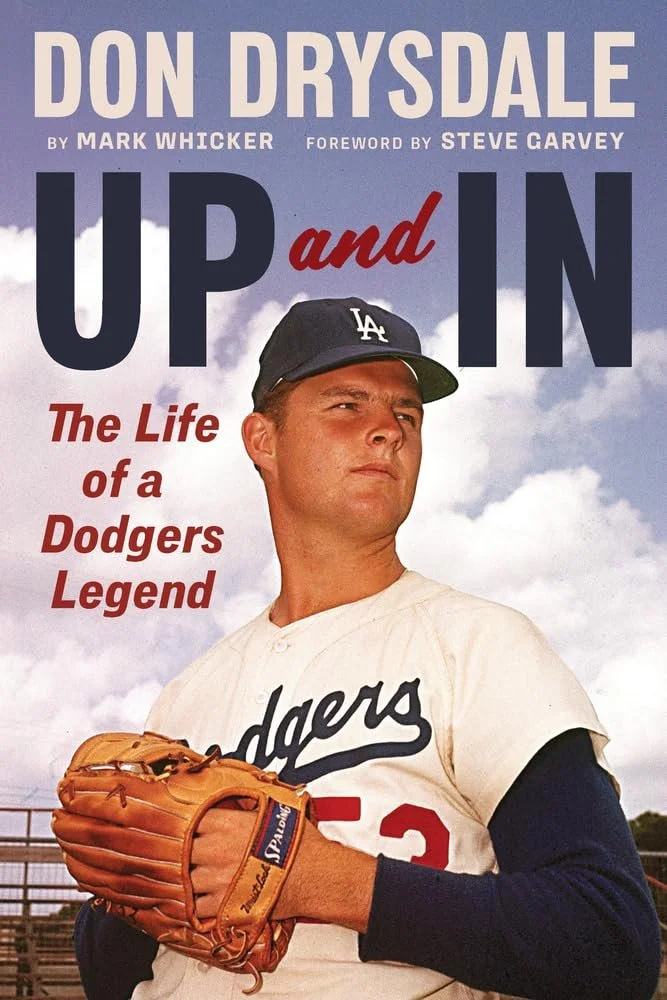
Canadian Baseball Network columnist Mark Whicker recently published an excellent new biography about Don Drysdale. Photo: Triumph Books
September 10, 2025
By Kevin Glew
Canadian Baseball Network
It wouldn’t be much of a stretch to say that Don Drysdale’s career in professional baseball started and ended in Montreal.
As a fiery, fresh-faced teen, he pitched his first full pro season with the triple-A Montreal Royals in 1955.
And sadly, 38 years later, he suffered a fatal heart attack in a Montreal hotel room while he was part of the Los Angeles Dodgers’ broadcast team.
Both Drysdale’s season with the Royals and the night of his death are detailed thoroughly in Mark Whicker’s excellent new book, Don Drysdale: Up and In: The Life of a Dodgers Legend.
It’s a project that was 12 years in the making for the award-winning Whicker, whose resume boasts almost 50 years in sports journalism.
He started researching and conducting interviews in 2013 but a deal for the book fell through before it was resurrected by Triumph Books in 2022.
A longtime sports columnist with The Orange County Register, Whicker was a colleague of Drysdale’s in the Los Angeles media that followed the Dodgers from 1987 to 1993. Most of his recollections of Drysdale come from spring training in Vero Beach, Fla.
“He would get there early and I would try to get there early,” said Whicker. “A bunch of us would have dinner in the pressroom and he’d start telling stories, so I had a pretty good feel for him.”
That definitely seems to be the case. Whicker’s Drysdale biography is definitive and superbly crafted. It’s a page-turner that details the Hall of Fame right-hander's story from his youth in Van Nuys, Calif., to his final day.
Drysdale was signed by the Dodgers in 1954 and he’d pitch half a season with class-C Bakersfield the same year.
He was just 18 when he was assigned to the Dodgers’ triple-A Montreal Royals in 1955.
“That was a big year. He was 18 years old and nobody else on that team was under 23,” said Whicker. “And I think the average age of that team was 28. So, he was by far the youngest guy in the International League that year and he survived and did very well.”
After watching Drysdale in spring training, Royals manager Greg Mulleavy wanted the young righty on his team. Whicker shares that the Dodgers obliged on the condition that Mulleavy would never skip Drysdale’s turn in the rotation.
On multiple occasions that year, Drysdale’s youth showed through his explosive temper. Whicker notes that the teenager was ejected from a game in Toronto for arguing balls and strikes. He also details an incident where after a frustrating 1-0 loss in Havana, Cuba, Drysdale was about to throw a chair in the clubhouse. Mulleavy told him to stop, but Tommy Lasorda, back then an intense, 27-year-old lefty with the Royals, told Drysdale to go ahead and throw it. He thought it would be good for the young right-hander. Drysdale threw the chair and it made a hole in the clubhouse wall.
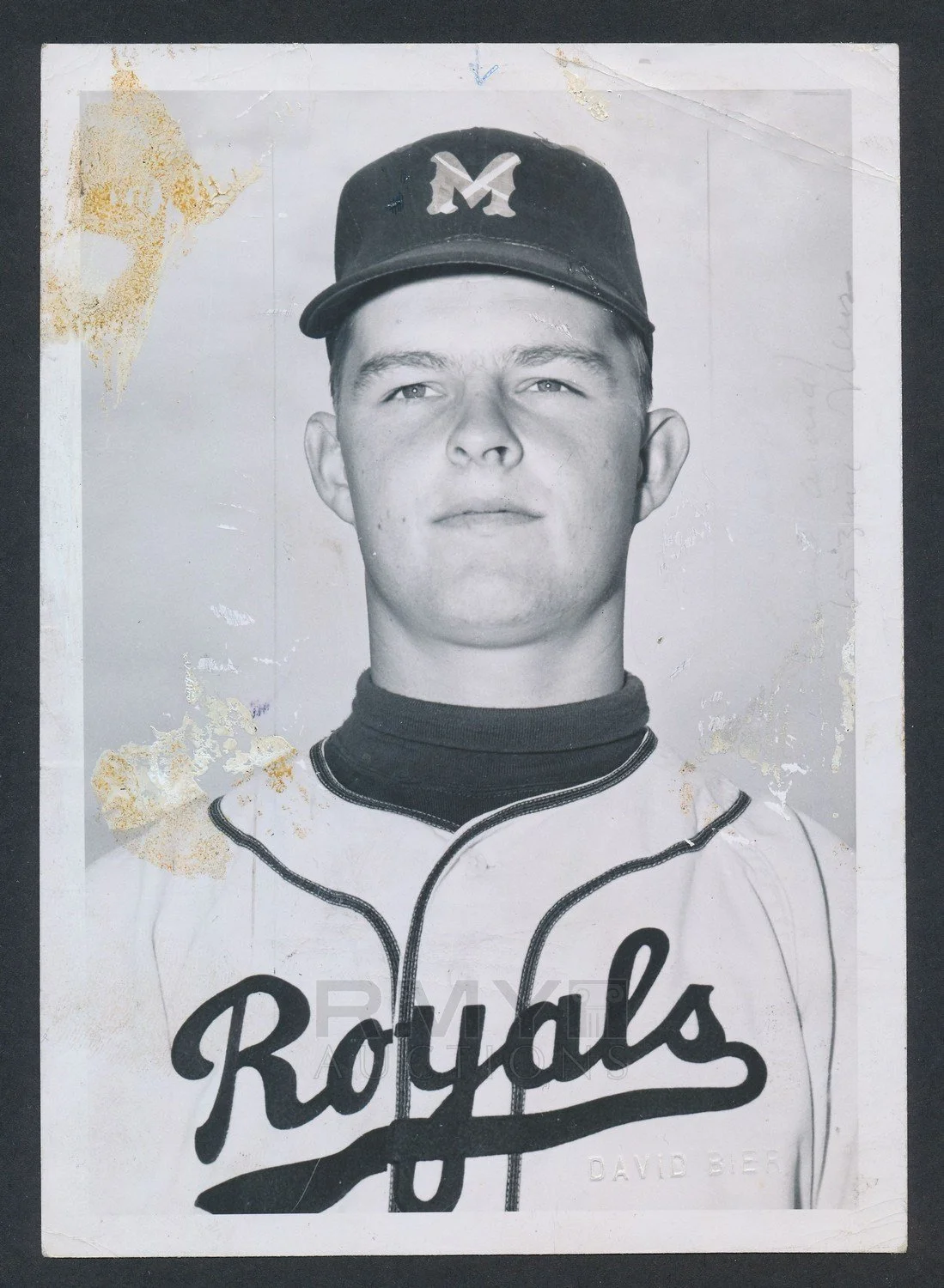
Don Drysdale pitched with the Montreal Royals as an 18-year-old in 1955.
But Drysdale was not similarly surly away from the field. Whicker reports that during Drysdale’s season in Montreal when the young righty was not at the ballpark, he could sometimes be found playing sandlot ball with the kids at Rouen Park. One of those kids was future Montreal Expos broadcaster Rodger Brulotte.
It was also in Montreal that Drysdale developed his “mystery pitch.” It was sometimes described as a “super sinker” or a “knuckle forkball,” shares Whicker, but it was essentially a spitball that was taught to him by Royals’ catcher Johnny Bucha.
Overall, Drysdale’s season in Montreal was a success. In 28 appearances (27 starts), he finished 11-11 with a 3.33 ERA to help the Royals to a first-place finish. Unfortunately, by the end of the season he was suffering from bursitis and was unable to pitch in the playoffs.
Still a teen, Drysdale was impressive in Dodgers’ camp the following spring and he cracked the Opening Day roster. He posted a 2.64 ERA in 25 outings (12 starts) for the Dodgers in 1956, which cemented him a spot in the Dodgers’ rotation the ensuing season.
At 6-foot-5, he was already one of the biggest pitchers of his era, but if that wasn’t menacing enough, Drysdale developed a reputation for throwing his fastball “up and in.” He topped the National League in hit batters five times.
“When Don pitched, hitters had to worry about the inside fastball. They had to worry about the outside breaking ball or slider,” explained Whicker. “And then the spitball was just one more thing they had to worry about.”
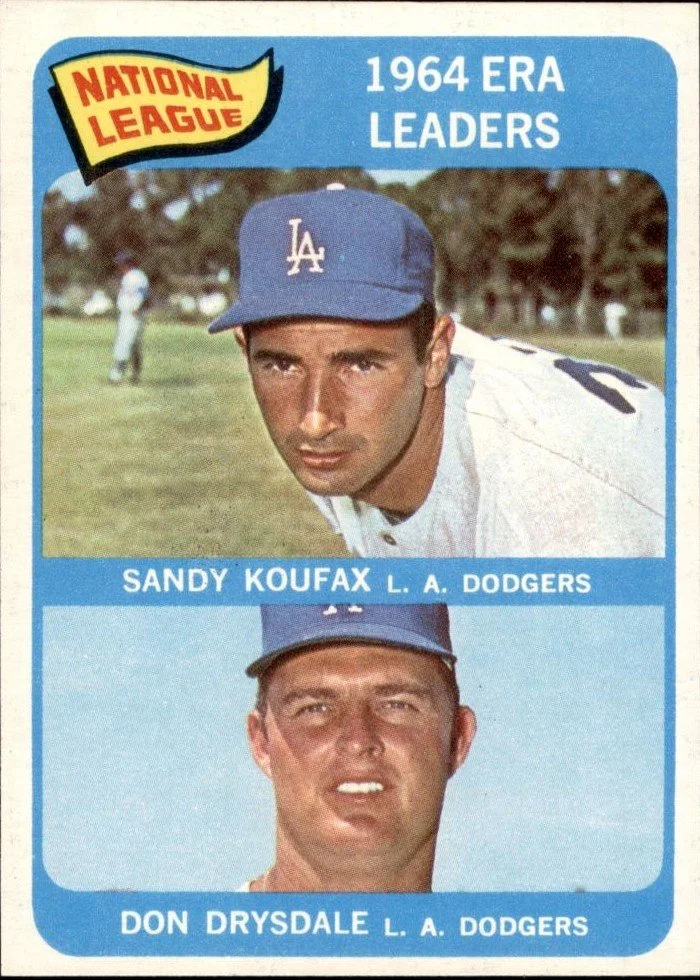
For parts of 11 seasons, Drysdale pitched in the Dodgers’ rotation alongside Sandy Koufax. In the book, Whicker offers insight into the relationship between the two stars. He reveals that rather than be jealous adversaries, the two forged a strong friendship that endured long after their playing days.
In a major coup, Whicker secured an interview with the reclusive Koufax for the book.
“Ann Meyers [Drysdale’s second wife] said Sandy would really loosen up around Don and tell stories, where he wouldn’t show that to many other people,” said Whicker.
Just how close were Koufax and Drysdale?
Close enough that they held out for better contracts together in the spring of 1966. They hired an agent (which was unheard of at the time) and they asked for three-year contracts (also, almost unheard of).
They eventually settled for one-year agreements. Koufax got $125,000 and Drysdale $110,000.
“I think it planted the seed among players that ‘Hey, we do have power,” said Whicker of the holdout. “They [Drysdale and Koufax] were able to shake up the game.”
Another excellent chapter discusses Drysdale’s 58 1/3 scoreless inning streak during the 1968 season. During that streak, Drysdale tossed a remarkable six consecutive shutouts between May 14 and June 4.
Whicker believes the streak is what ultimately got Drysdale into the National Baseball Hall of Fame, but it also expedited the rotator cuff injury that ended the right-hander's career in 1969.
“When he threw six straight, nine-inning shutouts, in retrospect, that took a lot out of him. He had already pitched a lot of innings, but the intensity of that streak. He was going max effort on all of those days,” said Whicker. “And the next year, he just didn’t have it. He tried to pitch, but it was just too much for him.”
Drysdale retired in 1969 at the age of 33, finishing his big-league career with 209 wins, one Cy Young Award (1962) and three World Series rings.
Drysdale then seamlessly transitioned into broadcasting. The Expos hired him as an analyst for the 1970 and 1971 seasons. He then moved on to broadcast with the Texas Rangers, California Angels, Chicago White Sox and, finally, the Dodgers.
In 1986, he married Ann Meyers, a former basketball star. The couple had three children and Drysdale’s friends said they had never seen him happier.
“He had straightened his life out. He was a family man. He was very dedicated,” said Whicker.
This is what makes July 3, 1993 such a sad day.
After broadcasting the Dodgers/Expos game that night at Olympic Stadium, Expos play-by-play man Dave Van Horne waved goodbye to Drysdale as he got on the metro to go back to his hotel, shares Whicker. It would be the last time Van Horne would see Drysdale alive.
When Drysdale, just 56 at the time, didn’t show up for work the following day, his colleagues and Dodgers staff grew concerned. Bill DeLury, the Dodgers’ travelling secretary, went to the hotel and had hotel staff break open the door to Drysdale’s room.
They found Drysdale’s body lifeless and bloody. A drawer was open. Perhaps Drysdale, who had a history of heart issues, had bumped his head on it when he fell. It was estimated that he had died at midnight.
The Dodgers scrambled to contact Ann who was in transit to a birthday party with her children. Scully made sure that Ann had been told of her husband’s death before he announced it on air.
“I remember Vin’s voice that night was different than any other game he ever did,” said Whicker. “He clearly didn’t want to be there and it was a really subdued monotone.”
Whicker was not in Montreal that day. He was covering an Angels game, but he quickly began to work on an obituary. He called Gene Mauch, a close friend of Drysdale’s, and Buzzie Bavasi, the Dodgers former GM – both were crying.
“People were really shook up about it,” said Whicker. “You knew when Don Drysdale was in the room. He was unmistakable. He was a big guy. He always wore his Hawaiian shirt. He had a big voice . . . When he walked into a room, he kind of took over whatever room it was. And for him not to be there all of a sudden, it left a big hole.”
Thirty-two years later, Drysdale’s death has still left a “big hole” in the hearts of his family members, friends and fans. But Whicker has helped fill some of that hole with his excellent and definitive biography of Drysdale. In it, we get to know Drysdale the man, the pitcher, the teammate, the broadcaster, the husband and the father. We learn more about a life that included significant time in Montreal.
Yes, it was a life that was too short, but in reading Whicker’s superb book, you can’t help but come away thinking it was a life well-lived.
You can purchase Don Drysdale: Up and In: The Life of a Dodgers Legend here.