
Sinclair: Campbell’s passion for baseball and helping others runs deep

Jamie Campbell (Oakville, Ont.) has been the beloved host of Blue Jays Central since 2010.
May 19, 2026
By Aidan Sinclair
Canadian Baseball Network
Born in 1967 in Oakville, Ont., Jamie Campbell entered the world not knowing he would not only pursue a career in baseball but also touch the lives of so many others throughout his journey.
Fans today may recognize him for his eminent delivery on Blue Jays Central, and fans from previous generations may remember him for his time in the booth providing play-by-play. What they do not see is the continuous work he puts in behind the scenes to improve the community and the country at large.
Early Beginnings in Baseball
As a young child, Campbell did not have access to baseball at large, with the only Canadian team in Major League Baseball (MLB) being the Montreal Expos, who played their first ever game in 1969.
It was not until 1977, when the Toronto Blue Jays became the new face of baseball in Canada, that Campbell would be able to experience an MLB game in person. The Jays played their inaugural game at Exhibition Stadium on April 7, 1977, against the Chicago White Sox — a game Campbell’s father attended. He would bring home a team program for his son to read, and the sight of an empty Stadium in downtown Toronto was all it took for Campbell to be hooked.
“I just distinctly remember being so excited to finally figure out what this Major League Baseball game was all about,” said Campbell.
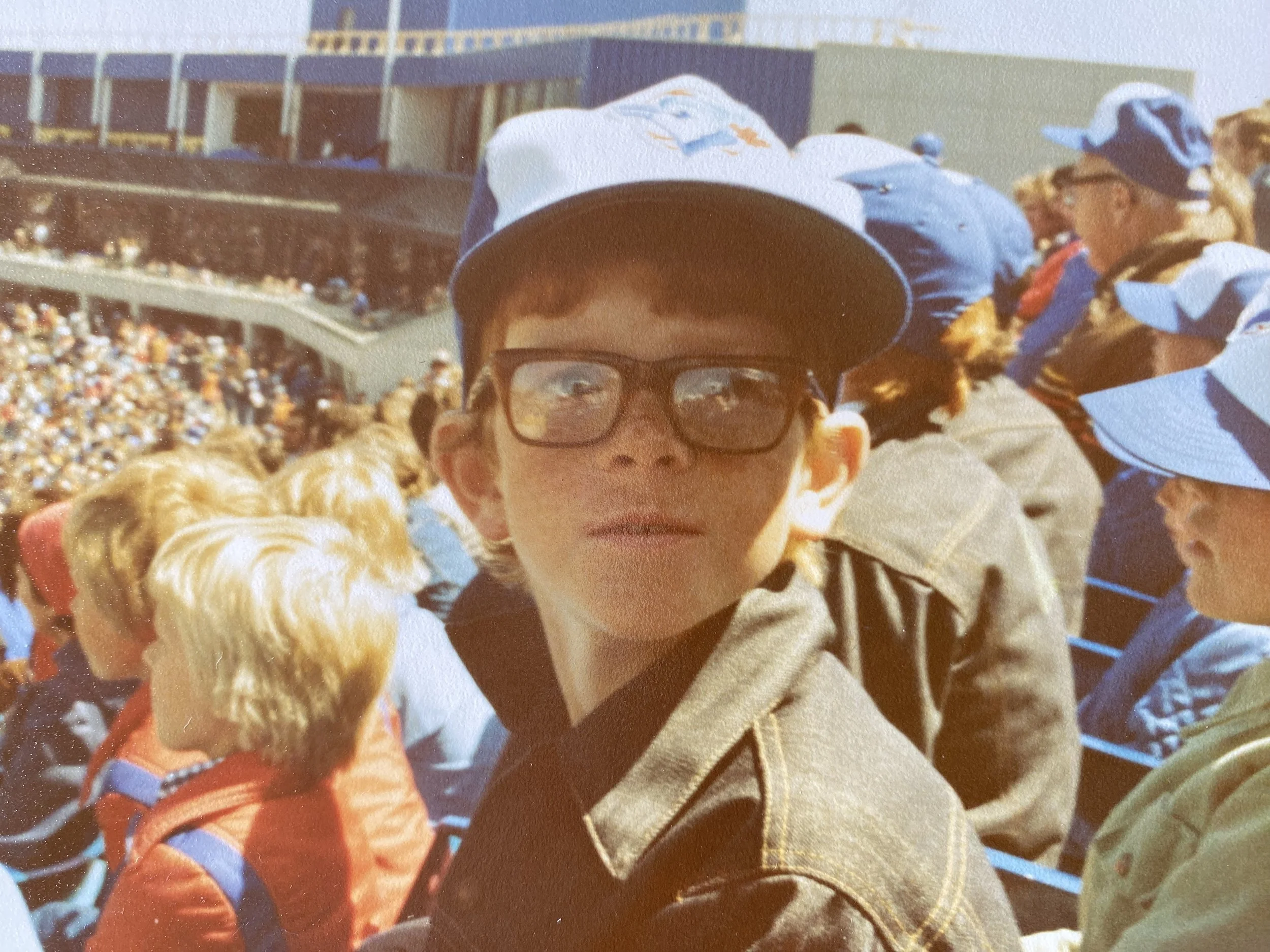
A young Jamie Campbell on Hat Day at Exhibition Stadium in 1978.
As years passed and he attended more and more games, Campbell quickly began to realize there may be a path to turning this passion for baseball into a career. He became so attached to the Blue Jays as a teenager that he would do everything in his power to attend as many games as possible.
“I was jumping on a commuter train and going to games by myself at the age of 14,” said Campbell. “I had this scheme where I would go to games four or five hours early, find the hotel of the visiting team, and wait in the lobby to introduce myself to the players. It was a tried and true habit, all because I had this incredible passion”.
World Series Champions
By the early 90s, the Blue Jays had solidified themselves as true contenders, finally breaking through to the World Series in 1992 against the Atlanta Braves.
At the time, Campbell had immersed himself in the sports world, working with CBC Sports, though he had no direct affiliation with the team. Games one and two were played in Atlanta, making game three the first World Series game to be played outside of the United States — a game Campbell could not miss.
With no credentials, he found a way to purchase a ticket in the front row overlooking the Braves’ bullpen at SkyDome. Later that game, seven-time Gold Glove winner Devon White made one of the most spectacular catches in Blue Jays history, starting what should have been a triple play.
“I can still hear and see the thud of Devo smacking the wall because I was so physically close to it,” said Campbell.
Campbell was within approximately 50 feet of White at the point of contact when he famously went face-first into the centre field wall, a moment he will never forget.
October 24, 1992. A day, baseball fans across Canada have ingrained in their memory banks, including Campbell, who was in Halifax, N.S., when a team from Toronto finally became World Champions in game six of the series.
“I was working an equestrian event that we were broadcasting nationally for CBC,” recalled Campbell.
The event happened to be taking place during the day, which allowed Campbell and colleagues to convene at a pub in downtown Halifax to soak in the moment the Blue Jays won it all for the first time.
“I thought it was fascinating that a place so far away from Toronto would react the way that it did,” said Campbell. “Thousands of locals flooded the streets; people were annihilated and inebriated. Everyone was celebratory. It garnered attention across the country”.
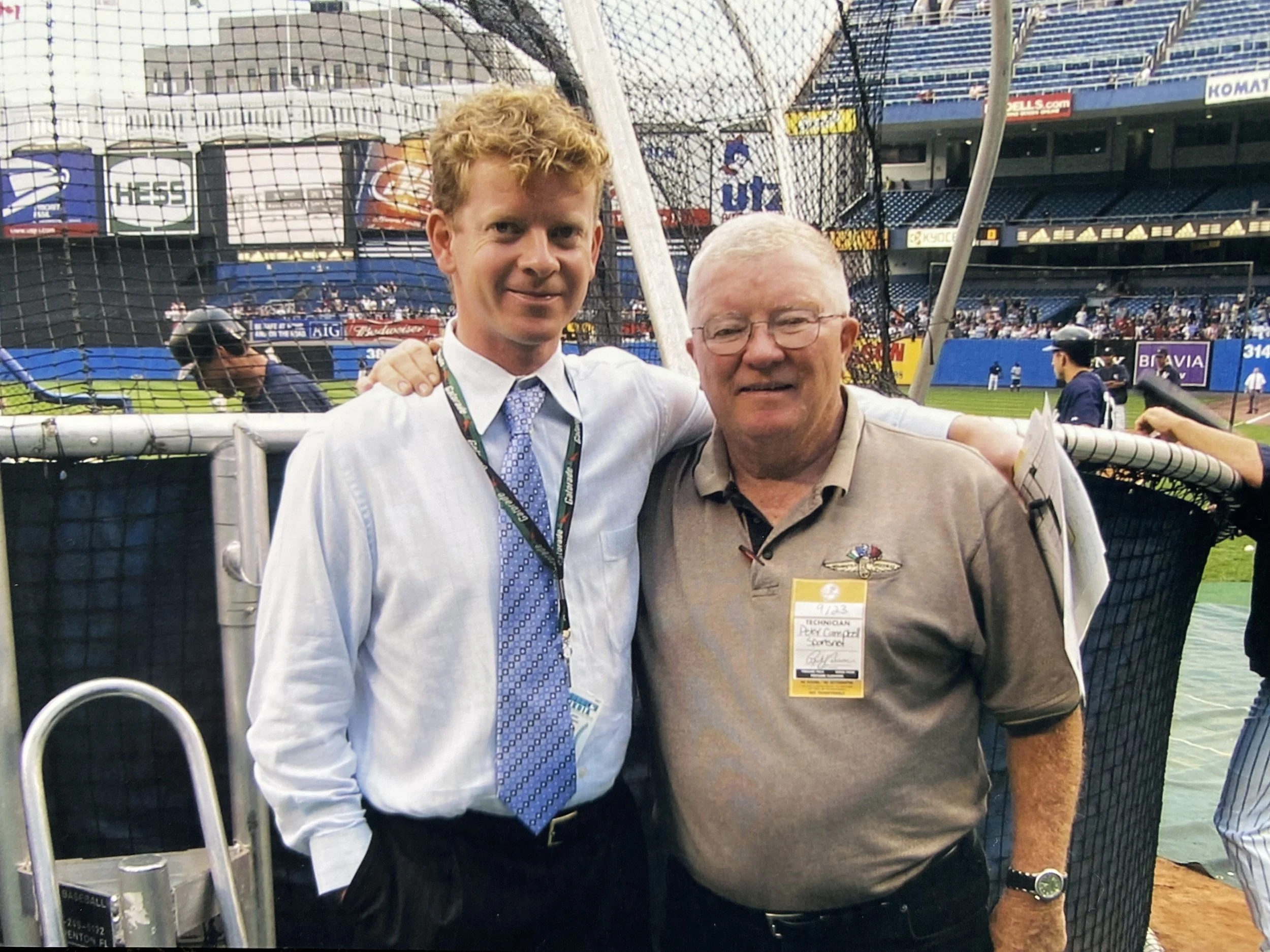
Jamie Campbell with his father, Peter, at Yankee Stadium in 2008.
1993: Back-to-Back Champs
The Blue Jays became a fixture of Canadian sports over the offseason heading into the 1993 campaign as reigning champions. For Campbell, a new chapter was beginning. It was a fresh start in a new province. In September of that year, he joined the Canadian Broadcasting Corporation in Edmonton, Alta., working as a sportscaster. A young 26-year-old diehard Blue Jays fan was leaving his hometown for the first time in his life, not knowing how it would affect his love of the team and the game.
While in Alberta, Campbell sought out any baseball he could get his hands on. He looked no further than the Edmonton Trappers, the then triple-A affiliate of the Florida Marlins, hailing from John Ducey Park.
“I spent an abnormal amount of time in that ballpark,” said Campbell.
With media accreditation, he had access to the Trappers whenever he wanted, spending hours around the park talking to players and soaking in the game he loved.
“They were so important in giving me my fix,” he said.
With no Blue Jays games to attend, the Trappers became Campbell’s new home away from home, rebirthing his love for the game of baseball. Less than two months later, just like so many other fans across the country, he became a witness to the greatest swing in Blue Jays’ franchise history, having to watch from afar for the first time. Game six of the 1993 World Series, at SkyDome, Joe Carter against Mitch Williams, and the famous ‘touch ‘em all Joe’ that was heard around the world.
2025: Return to the World Series
Thirty-two years later, a magical season culminated in a battle with the Los Angeles Dodgers, as the Blue Jays returned to the World Series for just the third time in their franchise’s history. Campbell reflected on his time covering the team through Sportsnet, highlighting what tied for the longest game in World Series history in game three.
“I remember checking my phone close to the 18th inning and seeing it was midnight in Los Angeles and trying to process what time it would be on the East Coast,” said Campbell. “I then realized that it was 4:30 in the morning in Newfoundland and Labrador, and fans were still watching.”
Midway through extra innings, the Sportsnet crew had exhausted its commercial inventory, relying on Campbell, Madison Shipman, and Joe Siddall to fill the gaps in between innings. At one point on air, Campbell mentioned the dedication of fans remaining awake to watch the game, and was subsequently bombarded with direct responses from said fans on X.
“There were about 50 notifications on my X feed, all from Newfoundland and Labrador,” said Campbell.
Fans were informing him of their hometowns across the East Coast. By the 18th inning, it approached five o’clock in the morning in some areas.
“For example, one fan told me their fishing vessel was leaving in 45 minutes; it blew my mind how many people were still tuned in in Newfoundland and Labrador,” stated Campbell.
He later explained that the live count of viewers across the country ends at two in the morning Eastern time, and at that point, viewership registered at 4.5 million, once again demonstrating the dedication of a country-wide fanbase.
The 2025 campaign sparked a new love of baseball for both diehard and brand-new fans, increasing the popularity of the team dramatically. When reflecting on both the two championship seasons and the near victory a season ago, Campbell offered an anecdote he shared with former National League MVP and Canadian Joey Votto (Etobicoke, Ont.).
“He told me that watching the 1992 and 1993 Blue Jays teams made me think I could play in the MLB. There will be kids in 20 years from now who make the big leagues that will say their love of baseball emerged from the 2025 playoff run,” said Campbell.
This demonstrated how instrumental the return of Canada’s only MLB team to the World Series was in reinvigorating a love of the game across the country.
Sportsnet and community initiatives
In 1998, Campbell was offered a position at a new network called CTV Sportsnet and was able to return to Toronto after spending the prior few years in Ottawa working for CJOH-TV. This new network ended up becoming Rogers Sportsnet.
From 2002 to 2009, Campbell had stints working as the play-by-play voice of the Blue Jays, before the legendary Buck Martinez returned to the booth to call games in 2010. From that point forward, Campbell was assigned to Blue Jays Central, acting as the pre-game host for all Blue Jays games. Sixteen years later, he continues to deliver consistent and reliable information for fans across the country, but it is his behind-the-scenes work that sets him apart from the rest.
Wes Johnson
As of January 2026, Campbell, like many others, had no idea who Wes Johnson was or what he was going through. Then, through the power of the internet, someone reached out directly informing Campbell of his situation and his love for the Blue Jays. At just 17 years old, Johnson was battling heart disease and, earlier this year, had his eligibility for a heart transplant revoked due to health complications.
By mid-February, his family had realized he would be nearing the end of his life within weeks, prompting Campbell to reach out to the family and visit Johnson in person.
“I spent a day with Wes at his family home and later learned that his last wish was to see a Blue Jays game in Dunedin, and meet Davis Schneider and Trey Yesavage,” said Campbell.
As he walked out the front door, he recalled turning back to Wes’s mother, Jenna, who mentioned that a GoFundMe was set up to raise money in an attempt to get their son to Dunedin.
“I asked Jenna if I could post a picture of Wes to my X feed with a link to their GoFundMe to raise awareness of his situation. 48 hours later, their total money raised went from approximately $16,000 to $43,000. The generosity of Blue Jays fans really took me aback,” said Campbell.
Before the family’s trip to Dunedin, Campbell spoke to the chairman of the Jays, Edward Rogers, and, though he would not be present in Florida, relayed that “we need to get Wes an introduction to Schneider and Yesavage”. The rest was history.
By early March, Wes and his family made it to Dunedin, getting to not only see a Blue Jays game, but also get a tour of the entire training complex through the guides of Schneider and Yesavage. Campbell recalls Jenna reaching out to him after the eventful day, saying Wes had told her “it was the greatest day he had ever had”.
On May 9, 2026, it was announced that Wes Johnson had passed away after a hard-fought battle with heart disease, making the last few months of his life so incredibly special. Campbell’s lone in-person interaction with the young Blue Jays fan is a moment he says he will never forget.”
Pandemic phone calls
When the COVID-19 pandemic hit, the baseball world, like everywhere else, was shaken. By mid-March, like many other major sports leagues, it was announced that the MLB season was being suspended, leaving Campbell with no Blue Jays games to cover. He realized during this time that elderly people were at a greater risk of health problems and less inclined to visit family members to protect themselves from the virus. This prompted Campbell to purchase a flip phone, with the intent to offer a friendly voice to those who were isolated and needed some support. He made a post on Twitter offering his time to speak with fans across the country, and within days had received thousands of messages from those in need.
“I realized in hindsight that there were nearly 1200 phone calls,” said Campbell.
One of those calls happened to come from a 105-year-old woman who joked about the fact that she had lived through two pandemics in her life, being two years old at the commencement of the Spanish Flu.
“The calls were magnificent, some eclipsed 30 minutes, and I got into really deep conversations with lots of fans,” said Campbell.
At one point, the number of phone call requests became too much for one man to handle, prompting the now-retired Buck Martinez to chip in, so he and Campbell could offer more time to each fan. It turned out that the first phone call Martinez made, the recipient was “pissed off” in the words of Campbell, being absolutely convinced that it was not Buck Martinez on the phone. Eventually hanging up on the longtime Blue Jays play-by-play voice, the older gentleman had not realized what he had done until after his children let him in on the nature of the call. Nonetheless, Martinez called the man back hours later, and the two enjoyed a lengthy conversation talking about all things baseball and the Jays.
Timmins, Ontario
When Campbell was just 17 years old, he was sent to a summer camp in Timmins, Ont., learning how to live independently for the first time. After spending the entire summer in a town seven hours outside of Toronto, Campbell would not return until 35 years later, during COVID-19.
With no work, Campbell got busy quickly, signing up with a volunteer organization to help distribute PPE (Personal Protective Equipment) to those in need. A paramedic from Timmins had reached out to Campbell, relaying the town’s desperate need for PPE’s, prompting the Blue Jays host to make the solo journey to the place he once called home for a summer.
“We were focusing on distributing within the GTA, but I went to the head of Conquer Covid-19, Sulemaan Ahmed, and told him how important Timmins was to me, offering to be the northern driver. If we had any further requests up north, I wanted to be the person to fulfill them,” said Campbell.
Within a handful of days, he was on the road heading north, passing through North Bay, Temiskaming Shores and Sudbury before reaching Timmins, delivering PPE to locals along the way. He eventually made a separate trip to Thunder Bay, Ont., a 15-hour car ride from Toronto. Though he made the trip solo once again, Campbell looks back fondly on those journeys.
“When I am feet up in a retirement facility one day, I will look back on those solo rides across Northern Ontario as some of the greatest moments of my life,” said Campbell.
Fast forward to the 2025 playoff run, fans from Timmins had created t-shirts with the message ‘He hit it all the way to Timmins,’ after hearing Campbell reference the town on numerous occasions during live broadcasts. At one point, Campbell caught sight of an initiative to raise $1,000 for the oncology unit at the Timmins District Hospital, later mentioning it during a separate Blue Jays game, prompting fans from across the country to chip in once again. Just a few days later, $31,000 was raised.
Personal battles
In early 2021, Campbell received a phone call from his doctor, who diagnosed him with chronic lymphocytic leukemia (CLL), ultimately forcing the Blue Jays' central host to miss time from the broadcast. He would later post an image of his face revealing the damage that had been done as a result of this cancer.
“I was unaware at first of how long I would be away from the broadcast,” said Campbell.
When asked if he made a point of revealing these health struggles to the public, he suggested there was full intent behind the decision.
“I realized that if I could go on a Blue Jays broadcast every night while carrying this disease, at some point other people in this country are going to get the same diagnosis, and in their moments of fear, will see a healthy me on their television,” said Campbell.
He went on to say, “if I can live and thrive with this thing, other people who get a similar phone call will get the comfort they need knowing I am doing just fine. If I made the promise that I was going to live vibrantly with leukemia, I had to come through on that.”
Though his symptoms have been suppressed to a point that he has been able to work since 2022, CLL is still incurable, and Campbell is aware that there is a great possibility that the cancer will return in the future in a larger capacity. His commitment to Sportsnet and the Blue Jays epitomizes his continuous perseverance and dedication to his craft, something that has remained a constant throughout his entire career.
Imprint on Canada
In nearly three decades working alongside the Blue Jays, the name Jamie Campbell has evolved into an extended part of the families of fans at home. From all across Canada, those who turn on the television every night to watch a game know that his face will be on their screen, and his uplifting messages continue to empower others to be empathetic and caring for one another.
“I want people who watch the Blue Jays to know that I care deeply about this sport. I’m as passionate about the game and the team as anybody out there. I have been living and breathing this thing since I was nine years old,” said Campbell.
Though he has become a recognizable face for so many in his years with Sportsnet, he does not want to be remembered just as a broadcaster who happened to find himself working in television.
“What I try to tell my children is you can not save the world, but what you can do is shine your light on the people around you. My purpose here is to, as best as I can, every single day, make a positive impact on the people around me, whether through a TV screen or in my life directly,” said Campbell.
Beyond his work with the Blue Jays, fans across Canada will remember Jamie Campbell for his dedication to doing whatever he can to better as many communities as he possibly can. A kind, compassionate, and caring man, he is a true Canadian hero and the beacon of hope that so many people rely on for support.