Whicker: Reds’ Burns latest of 2024 first-rounders to be fast-tracked to MLB
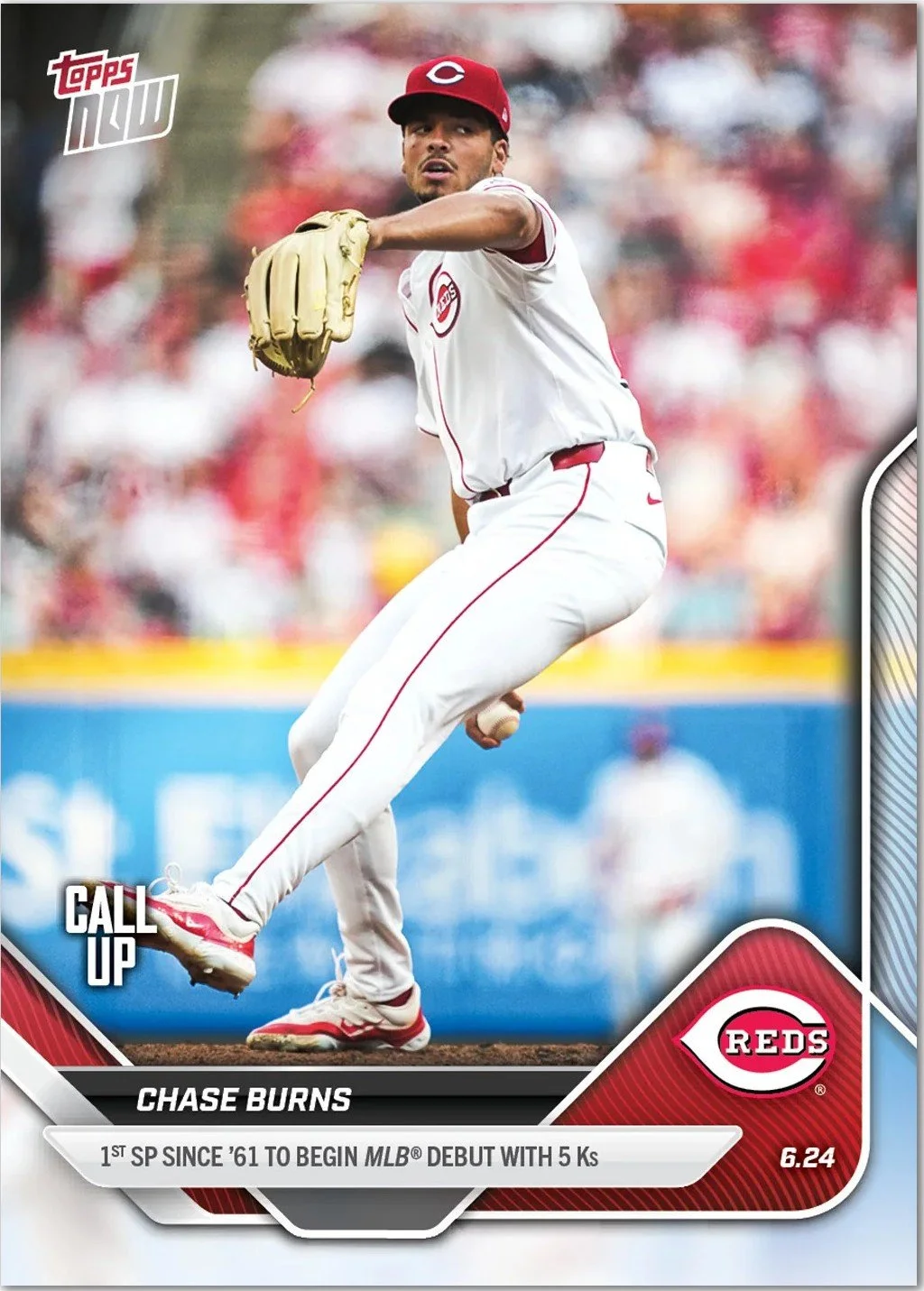
Chase Burns, chosen second overall by the Cincinnati Reds in the 2024 MLB draft, struck out the first five batters he faced in his MLB debut on Tuesday. Photo: Topps Now
June 27, 2025
By Mark Whicker
Canadian Baseball Network
Chase Burns strikes out the first five major league batters he faces, one of which was Aaron Judge.
Nick Kurtz propels three game-winning home runs in a five-game span, all of them against topnotch relievers: Josh Hader, Bryan Abreu and Carlos Estevez.
Christian Moore makes his debut on June 14. Ten days later he ties the game with a ninth-inning home run. Two innings later he hits another home run that wins it.
Aside from having the world in their pockets, they share one thing. Last spring they were playing college baseball. They were taken in the first round of the 2024 draft: Burns second by Cincinnati, Kurtz fourth by Oakland, Moore eighth by the Angels.
We talk and hear so much about player development, about the value of the minor league apprenticeships and the midnight bus rides and the motels without hallways. Burns, Kurtz and Moore bypassed all that, made that process look as dated as polyester. Perhaps the ‘24 draft will be gold-plated by the historians. More likely it’s the first wave of the future.
Paul Skenes was the 2024 National League Rookie of the Year, for Pittsburgh. He was also the first pick in the 2023 draft. That draft got a ripple of continental attention because Dylan Crews, Skenes’ LSU teammate, was the second pick (Washington). But Wyatt Langford was the fourth pick and he was hitting major league doubles for the Rangers before their season was out, and Jacob Wilson, the sixth pick, slipped into the big leagues for the last 26 games with Oakland, which was about as incognito as you can get. Nolan Schanuel got to the Angels two and a half months after they drafted him. Now Skenes might start the 2025 All-Star Game and Wilson might play in it.
Major League Baseball never has known what to do with its draft. For many years it was conducted strictly by phone, on a weeknight in June. The players weren’t invited to headquarters and they weren’t introduced by the commissioner. Most of them were unknown to the public. Until Baseball America magazine came along, nobody wrote about the high school players, and the college players didn’t come to life until the College World Series.
Now there’s more of a come-on-down feel to the draft, and it is held during All-Star week, and most of the important players are there. But it still isn’t taken seriously because nobody expects to see these kids in the 3-deck stadiums for three to four years. For the most part, that’s still true. Last year’s first pick, Travis Bazzana of Oregon State, is in double-A Akron, hoping to see Cleveland next year.
What’s changed is the acceleration of college baseball. All of the fast-tracked kids providing the flashes this year went to college. They play from February until Memorial Day, unless they make the NCAA tournament. Mostly they play on Tuesday and then on the weekends. There is nothing casual or amateurish about baseball in the Southeastern Conference, which has won the past six College World Series. Tennessee, for instance, has a four-man coaching staff but also has an analytics coordinator, a recruiting coordinator, a baseball performance guy, a pitching coordinator, a video man, a player development coordinator, a sports medicine person and a nutrition supervisor. And it’s not just Tennessee. LSU, the champion this year and in 2023, averages 11,000 fans per game and so does Mississippi State. It’s hard to imagine that triple-A baseball is more conducive to major league success than a top-level college league, at least not for a 21-year-old.
Two SEC lefthanders, LSU’s Cade Anderson and Tennessee’s Liam Doyle, find themselves on top of some of the mock MLB drafts. Washington and the Angels have those picks.
The ACC and the Big 12 are nearly in the SEC’s league, and the old Pac-12 was, too. There’s still room for an insurgent. Coastal Carolina lost to LSU in the finals this year but won the tournament in 2016, and Fresno State won it in 2008. But that’s changing, as is everything else in college sports. The administrators still have to figure out a salary structure in every sport, but the sentiment is to increase the scholarship limits from the current 11.7. If college teams are allowed to carry 20 scholarships, the SEC will soon be playing in a different league from anyone else, because many schools can’t afford to do that.
More money for the players will mean better players, or more interest in baseball from better athletes. That is exactly what MLB needs.
It’s one thing to start auspiciously but it’s another to bring fans to their feet. Burns’ debut was in Cincinnati, and he struck out Trent Grisham, Ben Rice and Judge, all of whom went down swinging. In the second inning Burns fanned Cody Bellinger looking and got Paul Goldschmidt swinging, and then Anthony Volpe whiffed after Jazz Chisholm had singled. Burns gave up a home run to Rice in the fourth, and left after five innings, trailing 3-0 but with eight strikeouts. Then Cincinnati won in the bottom of the 11th.
Burns went to Tennessee first and was a major reliever in that year’s College World Series, when the Vols beat Texas A&M in the final. He pitched for Wake Forest last year and broke the school record for strikeouts. He had 11 minor league starts and went 7-3, with 89 strikeouts in 66 innings. A guy like this could help the Reds nail down a wild-card spot.
Kurtz also played at Wake Forest, but when he was 12 he pitched Team USA’s U-12s to a WBSC World Cup championship in Taiwan. At Wake, he led the country in walks and also slugged .510. The A’s brought him up after 32 minor league games, and, beginning on June 12, Kurtz had the BLT hit — Broke The Last Tie — in six of seven Athletics’ wins. His game-winning homers came in the ninth, ninth and 10th innings. The one off Hader was notable because Kurtz is a lefty hitter, and Hader, of the Astros, has given up 10 home runs to lefties his entire career, in 483 plate appearances.
“The thing I like best is the way he wants to go to left-centre,” said Sean Casey, of the MLB Network. “He’s going to be a big star in this league.”
Moore played second base for Tennessee in last year’s CWS. He spent 79 games in the Angels’ system before he got the call, and was able to start his clock at Yankee Stadium, which was nice because his family lives in Brooklyn and got to see his first major league hit, a triple.
Moore is still fishing for consistency, but Angel fans already can see how he broke Tennessee’s home run record last year, and he already handles second base like a veteran. His shortstop is Zack Neto, who played collegiately at Campbell (the Camels) and was the 13th pick in the 2023 draft. Neto was also the first player in that draft to get to the majors.
But then we don’t want baseball to be like the NFL, where 300,000 people with not nearly enough to do wind up at the draft, and everyone with a cellphone is an expert. Maybe the baseball draft should remain on the down-low, so Burns and Kurtz and Moore and the others can take us by sweet surprise.
Jacob Misiorowski was the 63rd player picked in the 2022 draft, from Crowder Community College. Milwaukee took him, gave him enough money to make him forget his commitment to LSU, and pushed him into the deep water. The 6–foot-7, 197-pound Misiorowski has now started three major league games and won them all. He also has given up three hits, total, and outdueled Skenes on Wednesday. We’re still in a world where Brewers’ fans were happy to see such an outrageous pitcher no matter when he arrived. If the next Misiorowski spends two years in the bushes, we’ll be wondering why it took him so long.