
Whicker: Manfred can’t make salary cap sacrosanct by himself
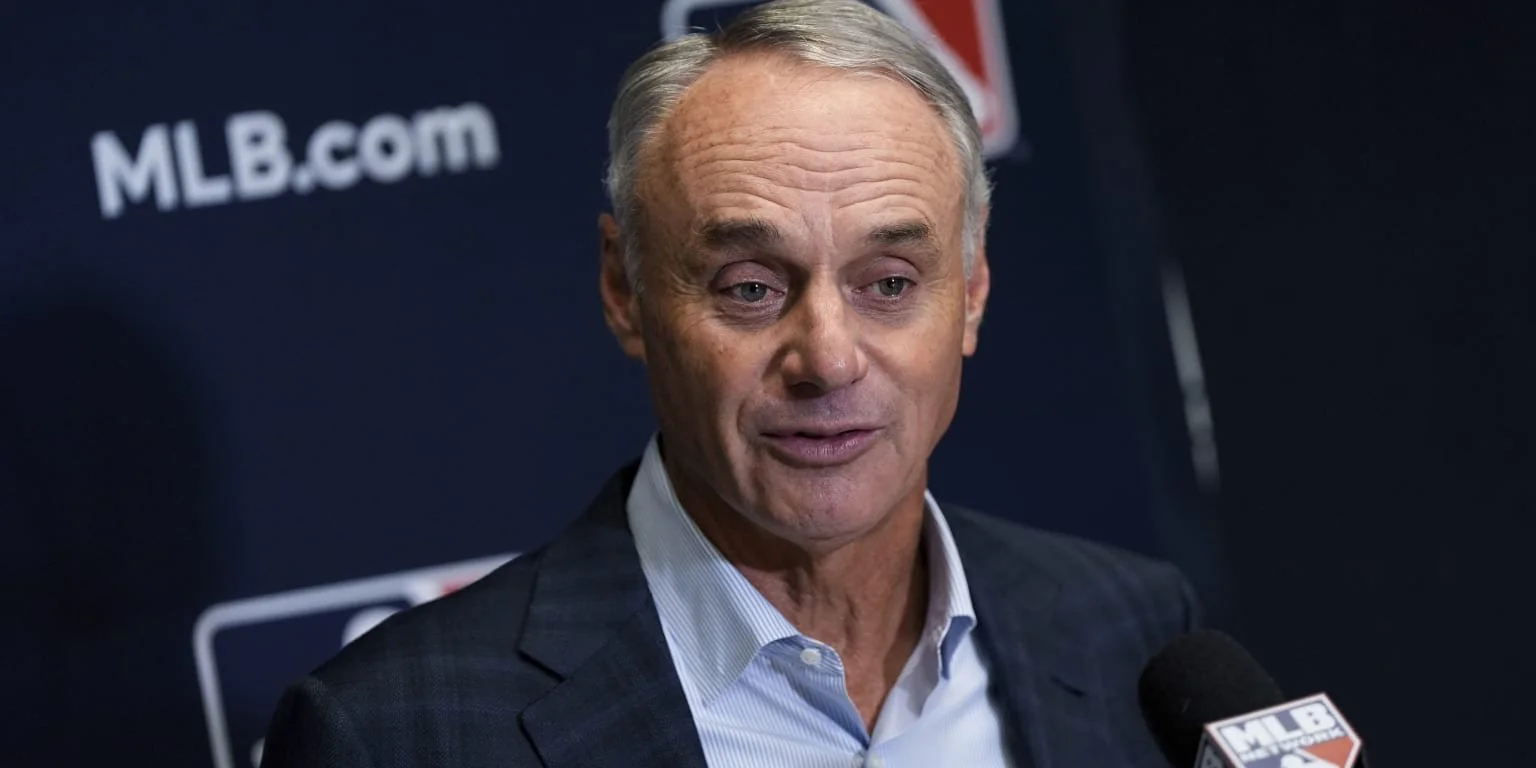
MLB commissioner Rob Manfred says there will be no new Collective Bargaining Agreement without a salary cap. Photo: MLB.com
November 19, 2026
By Mark Whicker
Canadian Baseball Network
Do you have the holiday blues?
For those in the U.S., are you girding up for your cousin ruining Thanksgiving dinner by saying transsexuals rigged the mid-terms?
Are you resentful of those, in the TV commercials, who give their spouses not one but two luxury sedans for Christmas and then leave them out in the snow?
Rob Manfred, the commissioner of baseball, shares those misgivings. He said the other day that he sees no reason to interrupt Collective Bargaining Agreement negotiations because of Thanksgiving.
“I’m not that big on Thanksgiving as a holiday,” Manfred said. “We’ll make ourselves available whenever and wherever to bargain in an effort to make an agreement.”
What, and miss the Bears and the Lions?
Manfred speaks with forked tongue, of course. He basically says the salary cap that he wants is non-negotiable. There will be no agreement, and therefore no baseball until or unless the owners get it. So what are we talking about here, what’s left to discuss? Two Field of Dreams games?
It was too much to expect Manfred to reflect on the recent postseason, in which the pipefitters from Milwaukee defeated the longshoremen from Tampa Bay in a World Series that was beloved by people who live outside Park Place and Broadway. He obviously closed his eyes, or watched BritBox, as the Brewers and Rays went 7-0 against the Dodgers and Yankees in the postseason. He would prefer to play Wordle instead of reading about Pat Murphy’s three consecutive Manager of the Year awards or the Brewers’ 200 wins in the past two regular seasons despite a payroll that ranks in the high teens.
Instead, he defies credulity when he claims that “70 percent” of fans want to see a salary cap, so we should bow to their whim. Let’s find out how many fans want Manfred to pull down an annual salary of $17.5 million, which would put him third on the Brewers’ payroll. Let’s determine how many fans want $16 hot dogs and $50 parking fees and public-address noise that benefits no one but migraine-pill companies. Let’s ask if they revel in exhibition games that feature two legitimate starting players at most.
Manfred must be credited for the pitch clock and the ball-strike system that have refined and civilized the game. His next project, a replay system for checked swings, is overdue and welcome. But the ghost runner in extra-inning regular season games remains an abomination, and now he wants to reward the defensive wizards of the game by making them stand in a designated circle before each pitch, to make it difficult for them to chase down aspiring doubles and return them to the pitchers as outs, as if they were runaway children. Next thing you know, he’ll push for a speed limit on four-seamers.
You’ll notice that the commissioner hasn’t been quite as vocal about “competitive balance” since we managed to have a World Series without the Dodgers, Yankees, Blue Jays, Phillies, Mets and Cubs. And, in truth, the coming lockout has comparatively little to do with that at all. The plan is to consolidate all the local TV revenue and share it, and thus allow the middle and lower classes to bump their payrolls to an agreed-upon minimum. That would mean the Dodgers, for instance, would take a hit because they make about $330 million a year from Spectrum, although at least $50 million of that is shielded from revenue-sharing. However, their bottom line would be eased by the introduction of a salary cap, presumably one without an NBA-style laundry list of exceptions. Then the cap would swell the franchise valuations for everyone, which seems to be the goal here because the baseball owners envy how much NFL and some NBA teams are worth.
That’s a lot of gymnastics and a lot of adjustments to a system that seems to be functioning for everyone. Obviously you don’t know the true worth of something until it is sold, but the Marlins, who behave like debtors and are as popular as algae, were sold for $158 million in 2002 and are worth (according to Forbes) $1.5 billion today.
Manfred puts on his benevolent face when he says he wants the players to split the overall revenue evenly with the owners. Bruce Meyer, the interim head of the Players Association, points out that the players already get 55 percent.
And, obviously, not all the teams can be expected to get underneath or get up to the floor immediately. What’s the grace period and how will the contracts get grandfathered? Those are sticky questions when you settle on March 20 and Opening Day is March 24.
Words, in the midst of labor negotiations, fly away with the wind. But Manfred can’t make a salary cap sacrosanct by himself. MLB’s efforts to put their point of view on TV commercials is amateurish and insulting. It takes little skill to create a crisis, to fashion a domination instead of a relationship. Manfred would find it much easier if he split the turkey down the middle, instead of suggesting that the players occupy the kids’ table.