Whicker: Remembering former Braves owner Ted Turner
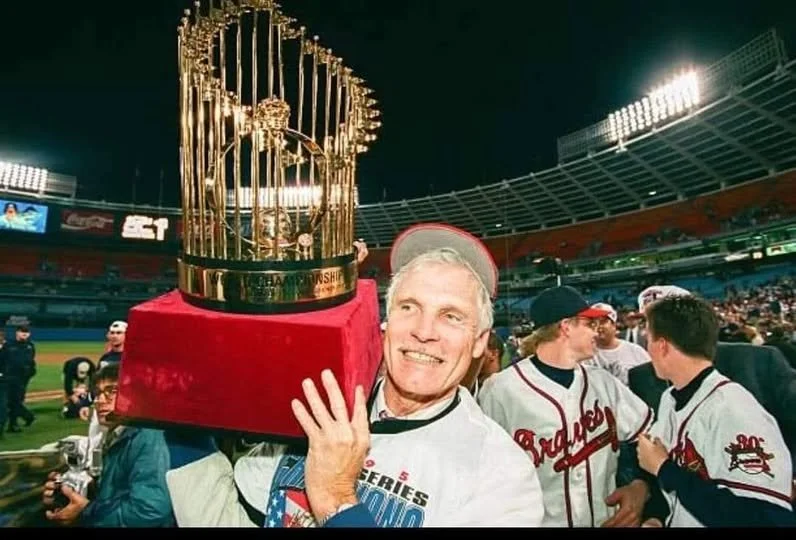
Former Atlanta Braves owner Ted Turner hoists the World Series trophy in 1995.
May 7, 2026
By Mark Whicker
Canadian Baseball Network
The 1975 Atlanta Braves had Phil Niekro, Dusty Baker and Tom House.
Darrell Evans was their top home run hitter, with 22. They also went 67-94 and drew 534,672 fans. More than once, the team would trail by eight runs after three innings, and Skip Caray, the play-by-play man, would intone, “Ladies and gentlemen, if you promise to keep patronizing our advertisers, you have my permission to watch something else.”
When the Braves went up for sale, mental health professionals watched closely to see who would be interested. Ted Turner was. It figured.
Turner had taken over a failing UHF station in Atlanta and beamed sitcom reruns. If you wanted to see what Opie and Aunt Bea were up to, WTCG (Watch This Channel Grow) was your outlet on Channel 17. Then Turner picked up the rights to show the Braves, as if anybody wanted to watch such a civic eyesore. Then Turner put up $12 million to buy the team itself. Atlanta baseball changed from that day forward, like everything else Turner touched. When he died on Wednesday, at 87, the Braves led the National League East by eight-and-a-half games and were in good position to make the playoffs for the 25th time in 36 years.
There’s a wide canyon between those days and these. In the mid-70s Turner was already Captain Outrageous, challenging the sailing establishment, winning the America’s Cup in 1977 and practically falling into the bay during the celebration. He had already divorced his first wife because she had beaten him in a boat race. Now Turner would execute a cannonball into the stratified world of Major League Baseball, in which the starchy Bowie Kuhn was commissioner.
Turner appointed himself manager for one game, a loss to Pittsburgh in which he wore the shoes of outfielder Cito Gaston. He thought there was nothing wrong with bounding out of his front-row seat at Atlanta Fulton County Stadium to high-five his players. He unleashed promotions director Bob Hope on the world, and the Braves were suddenly sponsoring Wet T-Shirt Nights and Star Trek Nights and peanut races, in which a contestant pushes a peanut down the baseline with his nose. Turner joined in and defeated Phillies’ reliever Tug McGraw, and emerged with blood flowing into his mustache. He also was laughing, as were most witnesses. His first Braves team won three more games than its predecessor but gained nearly 300,000 fans.
But then he ran afoul of the suits. He signed Gary Matthews, a free agent from the Giants, for the staggering sum of $1.2 million spread over five years. Problem was, Matthews’ contract hadn’t expired yet. And Turner, after a few pops at a World Series party, told Giants’ owner Bob Lurie that he was going to do that very thing. That cost the Braves a first-round pick and got Turner suspended, although he fought it in court and got the suspension reduced.
He also signed Andy Messersmith as a free agent and gave him an even more staggering sum of $1 million over three years. Messersmith wore No. 17, so Turner made him wear “Channel” above it, instead of his surname. That lasted one game before Kuhn blew the whistle again. In 1977 the Braves outdid themselves with a 16-game losing streak. Turner gave manager Dave Bristol a 10-day vacation and took over the team. When Niekro jokingly asked him where he would hit in the batting order, Turner said, “Hell, you can lead off. Hit anywhere you want.” The Braves lost and Kuhn said Turner couldn’t do that anymore. Turner really hadn’t had a boss before, except for his dad Ed, who founded the family billboard business. But the fans loved the distraction. It was much more fun to follow the owner than the team.
In 1982 the Braves were actually good enough to win the N.L. West, with Joe Torre managing. Then they lost 15 of 16 in August. On Aug. 19th, young righthander Pascual Perez got his Georgia driver’s license and set off to the ballpark, where he was supposed to face the Mets. Three hours and 20 minutes later, and after the game began, Perez finally arrived, having circled Atlanta on Interstate 285, a/k/a The Perimeter, three times. His start was moved back one night and Perez won, and the Braves, sufficiently loosened, won 12 of 13 and nailed down the division.
“Now I just follow the map,” Perez said.
But after 1982 the Braves went bad again, and Turner was chasing other rainbows, and there was nothing funny about futility. At least the nation could watch and empathize. Thanks to the WTBS superstation, baseball-deprived fans in Wyoming and North Dakota began rooting for the Braves. Bill Tush, an outlandish WTBS newsman, was named Grand Marshal of the Valdez, Alaska Christmas parade, even though he’d never been without a thousand miles of it. For once, people could watch someone play baseball on a weeknight, and somehow there was power in that.
Seasons of 65 and 63 wins convinced Turner to realize there were things he didn’t know. He brought back manager Bobby Cox and paired him with general manager John Schuerholz. There were good pitchers on hand, thanks to Cox’s work as GM, plus an astute scouting director named Paul Snyder. Schuerholz improved the playing surface, professionalized the operation. Stunningly, the Braves won the division in 1991 and their home attendance soared from 980,000 to 2.1 million and then to 3 million in 1992. A generation of excellence was born. The old cautionary tales disappeared. Yes, fans would come to the ballpark even if they could watch the games for free at home. No, the dilapidated neighborhood would not keep the people away. The Braves won the 1995 World Series, won 14 consecutive division championships, and produced Hall of Famers Greg Maddux, Tom Glavine, John Smoltz, Fred McGriff, Chipper Jones and Andruw Jones, along with Cox and Schuerholz. And Turner confined his participation to sitting in his first-base-line seats and eating peanuts and drinking beer with wife Jane Fonda and an assortment of guests, sometimes Jimmy and Rosalynn Carter.
It’s hard to recall an American with more impact on daily lives, and more determination to get big things done, than Ted Turner. He founded CNN in 1980 and confidently said it would stay on the air until the end of the world, which, so far, it has. His network was the first to provide live coverage of the Iraq War and has become the first choice of viewers who want to be plugged into developing stories.
He also replenished the bison population in America, became the country’s largest private landowner with promises never to develop those millions of acres, and gave the United Nations $1 billion for peacekeeping and environmental causes. His Goodwill Games, with Americans competing with Soviets, was a typically audacious idea that at least provided a nudge toward the end of the USSR. When the Goodwill Games came to St. Petersburg, a vice mayor named Vladimir Putin was assigned to take Turner around. When Putin’s wife became ill, Turner overrode Putin’s bosses and told him to go home.
Turner was talking to Fidel Castro when no other American was. He bought the MGM’s storehouse of movies and, to others’ dismay, tried to “colorize” some of the classics. His favourite was Gone With The Wind, and his avatar was Rhett Butler. He produced a movie called “Gods And Generals” that was somewhat sympathetic to Confederate soldiers, but he was anything but a racist. Turner made Bill Lucas the first Black general manager in baseball, and Lucas might have been a great one, but died of a brain aneurysm when he was 43.
Turner lived at least a half-dozen lifetimes at once. He never entertained the thought of running for President, on the grounds that he never accepted demotions. But except for CNN, which was like a family member, Turner got his biggest thrills out of taking a decrepit baseball team and applying CPR until it reached its feet. The fact that Turner never knew CPR, in a baseball sense, was just an inconvenience.
Unlike today’s unqualified disruptors, Turner was a creator. Move fast, but don’t break things. Build them. Now the Braves play in the northwest suburbs, their stadium surrounded by a district of shops and restaurants that overflows its banks with revenue. Turner left monuments all over the world but, if he were here and functioning tonight, he’d be there.