
Wilson: Dickson talks Road to Okotoks, national championship tournament begins today
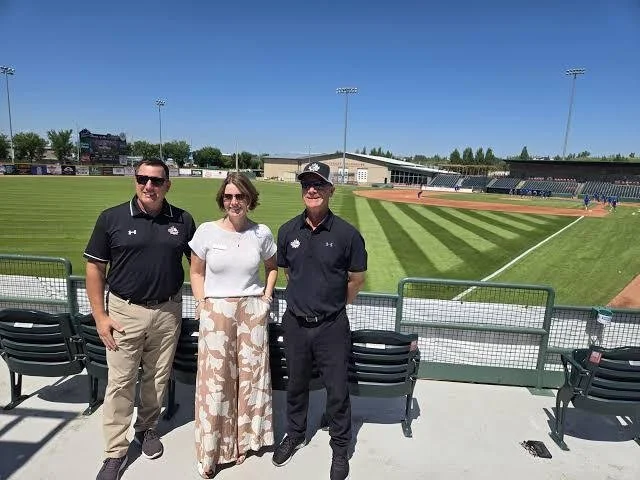
On Monday, Baseball Canada CEO Jason Dickson (left), Okotoks Mayor Tanya Thorn and Junior National Team Coach Greg Hamilton gathered at Seaman Stadium in Okotoks, Alta. for a press conference prior to the start of the Road to Okotoks national championship. Photo: Ian Wilson, Alberta Dugout Stories
*This article was originally published on Alberta Dugout Stories on July 13. You can read it here.
July 14, 2026
By Ian Wilson
Alberta Dugout Stories
Jason Dickson has talked a lot about The Road to Okotoks recently.
But now the Chief Executive Officer (CEO) of Baseball Canada has actually taken the road to Okotoks, Alberta … and he likes what he sees.
The national championship between 16 of the top 19U baseball programs in Canada is set to take place at Seaman Stadium and Tourmaline Field from July 14-19, culminating with the tournament winner taking home the Morneau Cup.
During his first trip to the Seaman Stadium Complex, which is home to the summer collegiate Dawgs of the Western Canadian Baseball League (WCBL) and Dawgs Academy, Dickson discussed what he expects out of the inaugural tournament.
Here’s what he had to say in a question-and-answer session with Alberta Dugout Stories:
Q: First off, why Okotoks?
When we started looking at this tournament, it was something that we wanted a little bit different environment, where it was less maybe about being from a showcase perspective and really get into that compete level and really see what the kids can do.
It’s going to help them on the scouting side and the school side. It helps us pick our national teams in really understanding … how do they actually compete when it gets tough? And so the next kind of slice to that, or layer to that is, we’ll amp it up when you put them in front of a big crowd, right? It’s very different when the game’s on the line and there’s a big crowd.
Then you start looking around the nation at spots that have a stadium that, you know, we feel these players are worthy of playing in. Who has the fan base that will create that exact environment that we want? And also, you know what, for the kids, a really special moment that they’ll remember playing in front of all these kids and all those people. And as you start to look across the country, it gets narrowed down pretty quickly. And Okotoks popped up on our list very early and we started those conversations with (Dawgs Managing Director) John (Ircandia) just around how we fit that into the schedule and use of the stadium and the partnership. And I think it was the natural fit. I think the things that we were looking for in the field that we wanted and the environment that we wanted and the fans we wanted, I think this is how we quickly got it narrowed down to here.
Q: This is your first trip here. Now that you’ve got eyes on it and you’ve looked around, what are your first impressions?
Yeah, I mean, obviously our staff have been in here quite a bit, and we’ve hosted national championships out this way, and obviously on social media you can see everything, but I’ve never had the opportunity to be [here] in person, but it’s everything that everybody’s talked about. And I’m really excited to see this place full and see the crowd. And for the kids at the end, they’re really excited for those players to get that opportunity to play in front of those crowds like that. We hope that they all become college players and move on to the pro ranks. And this might give them a little taste of what that looks like.
Q: This is an event that’s been years in the making. So, going from concept to the eve of this event, what are the expectations that you have now and have those changed since Baseball Canada announced The Road to Okotoks last fall?
The concept of a tournament like this as a best-on-best has been a long time in the making. We have national championships each year at Baseball Canada, different age classes. So, we’re in that business of understanding how to kind of get everybody under the umbrella. And, we really wanted to figure out, okay, how do we capture, that private world or that academy world or that travel baseball world? Because I think we firmly believe that baseball is better when everybody is under the same umbrella and we’re all proud of that Canadian flag and really supporting baseball in Canada.
And to get that from concept to today, I can’t even begin to tell you the number of calls that we’ve had, Greg (Hamilton) and I, the number of calls that we’ve had with Greg and I and John and with teams and with everybody who’s kind of in that baseball network to say, ‘What does it look like if we do this? What does it look like if we do that? How do we shape some of those things, leading into it?’ So, I’m excited to, seeing some of the kids on the field today working out, games get started tomorrow.
I’m probably the happiest person that we’re getting to finally get this thing launched to see what we’ve got. And like anything with a first-year tournament, you start compiling that list of … OK, what worked, let’s keep it, make it better. What didn’t work, how do we improve it or change it? What did we miss? We’re going to enjoy it, but obviously we never stop working on it and we’re probably our own worst critics to try to make the tournament better. But at the end of the day, it’s all to make sure that the experience is best for the kids and we work hard to make that happen.
———————————————————————————————————————————————————————————————-
Listen to Alberta Dugout Stories full interview with Baseball Canada CEO Jason Dickson here.
————————————————————————————————————————————————————————————————
Q: That kind of leads into my next question, which is that evaluation piece, what does that look like? What will you be looking for and what will you be looking to tweak, enhance, or build on?
I think like one of the biggest challenges we face, we face it with a lot of our other championships too … these teams will turn over from year to year and the strength will kind of go up and down. And I think that’s always been the challenge when the discussion starts around. Who’s the best or who’s better than who?
I think as we go through some of those qualifying tournaments and figuring out how to get the schedules right and create the best games, I think we’ll look really closely at that. I mean, we’re not handicapping a schedule to make it even. I mean, that’s not the purpose. We want best-on-best, but just understanding kind of where everybody fits in and how they’re doing and whether it was a weak year for somebody or a strong year for somebody. I think that’s important to us.
I think it’s really important to see that these kids get the showcasing, the social media and that the scouts are watching and we know that that’s happening. Our coverage on social media and the run up to this event I think has been outstanding in really trying to see the pride kind of come out from the different programs, help the kids understand this isn’t just a regular tournament I’m going to. There’s a lot on the line. I really am playing for the club that’s on the front and, you know, I really am fighting to see who is the best in Canada.
So, I think it’s looking at all of those elements, as well. And then operationally, the Dawgs have done a tremendous job here and their staff. We talk all the time just around little things of how can we do certain items better, and whether it’s just the logistics of the whole thing, we’ll look at everything to make sure both the Dawgs and Baseball Canada have a lot of pride in delivering on the concept and what the product looks like, so we’ll be pretty tough on ourselves when we start to evaluate how to make it better.
Q: I’m assuming you’ll get lots of feedback along the way?
We’ve been getting feedback, we’ll get some more feedback, and I’m sure we’ll have continued feedback. Like with most of these events, your ears are open and you listen to all comments. I mean, whatever form they come in, sometimes people are a little fired up and sometimes they’re, it’s maybe a helpful thought and sometimes maybe they’re looking at it through their lens or a broader lens. But we’re open to all of that because I think it’s very important to listen to what everybody has to say.
We also understand sometimes it’s hard to keep everybody pleased. It’s a big country. It’s a big country and you know what? It’s a big competition.
The inevitable is this: there’s going to be one team that’s going to be very, very happy. And there’ll be some other teams that will be disappointed that they didn’t win it, but hopefully they’ve got some fire and hunger to come back and try to tackle it again. I think we’re open to everything that kind of comes our way, because at the end of the day, it’s not about our pride and ego. It’s about how do we deliver the best for the kids and the teams.
Q: Last question for you: what does the future look like for this event?
I think we understand that this final tournament is a 16-team tournament. At least that’s where we are now. I don’t know if we would expand it to more than that.
But I think you’re going to see the qualifiers to get in the tournaments expand. And we’ve got three now. Obviously, the more interest that comes in, we have to create more qualifying events for that. So, on the positive side, some of the teams that may not be here this year have already committed to coming next year. And maybe they passed on it this year just because of a planned schedule or a financial commitment that they’ve already committed to other events or some of those other pieces. But we’ve heard from a few more that are looking to get in. So, when you fast-forward five years from now, we had 29 that kind of started this thing, we’re hoping to make it 35, 40, 45, 50 … the more the merrier on really getting programs from across the country to kind of fight it out to get to this final 16 team event.