
Wilson: Many Blue Jays and Dodgers stars honed skills in Alberta prior to earning WS rings
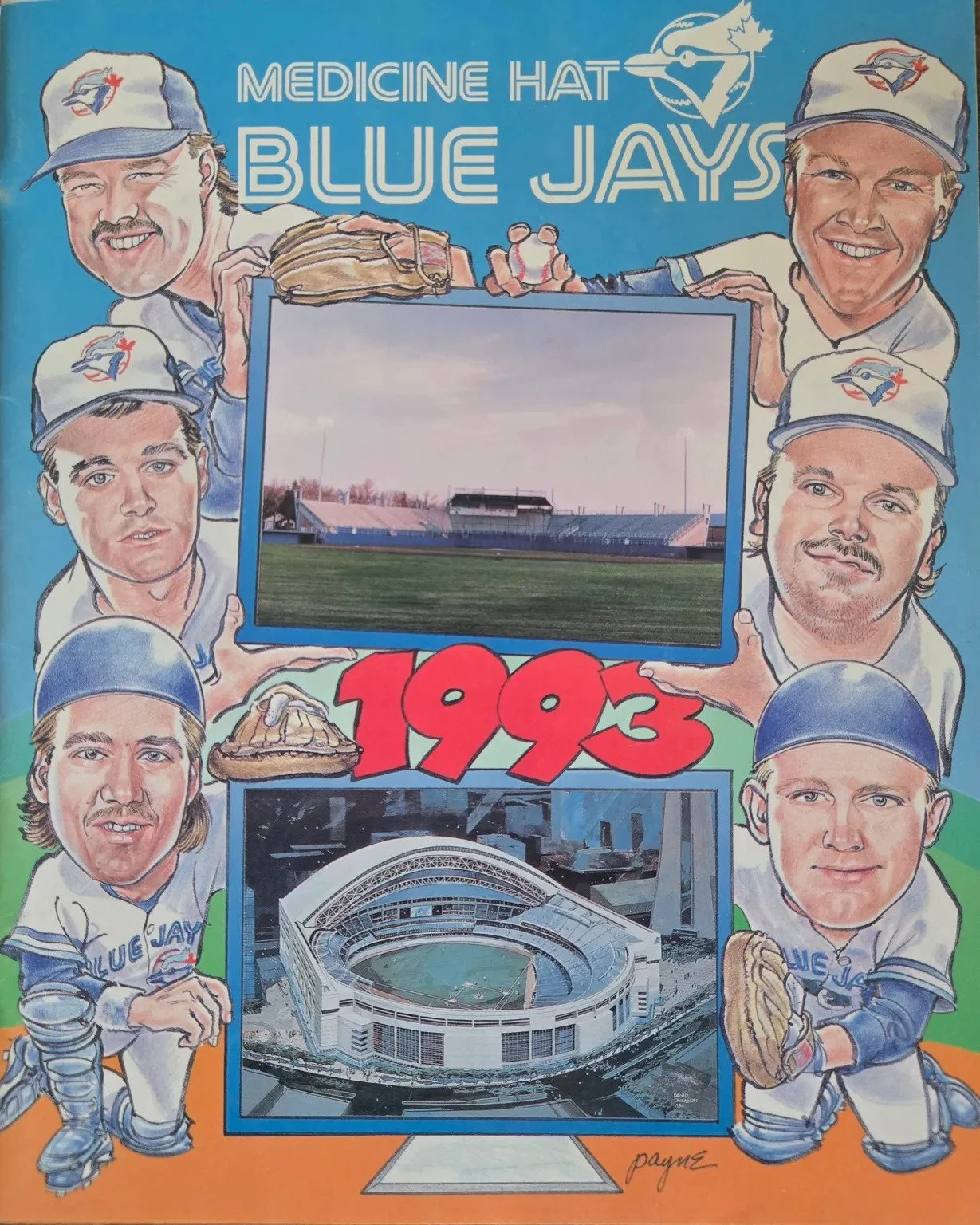
Some of the players on the Toronto Blue Jays’ 1992 and 1993 World Series-winning teams began their professional careers with the Blue Jays’ Rookie-ball affiliate in Medicine Hat, Alta. Illustration by Bill Payne
*This article originally appeared on Alberta Dugout Stories on October 24, 2025. You can read it here.
October 25, 2025
By Ian Wilson
Alberta Dugout Stories
The Toronto Blue Jays and Los Angeles Dodgers bring championship pedigrees to their 2025 battle for a World Series title.
The Jays won Major League Baseball’s top prize in 1992 and 1993, while the Dodgers have eight championships, including one from their time in Brooklyn.
There was a time – in the 1980s and 1990s – when Pioneer Baseball League squads from Medicine Hat and Lethbridge contributed to the ultimate success of their parent clubs in Ontario and California.
Let’s hop in the way-back machine and examine how talent nurtured in Alberta helped build World Series-calibre rosters for the Dodgers and the Blue Jays.
L.A. STORY: FROM LETHBRIDGE, ALBERTA TO LOS ANGELES
The Dodgers operated a rookie-level affiliate in Lethbridge from 1977 to 1983 and the team thrived, picking up three Pioneer League championships during their tenure in southern Alberta.
They also produced players who excelled in the big leagues.
A number of the hitters paid dividends for Los Angeles, especially when the Dodgers defeated the Oakland Athletics in the 1988 World Series in five games.
The quality pitching of Orel Hershiser and the pinch-hitting heroics of Kirk Gibson headlined that title run for the Dodgers. That team also included second baseman Steve Sax, third baseman Jeff Hamilton and outfielder Mike Marshall.
Sax patrolled the middle infield for the Lethbridge Dodgers, along with his brother Dave, in 1978. During his 39 games for the junior Dodgers, he batted a healthy .328 with a .405 on-base percentage. He also scored 24 runs and registered 21 RBIs. It was with the parent club in Los Angeles where Sax developed into an elite hitter and base-stealing threat, claiming the National League (NL) Rookie of the Year Award in 1982 and a Silver Slugger Award in 1986. Sax appeared in four postseason games for the Dodgers when they won a World Series in 1981, but he was a bigger contributor in 1988 when he collected 14 hits, 10 runs and six stolen bases in 12 playoff contests.
Hamilton was excellent for the baby Dodgers in their final season in Lethbridge. The right-handed hitter from Flint, Michigan led the squad in RBIs (61), doubles (23), and total bases (130). He also scored 48 runs, batted .335, posted a .382 OBP, chipped in three home runs and stole three bases during his 68 games played in 1983. The Pioneer League took notice and named him an All-Star and the Dodgers were impressed enough to label him team MVP. After he rose through the minor-league system, Hamilton played six MLB seasons with Los Angeles and was a regular postseason player when the Dodgers captured the World Series in 1988.
Marshall was a sixth rounder from Illinois who played first base and in the outfield in the Windy City in 1978. He finished tied for the team lead in home runs, with 12, and found himself atop the Lethbridge team stats for RBIs (70) and total bases (138). In addition, he batted .324 with a .395 OBP. Nicknamed “Moose,” he played over 1,000 MLB games, mostly with the Dodgers, and had a career .270 average. Marshall had one at bat in the 1981 postseason and suited up in 12 playoff games for the Dodgers in 1988, earning himself a pair of World Series rings.

The Lethbridge Dodgers produced a number of other World Series champs, as well, but many of them won with different organizations.
The highest profile shortstop to take the field for the home team at Henderson Stadium in Lethbridge was Mariano Duncan. The native of the Dominican Republic suited up in 1,279 MLB games for the Dodgers, Cincinnati Reds, Philadelphia Phillies, New York Yankees and Toronto Blue Jays. He was selected as an All-Star in 1994 and helped the Reds and Yankees claim World Series titles in the 1990s. In Lethbridge, Duncan appeared in just 30 games and made 55 at bats in 1982, compiling a .236 average with nine runs and eight RBI.
The most successful graduate of the Lethbridge Dodgers arsenal of arms was Sid Fernandez. The southpaw from Honolulu, Hawaii – who drew comparisons to Fernando Valenzuela (who took the mound for the Edmonton Trappers in 1991) – made 11 starts for Lethbridge and recorded 128 strikeouts in 76 frames in 1981. He also went 5-1 with two complete games and a 1.54 ERA. The strikeout total and ERA were tops in the Pioneer League. The 73rd overall draft pick went on to have a 15-year MLB career that included a pair of All-Star nods and a World Series championship with the New York Mets in 1986.
Outfielder Candy Maldonado played two years in Lethbridge, where he appeared in 116 games for the Dodgers. In that time, he recorded 87 runs, 81 RBIs, 17 homers, 35 doubles and 60 extra-base hits. The “Candyman” had a lengthy MLB career that saw him don the ball cap of nine different teams. The undrafted Puerto Rican worked his way into 1,410 big-league games and picked up a World Series ring with the Blue Jays in 1992. In 12 postseason contests that year, Maldonado had nine hits, eight RBIs and three homers.
Sax, Marshall and Maldonado all honed their skills under manager Jim Lefebvre in Lethbridge. As a player, Lefebvre won a World Series title in 1965 with the Dodgers. He was also a member of the coaching staff with the Athletics that lost to the Dodgers in 1988.
LET’S GO BLUE JAYS
The Baby Jays – the lowest rung of Toronto’s minor-league ladder – spent a quarter of a century in Medicine Hat from 1978 through 2002.
They won one Pioneer League title in 1982, but more importantly, they incubated talent for the major leagues.
When the Toronto Blue Jays struck for back-to-back World Series wins in the early 1990s, you could trace a good portion of those rosters back to Medicine Hat.
Foremost was catcher Pat Borders, who was named the Most Valuable Player of the 1992 World Series after the Blue Jays defeated the Atlanta Braves in six games. Borders didn’t mask up behind the plate at Athletic Park in Medicine Hat in 1982, but he did play in the outfield and the infield. His fielding was an issue, as indicated by his 25 errors in 61 Pioneer League games. However, his bat showed promise. The Ohio-born sixth rounder recorded a .304 batting average, as well as 30 runs, 33 RBIs, 12 doubles and five homers. After developing into a dependable backstop for Toronto, Borders was at his best during their consecutive championship runs. In 1992, he batted .381 with a .404 on-base percentage, five runs, six RBIs and three doubles in 12 postseason matchups – a strong enough showing to earn MVP honours. Borders helped the Jays collect their second World Series in 1993 when he registered 13 hits, four RBIs and three runs while handling the pitching staff for another dozen playoff games.
Another catcher who collected rings during that time was Randy Knorr, who played eight regular-season games for Toronto in 1992 and another 39 in 1993. As the backup to Borders, the California product was not called upon for meaningful playing time in the postseason but he was ready to step in, if needed. Knorr got his start in Medicine Hat and suited up in 81 games with the Baby Jays in 1986 and 1987. He collected 42 runs, 20 doubles, 14 homers and 56 RBIs. Knorr ended his pro playing career as a member of the Edmonton Trappers of the Pacific Coast League (PCL) in 2003 and 2004.
On the mound, a number of pitchers cut their teeth as first-year pros at Athletic Park.
Lefty Jimmy Key, a third-round pick from Alabama, made five starts for Medicine Hat in 1982 and went 2-1 with a 2.30 earned run average (ERA) and 25 strikeouts in 31 1/3 innings. Two years later, Key was a member of the Toronto Blue Jays and in 1992 he won his first World Series after going 2-0 with a 0.75 ERA in 12 postseason innings, including a masterful triumph over Tom Glavine and the Braves in Game 4 of the Fall Classic at the Skydome and the clinching Game 6 victory when he came out of the bullpen in Atlanta. Key won a second World Series with the Yankees in 1996.
David Wells charted a similar path to success, starting with his time alongside Key and Borders with the Baby Jays in 1982. “Boomer” went 4-3 with a 5.18 ERA in 12 starts that summer, while recording 53 strikeouts in 64-plus innings. With Toronto he went 47-37 in the regular season from 1987 through 1992 and during their first World Series run, the southpaw pitched in four games out of the bullpen. Like Key, Wells ended up with the Yankees after leaving Toronto. The Californian was outstanding in pinstripes when New York claimed the World Series in 1998. That postseason, Wells went 4-0 in four playoff starts, with a 2.93 ERA and 31 Ks in 30 2/3 innings. He was named the American League Championship Series (ALCS) MVP that year.
Medicine Hat Blue Jay alumni also worked out of the bullpen for the championship club in Ontario.
Mark Eichhorn, a 6-foot-3 righthander, took the mound for the Jays four times in the postseason in 1992 and 1993. He logged 4 1/3 innings and allowed two hits and zero runs. Eichhorn began as a starting pitcher for Medicine Hat in 1979. In 16 appearances, he went 7-6 with a 3.39 ERA, three complete games and 66 strikeouts in 93 innings with the Baby Jays.
Mike Timlin also began professional baseball as a starter in The Gas City. During his 13 games for Medicine Hat, the Midland, Texas native went 4-8 with a 5.14 ERA. The 6-foot-4 righty was a reliever during three playoff runs in Toronto, including the two that ended with championships. In 13 postseason innings with the Blue Jays, he picked up one save and struck out 12 batters. His lone save came in Game 6 of the 1992 World Series and sealed Toronto’s first championship.
Another clutch performer for the Blue Jays at the height of their baseball powers was Devon White. The centre fielder was traded by the California Angels to Toronto in December of 1990. He didn’t play for Lethbridge or Medicine Hat, but White appeared in 192 games with the Edmonton Trappers before he wowed fans at the Skydome with spectacular catches and timely hits. White won two World Series rings with the Blue Jays and a third with the Florida Marlins in 1997.
Shortstop Dick Schofield, who played 36 regular-season games for the Jays in 1993, also suited up for the Trappers and Angels before making his way to Toronto.
Another regular-season hitter for Toronto in 1993 and 1994 was outfielder Darnell Coles, who didn’t appear in the postseason for the Jays. He was a member of the Calgary Cannons for 31 games in 1985.
One remaining link between Medicine Hat and the defending World Series champs is the first base and infield coach with the Los Angeles Dodgers, Chris Woodward. He started his playing career as a member of the 1995 Medicine Hat Blue Jays. While he wasn’t much of a hitter (batting .232, with three home runs), the shortstop was good with his glove and good enough at the plate that he went on to play 12 major league seasons.
HOSTING THE WORLD CHAMPS
Medicine Hat put on a tremendous event to celebrate the Toronto Blue Jays at Athletic Park on June 6, 1994.
An exhibition game featuring the parent Blue Jays was a massive undertaking for Medicine Hat, a city of 51,000 with a ballpark that held 2,200 fans.
Pat Gillick, the vice-president of the Toronto Blue Jays, originally pitched the idea to Bill Yuill, the owner of the Medicine Hat rookie-level affiliate. Perhaps Gillick had a soft spot for Alberta, having played for teams in Vulcan, Granum and Edmonton in the 1950s. He once threw a no-hitter at a tournament in Medicine Hat.
“I think he was a little surprised we accepted,” said Yuill, who became the chair of the Blue Jays Baseball Festival Committee that was organizing the event.
“He said, ‘Can you handle it?’ I said, ‘Give me a couple days and we’ll look at it.’”
To pull off one of the biggest sporting events in the city’s history, 6,000 bleacher seats had to be built around the diamond. On top of that, 400 volunteers, 40 extra picnic tables and 47 portable toilets were brought in, along with additional garbage bins and concessions stands. Five committees oversaw the hosting duties.
Tickets could be snapped up for as little as $6 and there was interest from across Alberta, as well as Saskatchewan. Along with star players on the Blue Jays, the team also sent a management contingent that included Gillick, assistant general manager Gord Ash, international scouting director Wayne Morgan and Canadian scouting director Bill Byckowski. There were 25 media representatives dispatched to cover the game, as well.
Prior to the main event, the players and the fans warmed up with a home run derby. World Series hero Joe Carter, outfielder Mike Huff, infielder Darnell Coles and slugger Carlos Delgado led the Jays to a 13-4 triumph over the NBI Blues.
Alberta Premier Ralph Klein threw out the ceremonial first pitch to Pat Borders.
Toronto’s batting lineup was a star-studded cast that included Devon White, Roberto Alomar, Joe Carter, John Olerud, Carlos Delgado, Pat Borders and Darnell Coles. Manager Cito Gaston deployed his everyday lineup, with the exception of designated hitter Paul Molitor, who was in attendance and signed autographs for fans.
Local product Greg Morrison – an outfielder with the Blues who was drafted by the Los Angeles Dodgers later that month – took part in the exhibition game and had a blast meeting the players from Toronto.
“I had to go up to a school with (Jays) Mike Huff and Darnell Coles. I gave about a 30-second spiel and they each gave a five-minute thing on staying in school. They’re good guys. They’re normal people with superior baseball talent,” said Morrison, who now owns the Western Canadian Baseball League’s Medicine Hat Mavericks summer collegiate team.
The baseball festival was a smashing success for the Gas City. More than 9,000 fans made their way to Athletic Park for the home run derby and exhibition game, and the event generated $255,000 in revenues.
“It’s significant no matter how you look at it,” said Kevin Friesen, general manager of the Medicine Hat Blue Jays.
“If there’s been a bigger day, I don’t know about it.”