
Whicker: Underdog Jays deliver message to Dodgers with Game 1 rout
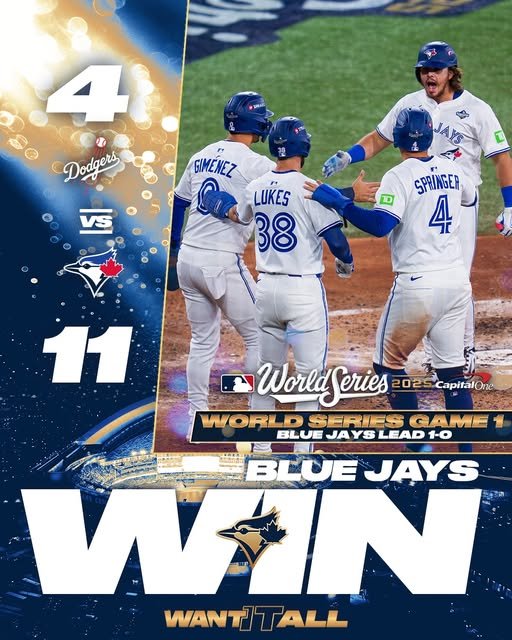
Blue Jays slugger Addison Barger belted the first pinch-hit grand slam in World Series history on Friday to help lead his club to an 11-4 win in the first game of the Fall Classic. Photo: Toronto Blue Jays
October 25, 2025
By Mark Whicker
Canadian Baseball Network
Questions we never thought we’d ask kept popping up through the artificial garden of Rogers Centre after Game 1.
If Alejandro Kirk is going to keep smacking home runs, can the Blue Jays get him a Home Run Jacket that fits?
Can Freddie Freeman, last year’s World Series MVP and perhaps the steadiest hitter in baseball, remember how?
Should we scout the Dunedin Blue Jays and other Florida State League teams to find the featured pitcher in next year’s World Series?
There were others, but only 24 hours ago the only question was if the Dodgers’ parade route would be kept secret, the better to frustrate ICE agents. Now that Toronto has thrashed the Dodgers, 11-4, nobody is sure of anything. It’s worth noting that Yoshinobu Yamamoto pitched a complete game last time out, and is working Game 2 for the Dodgers, and a team with a lifetime of postseason experiences should have little trouble clearing its head. But it’s more about the Blue Jays, and their unwillingness to serve as the scenery.
Lost in the Friday Night Lights was Trey Yesavage, who, as we all know, took the local to the big leagues. He pitched for four different minor league teams before he arrived in August, but then he was pitching for East Carolina University, alma mater of Sandra Bullock, in the spring of 2024. No wonder he blindsided the American League.
Yesavage pitched four innings Friday night. He was not overwhelming, but that wasn’t the assignment. Nobody expected him to bully the Dodgers. Instead, Yesavage refused to get overwhelmed, especially when Los Angeles began using its offensive Legos to build a big inning. Yesavage gave the Dodgers some rope, but he kept them under control. Without that, it’s doubtful that the Jays would have summoned the energy to attack Blake Snell and the increasingly moldy Dodger bullpen.
After Yesavage went 1-2-3 in the first inning and struck out Shohei Ohtani on a splitter, he walked the high wire in the second. The Dodgers scored once and had bases loaded with one out. Yesavage faced Andy Pages, with Ohtani on deck. He went 0-and-2 but then 3-and-2. That’s not the optimum time to roll out a pitch that isn’t your best, but Yesavage dropped a slider on Pages, who swung wildly and missed. Yesavage then got to 2-and-1 on Ohtani and tried another slider. Ohtani got out in front and dribbled it to Vladimir Guerrero Jr.
There was a Hall of Fame baseball writer named Phil Collier, from San Diego, who said he wanted his autobiography to be called, “The Bases Were Loaded And So Was I.”
Dodger manager Dave Roberts, who has watched the Dodgers trot solemnly off the bases too often this year, seemed in need of a nice wine spritzer. Baseball people can feel it when opportunities slide by, and they know the consequences, too.
But Yesavage was unsteady in the third inning, too. He started with two walks and an RBI single to right by Will Smith — and, yeah, Ohtani is the best player in planetary history and all that, but you really don’t want to see Smith in a scoring situation — and Mookie Betts scored. However, Freeman got hung up between second and third and was tagged for the first out.
Here’s where the game could have gotten tangled up in Pantone 294, the exact shade of Dodger Blue, but never did. Teoscar Hernandez sent a hard grounder up the middle. Bo Bichette was there, ranged behind second, turned and threw against most laws of physics, and threw out Hernandez. Bichette, a career shortstop, has twice led the American League in hits and hit .311 this season, but he hadn’t played at all since Sept. 6, and he had never played second base in the majors. This was a startling play that could have led to all kinds of trouble. Instead, it meant Yesavage had to face Max Muncy, a longtime executioner of struggling righthanded pitchers in big moments, with two out.
Muncy is particularly hard on fastballs in the hot zone, so Yesavage and catcher Kirk went with only one of those. On 2-and-2 Muncy struck out on a throttled-down 82 mph splitter, and the Dodgers’ lead was still just 2-0.
And in the fourth, with the Toronto bullpen heating up, Yesavage carved up the Dodgers on just 10 pitches. Only one of those was his famed splitter. Maybe you were too bleary to see this, especially if you were participating in a drinking game that got activated whenever John Smoltz said “release point.” But manager John Schneider removed Yesavage at this point, and the Blue Jays appreciated his resolve. They weren’t worried about the score. They were shut out only six times in 2025, and not once at home.
They didn’t mess around. Kirk spanked four two-strike foul balls off Snell and finally singled. Daulton Varsho saw a first-pitch fastball from Snell and turned it into a 423-foot memory, to centre field. It was 2-2, and Varsho had squared the circle. In 1993, the Phillies’ Darren Daulton had homered in Game 6 of the Series, and outfielder Gary Varsho was a teammate. Gary named his son after Daulton, and also gave him the middle name John, after renowned Phillies’ third base coach John Vukovich. Neither Daulton nor Vukovich are with us today, but it’s likely they heard what their godson did.
It was never easy for Snell, who negotiated his own bases-loaded jam in the first but needed 29 pitches to do it. Back on Oct. 13 against Milwaukee, Snell dealt with only one baserunner in six innings. The Brewers were passive and befuddled that night, and they let Snell establish his variety of pitches. The Blue Jays don’t really care about your repertoire. They’ve trained themselves to hit fastballs, anywhere and everywhere, and if they see breaking-ball mistakes they don’t miss those either. It’s a rare strain of confidence, of selective aggression.
The next time Snell matched up with Varsho was in the sixth inning, which was an eternity for Dodger fans and a Memorex moment for Blue Jays folk. With two on and nobody out, Snell hit Varsho in the shoulder. At that point Roberts put on his Hazmat outfit and went to the bullpen, and Emmett Sheehan, normally a starter, was fed to the wolves. Three runs later, lefty Anthony Banda came in to face pinch-hitter Addison Barger, who sent a high 2-and-1 slider to its deserved fate, the first pinch grand slam in Series history. Kirk, the squatty hitting savant, would homer two batters later, and he carried the jacket on his merry tour of the dugout. The Blue Jays had scored nine runs in that inning. The Dodgers had given up five in their five previous games.
Banda might not have been the choice if Alex Vesia were around, but Vesia is attending to a “deeply personal” situation back home in San Diego County. Lefthander Tanner Scott, the Dodgers’ closing hope back in the spring, is healthy but, pointedly, not on the roster. This is why relief pitching is so mystifying, and so equalizing. It’s the one position you can’t buy. None of the five relievers that Toronto used in the season opener, against Baltimore, is active for the Blue Jays today.
One question no longer exists In a five-day span Trey Yesavage has started a game that would have eliminated the Blue Jays and then Game 1 of a World Series. He wasn’t great in either one, and that’s what made his survival so impressive. He’ll get another call, probably in Game 5 in Dodger Stadium, a game that has now been made necessary unless Toronto sweeps. It’s a long way from Dunedin to Dodger Stadium, and no one knows how he’ll handle the manufactured tumult. But in four busy innings Yesavage eliminated the same thing that Varsho’s home run lacked. Doubt.