
Whicker: MLB’s salary cap commercials misdirected
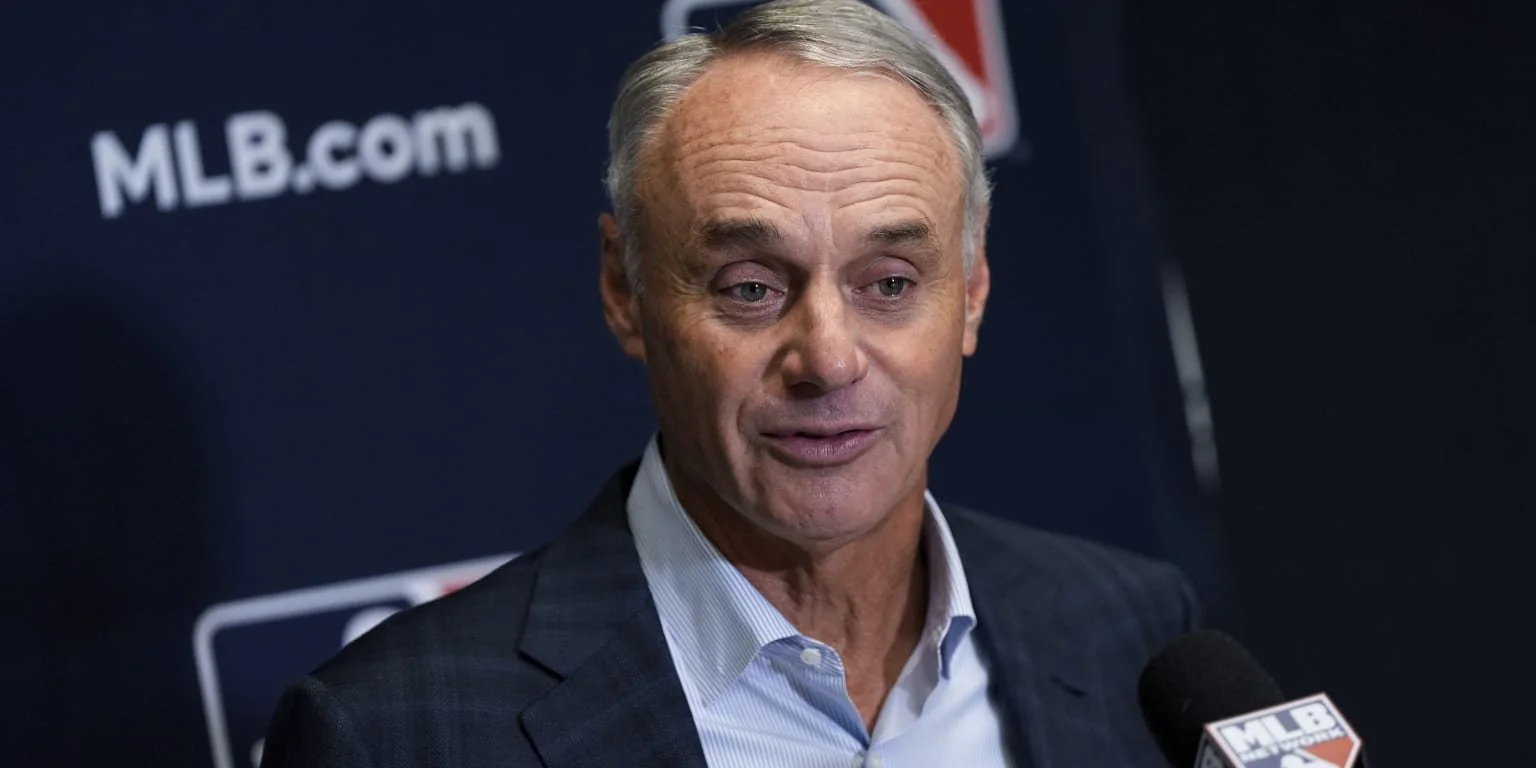
MLB, under the leadership of commissioner Rob Manfred, is airing commercials that champion a salary cap. Photo: MLB.com
July 10, 2026
By Mark Whicker
Canadian Baseball Network
The marketers of Major League Baseball, in a fit of FOMO, apparently thinks the 2026 U.S. elections include them.
MLB is airing commercials that champion the cause of the salary cap, its main objective in Basic Agreement negotiations. The people it features are either very misinformed fans or very bad actors or both. One woman says, “We just want to make it equitable,” referring to the supposed gap in competition. One problem: She’s wearing a Dodger shirt.
MLB’s slogans include Level The Playing Field and Make It Fair. The problem is that the fan in the street has control of neither thing. The audience should be the Players Association, which will have to approve or decline the new agreement. One would think the players might resent MLB using all this money on misdirected commercials at the same time that it’s pleading poverty in a business that will bring in $13 billion this season. Perhaps MLB could spend a few nickels promoting its emerging stars. The problem is that many of those stars are thriving on teams that MLB says can’t compete.
As of the morning of July 10, the teams that would qualify for the American League playoffs ranked third, 14th, 17th, 24th, 28th and 30th in salary. The teams that would qualify for the National League playoffs ranked second, fifth, sixth, eighth, 19th and 29th. The Mets, Toronto, Houston, San Diego and Detroit all have top ten payrolls, and none would make the postseason if the season ended today. For the Mets and Toronto, it ended long ago.
This is not to say a salary cap is a bad idea, especially if it included “Larry Bird’ rights that would allow a team to exceed the cap in an effort to sign its own players. If we were playing under those rules today, Detroit wouldn’t necessarily have to trade two-time Cy Young Award winner Tarik Skubal at the deadline. A salary floor, which the owners have also proposed, is another timely idea, although it would make Pittsburgh, Miami, Tampa Bay and the like pay more than they’re prepared to.
Tampa Bay and Miami are a combined 26 games over .500. Only the players who share the field with them seem to realize it. Certainly few in Florida do; the Marlins won their sixth consecutive game on Wednesday before a crowd of 8,810 in the gleaming downtown stadium that was supposed to end the ennui. A Tampa Bay-Miami World Series is a lot more likely than Mets-Toronto and would actually feature young, enthusiastic players assembled by front offices who have a good grasp on development. Unfortunately they might have to pass it down the network chain to the Home Shopping Network. But both teams prove that payroll’s correlation to winning is certainly not a straight line. Their combined payroll is $182.6 million, Fourteen clubs exceed that by themselves.
The Chicago White Sox lost 121 games two years ago and are in first place in the admittedly mediocre A.L. Central. Cleveland has the lowest payroll in the game and would be a wild-card participant. The Cardinals ridded themselves of deadwood, sank to 26th in the league in payroll, and are strong wild-card contenders. Washington was the first team to have three players hit the 60 RBI mark (CJ Abrams, James Wood and Luis Garcia) and is over .500. The Twins are pinching pennies hard enough to raise welts underneath Lincoln’s beard and are a half-game out of the wild-card.
Some of the most exciting players in the game play on teams in the economic wasteland. The Athletics’ Nick Kurtz has a .912 OPS and leads his league in walks. Jordan Walker of St. Louis leads baseball in RBIs. James Wood has the most walks and runs of any player and has slammed 25 home runs, and he’s the largest thing in Washington that doesn’t have Trump’s name on it. Junior Caminero of Tampa Bay has 56 home runs in a little over a season and a half.
On the mound, Cincinnati’s Chase Burns has an 11-1 record for a team that is 42-50. Cade Smith (Abbotsford, B.C.) of Cleveland is the American League’s best closer, unless it’s actually Tampa Bay’s Brian Baker, who was rescued from Baltimore and has 25 saves in 28 chances. Max Meyer is 9-1 for Miami; Foster Griffin is 10-2 for Washington. The Marlins’ John King, 31, has put together numbers that don’t belong with each other: Forty innings, 40 strikeouts, 20 hits and 10 walks. It is true, or at least probable, that most of those players will become Yankees, Dodgers, Cubs or Mets if they continue their pace into free-agent eligibility. But there’s no reason to use that probability as an excuse to shut down a most prosperous sport.
The Milwaukee Brewers don’t fit into this particular narrative because their payroll is 19th, but they remain the highest-mileage franchise. The Brewers led baseball in regular-season wins last year and they have 59 this year, primarily because they develop replacements for the players who get too expensive. They had three players (Christian Yelich, Jackson Chourio and Aaron Ashby) who have contracts beyond next season, but then they gave shortstop Cooper Pratt an eight-year deal for $50 million before they called him up last week. And not once have the Brewers exceeded the luxury tax.
American voters are besieged by propaganda about Graham Platner’s tattoos and other bodily features, pronouns, high school transsexual sprinters, and Presidential soccer expertise. Now they’re being lectured on twisted baseball economics, in a time when the Mets have the sport’s highest payroll and the National League’s 13th-best record. A good way to Make It Fair would be to quit charging fans $50 to park at the Mets’ Citi Field. A bad way is the way MLB has chosen, to tease them into thinking they have any influence over this coming battle of millionaires and billionaires, and to argue with the standings which, on a daily basis, contradict their point.